



201–300 of 535
Current Filter
Whole
Image includes a whole munition

Analyst Note
22 June 2025
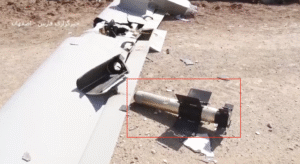
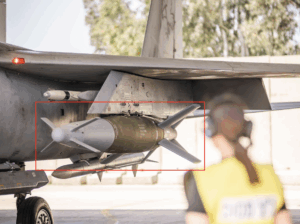
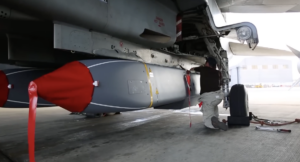
This image shows a Mikholit that was ejected from the weapons pod of an Israeli Hermes 900 drone that was downed in Iran. This Hermes 900 drone had two weapons pod, each capable of carrying 4 Mikholit bombs. (ARES)
Analyst Note
19 July 2025
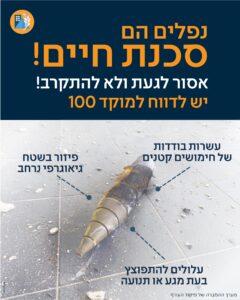
This image shows a unexploded Iranian submunition pictured in an awareness poster made by the Israel Defense Forces (IDF) Home Front Command. The poster warns people to not touch or disturb the submunition. The IDF reported that about 20 of these submunitions were deployed by a single Iranian ballistic missile, spreading over a radius of 8 kilometres. (ARES)
Analyst Note
19 July 2025
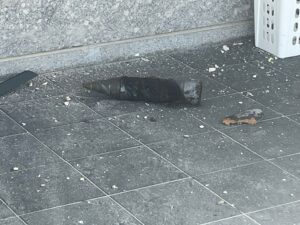
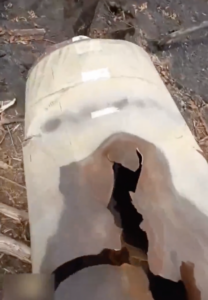
This image shows an unexploded submunition that was deployed by an Iranian medium-range ballistic missile over Israel. Inert variants of these submunitions were previously observed in an Iranian city following a failed missile test. (ARES)
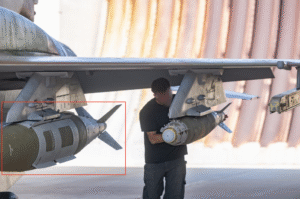
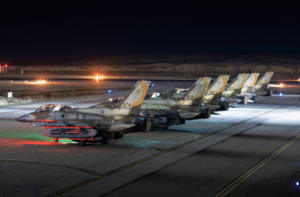

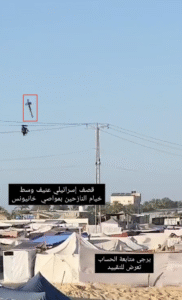
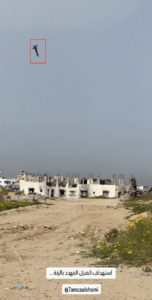
Analyst Note
3 June 2025
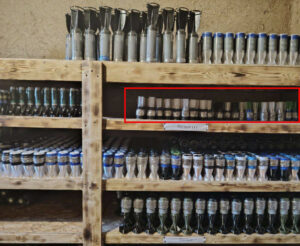
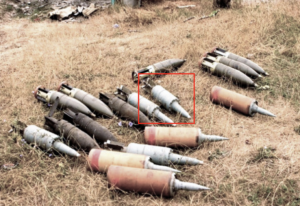
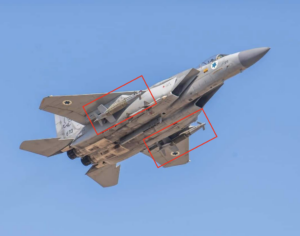
This image shows a variety of small air-delivered munitions that have been developed specifically for deployment via UAV. Some of these appear to be original designs, whilst others have been made by modifying existing munitions. This entry reflects those munitions outlined with the red box, but all of the munitions are generally of similar in size and format, and all have tailfin assemblies intended to orient the munition as it falls, just like more traditional air-delivered bombs. (ARES)
Analyst Note
3 June 2025
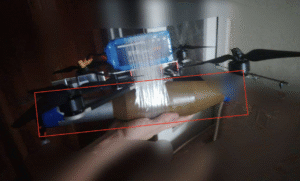
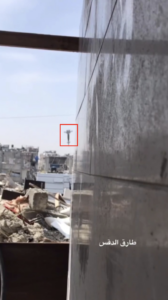
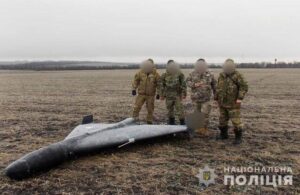
The munition in this image has been integrated into a commercial off-the-shelf (COTS) small UAV. This UAV (‘drone’) adds powered and guided delivery and converts the munition into a guided missile—regardless of the original, intended delivery method. (ARES)
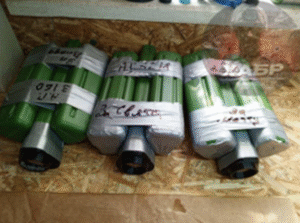
Analyst Note
14 July 2025
This image shows three sets of three PTM-1 series scatterable anti-vehicle mines taped together. While these mines have likely been repurposed from their original delivery munition to be delivered via UAV, this cannot be confirmed based off this image alone. (ARES)
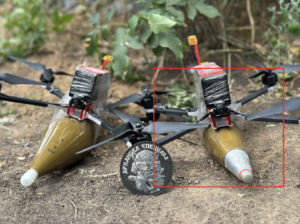
Analyst Note
21 April 2026
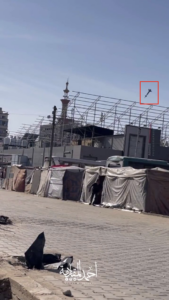
The warhead of the OWA UAV indicated in this image cannot be positively identified from this photograph alone. It appears to be the warhead section of either an OG-9 series or OG-15 series high explosive fragmentation (HE-FRAG) projectile, with a GO-2 or similar impact fuze fitted in the nose. (ARES)
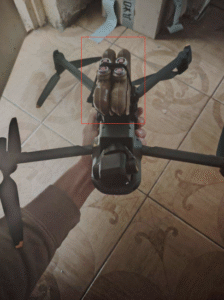
Analyst Note
3 June 2025
This image shows four PFM-1 series anti-personnel landmines retained by a release mechanism to enable deployment via UAV. Ordinarily, PFM-1 series and other ‘scatterable mines’ are deployed via carrier munitions or dedicated mine-dispensing devices. In Ukraine and other conflicts, these mines have often been removed from their original carrier munitions in order that they may be delivered via UAV. (ARES)
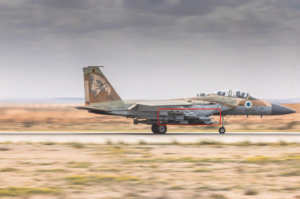

Analyst Note
30 April 2025
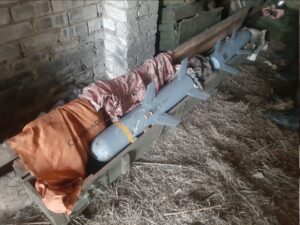
This image shows a Mikholit glide bomb, with its warhead removed (green cylinder on the left side of the box). The fins that spring outward when deploye have been taped down. This Mikholit was reportedly recovered by the Israeli Defense Forces (IDF) from Hamas, who had captured the bomb after it failed to function when originally deployed by the IDF. (ARES)
Analyst Note
18 July 2025
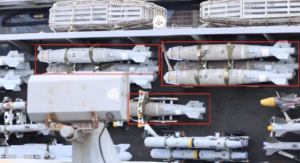
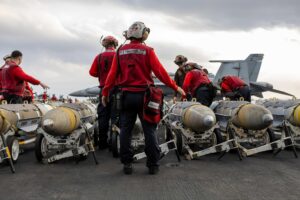
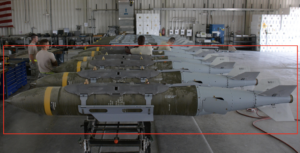
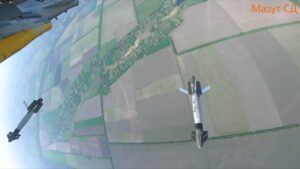
This image shows several GBU-53/B bombs photographed from above while on a munitions transport cart. GBU-53/B bombs are transported and loaded onto the aircraft with the wing assembly on the bottom. When the GBU-53/B is released from the aircraft, the bomb rotates, with the wing assembly side orienting as the top as the bomb glides to its target. (ARES)
Analyst Note
30 April 2025
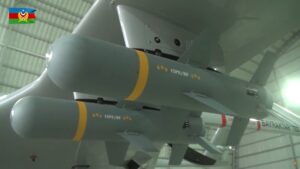
This image shows two MAM-L guided air-delivered bombs affixed to the wing of a Bayraktar TB2 drone. The MAM-L and TB2 are both produced in Türkiye by Roketsan and Baykar respectively. The MAM-L can have one of three different warheads: blast fragmentation, anti-tank, or thermobaric. The warhead section of each MAM-L in this image has “YIPE/BF” visible. ‘YIPE’ is the abbreviation of the warhead type in Turkish: Yüksek Infilaklı Parçacık Etkili (‘high explosive fragmentation’, in English). The ‘BF’ also indicates that these MAM-L munitions are of the blast-fragmentation variant. The warhead of a MAM-L cannot be determined from an external assessment without viewing markings such as these (or a clear view of the data plate, which can be seen on the aft portion of the MAM-L). (ARES)
Analyst Note
19 March 2025
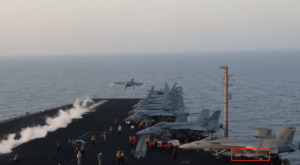
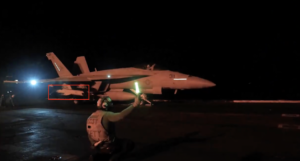
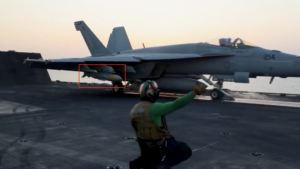
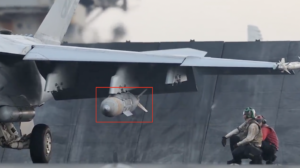
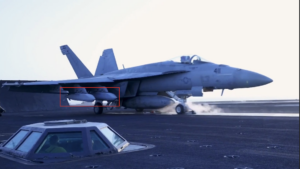
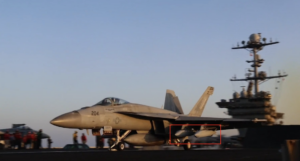
This image shows an American F/A-18 fighter aircraft armed with two AGM-154 Joint Standoff Weapon (JSOW) air-delivered bombs taking off to conduct strikes against Houthi forces in Yemen. The F/A-18 likely has two more AGM-154-series munitions carried on the opposite side of the aircraft, for a total of four bombs. The JSOW has multiple variants which are fitted with different warheads, including a submunition payload (AGM-154A and AGM-154B models), BLU-111 500-pound bomb (AGM-154A-1), and a Bomb Royal Ordnance Augmented Charge (BROACH) multi-stage penetrator warhead (AGM-154C or AGM-154C-1). All variants are externally identical without markings, with the exception that the AGM-154C and C-1 have a small reflective window on the bottom of the nose for the terminal infrared (IR) seeker. The munitions in the image are most likely AGM-154A-1 or AGM-154C-series bombs, due to the lack of reported submunitions following the strikes. (ARES)
Analyst Note
9 January 2026
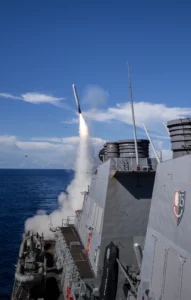
This image shows an RGM-109-series Tomahawk Land Attack Missile (TLAM) being launched from the USS Curtis Wilbur (DDG 54), an Arleigh Burke-class guided missile destroyer. The RGM-/UGM-109 TLAM series are surface-to-surface cruise missiles fired from various platforms. The ‘R’ and ‘U’ in RGM and UGM, respectively, denote the intended launch platform, with ‘R’ denoting surface platforms, such as ships, and ‘U’ denoting subsurface platforms, such as submarines. (ARES)

Analyst Note
29 January 2025
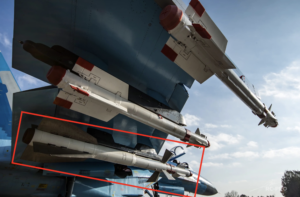
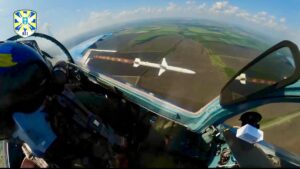
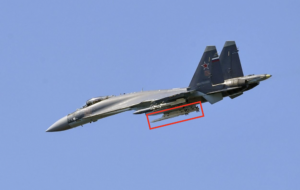
Two R-77 air-to-air missiles (NATO reporting name: AA-12 Adder) are carried in this photograph by a Russian Aerospace Forces Sukhoi Su-35 fighter aircraft. Key markings, including the aircraft’s bort number (a coloured numeral that acts as a unit or base identifier), have been digitally obscured. (ARES)
Analyst Note
30 January 2025
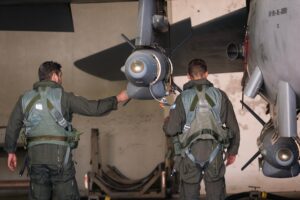
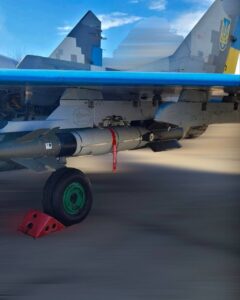
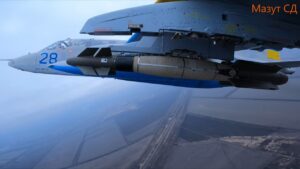
The Armement Air-Sol Modulaire (AASM; ‘Modular Air-to-Ground Armament’) family of French bolt-on guidance kits are fitted to air-delivered bombs of various sizes in a similar fashion to American JDAM kits. In some marketing materials, the acronym HAMMER is used, standing for ‘Highly Agile Modular Munition Extended Range’. This refers, in part, to the rocket boosters fitted to munitions in the family to extend their effective range. (ARES)
Analyst Note
30 January 2025
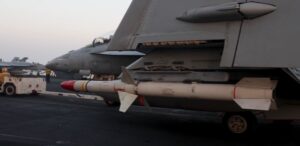
In this photo, a Ukrainian Sukhoi Su-25 ground-attack aircraft from the 299th Tactical Aviation Brigade, with the bort number ‘Blue 28’, is seen carrying an AASM-250 guided air-delivered bomb under its left wing. Available imagery shows that the AASM-250 has also been fitted to Mikoyan MiG-29 fighter aircraft, and can likely be carried by the Sukhoi Su-27 as well. (ARES)
Analyst Note
9 January 2025
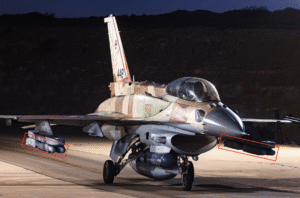
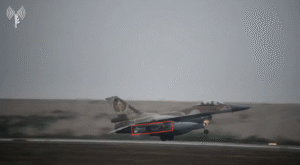
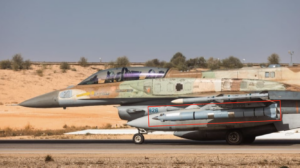
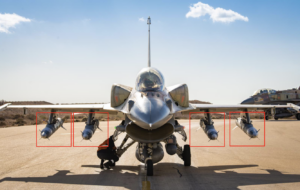
This image shows an Israeli Air Force F-16 carrying four Rampage air-to-ground missiles. The Rampage is a 580 kg (1,278 lb) missile with GPS and INS guidance. It carries a multi-purpose warhead that is designed for engaging a range of targets in the open as well as offering some degree of penetration. (ARES)
Analyst Note
31 December 2024
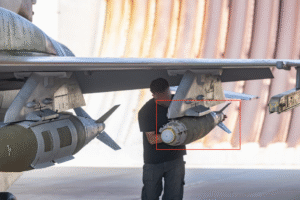
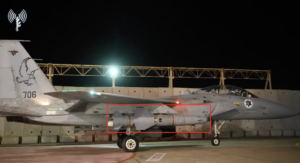
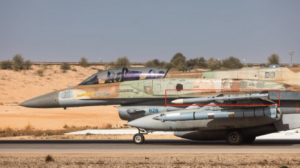
This F-16I fighter aircraft from the Israeli Air Force is carrying a CATM-120 inert missile simulant (indicated). These devices are used for training purposes, being designed to replicate the weight and centre of gravity of a live munition. They lack any means of propulsion and are not released from the aircraft. The CATM-120 can be differentiated from the AIM-120 missile series by the presence of only blue bands on the missile, denoting both an inert rocket motor and an inert payload. A ‘live’ AIM-120 will have two brown bands on the rear section of the missile (the rocket motor), and a yellow band on the forward, or warhead, section. An AIM-120 with an inert warhead, but a live rocket motor, will have a blue band on the warhead and two brown bands on the rocket motor. (ARES)
Analyst Note
9 January 2025
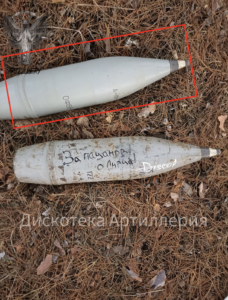
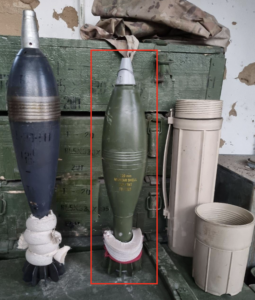
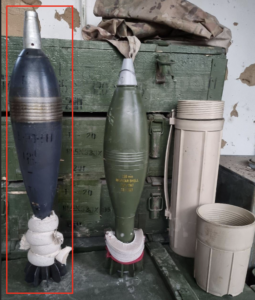
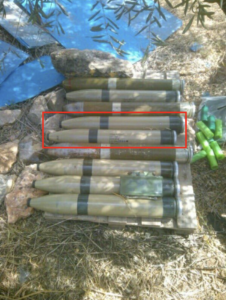
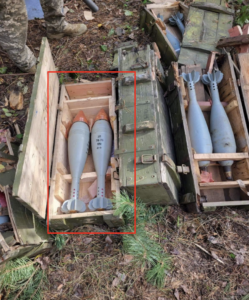
This image shows a North Korean 120 mm high explosive (HE) mortar projectile next to an Iranian 120 mm HE mortar projectile. Despite both being the same calibre, the overall shapes and dimensions of the two projectiles are noticeably different. Factors such as payload weight and range can be affected significantly by projectile shape. (ARES)
Analyst Note
17 December 2024
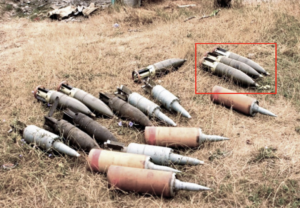
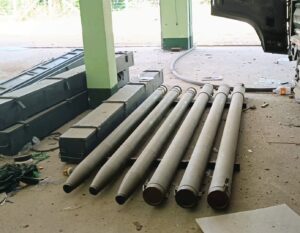
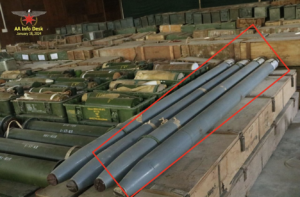
Whilst there are no visible markings explicitly identifying the model of the 122 mm rockets in this image, they are sitting atop a box marked “R-122” and exhibit physical features consistent with North Korean R-122 rockets. It should be noted that rockets marked with the generic “R-122” model name have been observed in both ‘long’ and ‘short’ overall lengths and painted in different colours. (ARES)
Analyst Note
26 November 2024
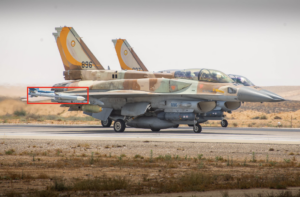
This F-16I fighter aircraft from 107 Squadron Israeli Air Force is carrying a CATM-120 inert missile simulant (indicated). These devices are used for training purposes, being designed to replicate the weight and centre of gravity of a live munition. They lack any means of propulsion and are not released from the aircraft. The CATM-120 can be differentiated from the AIM-120 missile series by the presence of only blue bands on the missile, denoting both an inert rocket motor and an inert payload. A ‘live’ AIM-120 will have two brown bands on the rear section of the missile (the rocket motor), and a yellow band on the forward, or warhead, section. An AIM-120 with an inert warhead, but a live rocket motor, will have a blue band on the warhead and two brown bands on the rocket motor. (ARES)
Analyst Note
14 November 2024
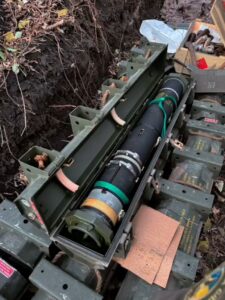
The M712 ‘Copperhead’ is a laser-guided 155 mm artillery gun projectile carrying a high explosive anti-tank (HEAT) warhead designed to engage armoured vehicles. The Copperhead was developed in the United States in the 1970s, and saw limited use during Operation Desert Storm. The M712 is is pictured here inside its shipping container, and the slots for the enclosed, deployable (‘pop-out’) wings and fins are visible. The M712 has two operational modes: a ballistic mode that follows a gun’s ballistic trajectory like a traditional artillery projectile, and a glide mode, which follows a longer and flatter trajectory. The preferred mode is set by the artillery crew before firing. (ARES)
Analyst Note
26 November 2024
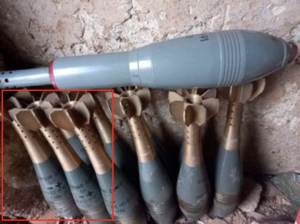
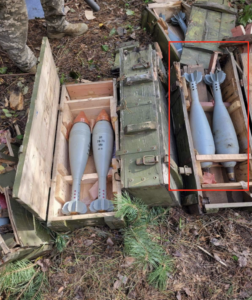
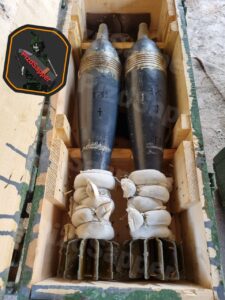
The two North Korean 120 mm high explosive (HE) mortar projectiles in this image are each fitted with five cloth bags affixed above the tailfins. These are incremental propellant charges (sometimes known as augmenting, auxiliary, or supplemental charges), the number of which can be varied along with a mortar’s elevation to adjust the trajectory and range of the munition when fired. (ARES)
Analyst Note
26 November 2024
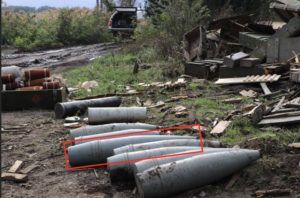
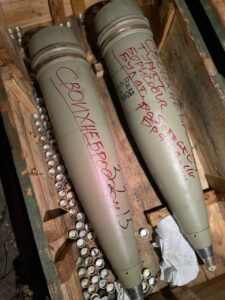
This image shows two Iranian 130 mm high explosive (HE) artillery gun projectiles. Calibre (“130MM”) and functional type (“HE - TNT”) markings are visible on the right-hand example, whilst a lot marking (“LOT:10/202[…]”) is partially obscured. The “TNT” marking indicates that this munition uses a trinitrotoluene composition as its explosive fill. (ARES)
Analyst Note
26 November 2024
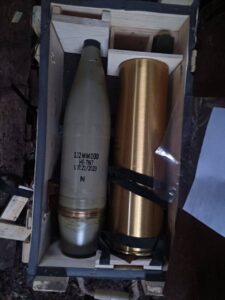
This image shows an Iranian 122 mm high explosive (HE) artillery gun projectile. Like several other munitions, it is described in Iranian sources—and, in this case, on the munition itself—only by reference to the weapon with which it is most often associated: the Soviet-designed 122 mm D-30 howitzer (often rendered ‘D30’, without the hyphen, in Iranian service). This munition is also marked to indicate it was produced in 2023. Interpreting munitions markings in this way, especially where they indicate recent manufacture, may provide evidence of ongoing supply during a conflict. (ARES)
Analyst Note
26 November 2024
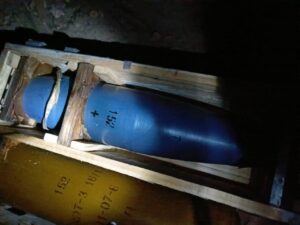
The munition indicated in this image as a 152 mm high explosive (HE) artillery gun projectile manufactured in the Democratic People’s Republic of Korea (DPRK). (ARES)
Analyst Note
20 November 2024
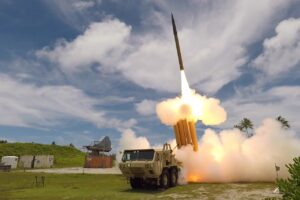
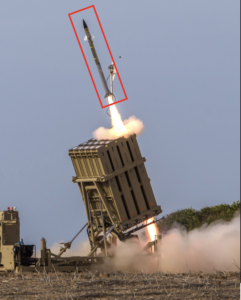
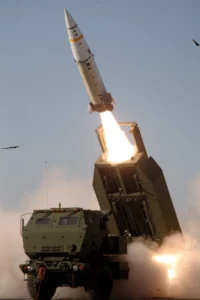
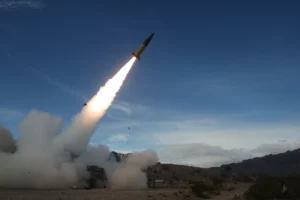
This U.S. Department of Defense file photo shows an M142 High Mobility Artillery Rocket System (HIMARS) launching an MGM-140 Army Tactical Missile System (ATACMS) series tactical ballistic missile. (ARES)
Analyst Note
19 November 2024
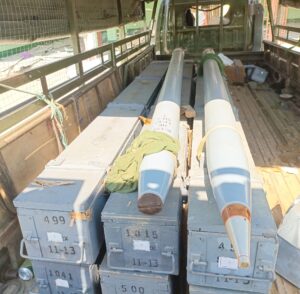
These R-122 ‘Grad’-type 122 mm surface-to-surface rockets were produced in North Korea. The example to the right is fitted with an F-122 impact fuze. Whilst a two-tone colour scheme is more common amongst those North Korean Grad rockets thus far identified in the context of the Ukraine conflict (these typically featuring a black forward section), uniformly coloured examples like this have also been identified previously. (ARES)
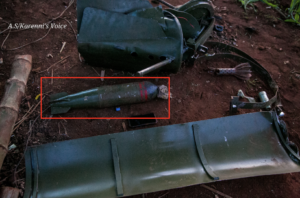
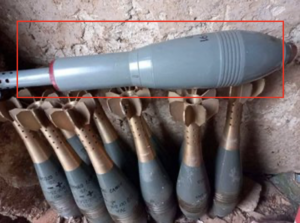
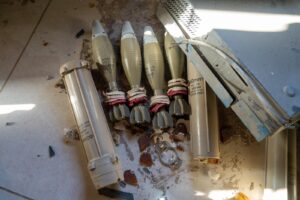
Analyst Note
11 November 2024
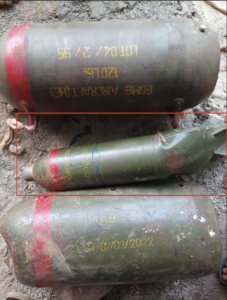
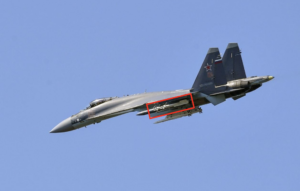
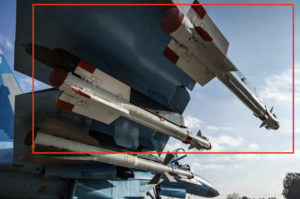
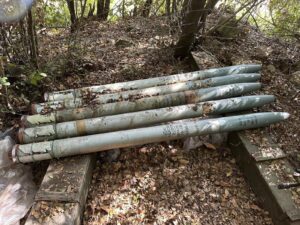
This Iranian 60 mm mortar projectile is of the ‘Long Range’ type described without a specific model name in various Iranian export catalogues and other sources. The designation as marked on projectiles and packaging is variable, with observed formulations including “60mm H.E. L.R.”, “60mm H.E L.R”, and “60mm HE L.R”. Sometimes, as here, “60mm L.R” is followed by “HE / TNT”. (ARES)
Analyst Note
2 November 2024
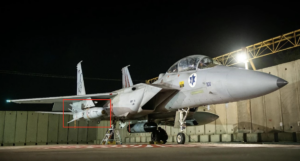
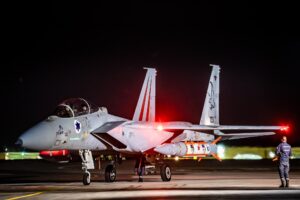
This Blue Sparrow-series air-launched ballistic missile is being carried by an F-15C fighter aircraft from 106 Squadron Israeli Air Force. The missile is marked with the logos of three organisations involved in its development—the U.S. Missile Defense Agency, the Directorate of Defence Research & Development, and the Israel Missile Defense Organization—and the Blue Sparrow programme logo of the manufacturer (Rafael Advanced Defense Systems). The booster section also features bright-orange fins and markings consistent with its use as a target missile, here modified to accept a high explosive warhead. (ARES)
Analyst Note
24 October 2024
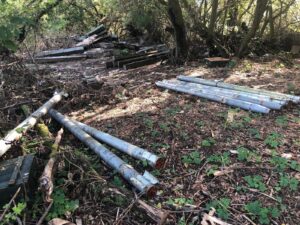
The 9M22S is essentially the ‘full-sized’ version of the shorter 9M28S surface-to-surface rocket previously recorded in the OSMP. Both rockets carry the same 9N510 incendiary warhead, but differ in the length of their rocket motor sections, and thus range. (ARES)