

Do not approach munitions
under any circumstances
Country or territory where the image was reported

Reported Location (49)

Year the image is reported to have been taken

Year (20)

Classification groups of key explosive munitions used in conflicts

Munition Category (8)

The impact or effect the munition is intended to have

Functional use (10)

The specific model of munition pictured

Tentative Model (380)

A temporary ID code assigned by ARES.
[TEMP] ARES-TMID-0012

Search

The external organisation that documented the munition

Research Organisation (6)

Colour of the munition pictured

Base Colour (12)

Colour of all, or some, of the markings on the munition

Marking Colour (11)

Language or script of the marking on a munition

Marking Script (9)

Condition of the munition pictured

Condition (6)

Key features defining the operation mechanisms of a projectile

Mechanical Feature (10)

Whether a munition is guided or unguided

Guidance (2)

Where the munition is launched from and what it targets

Domain (7)

The type of fins visible on the munition

Fins Characteristic (5)

The nominal diameter of a projectile. For most modern munitions, this is expressed in millimetres (e.g. 82 mm mortar projectile), but older artillery gun projectiles may be described in inches.

Calibre (72)

Weight class of the aerial bomb pictured

Weight Class (14)

1–6 of 6

Current Filter

[TEMP] ARES-TMID-0012
A temporary ID code assigned by ARES.
OSMP2211
Analyst Note:
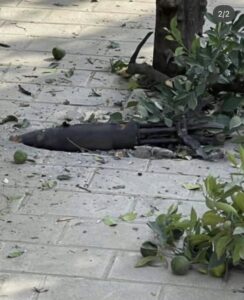
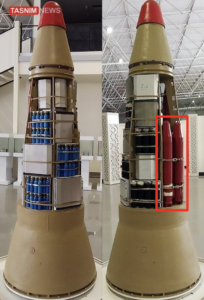
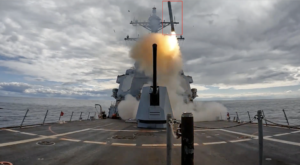
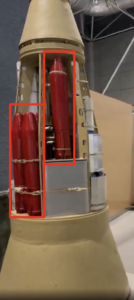
This image shows the ‘manoeuvrable re-entry vehicle’ (MaRV; a detachable, steerable payload section) of an Iranian ballistic missile loaded with submunitions. It appears there are three different models of submunition loaded into the MaRV (black, blue, and red). The black and blue submunitions are most likely anti-personnel designs, whilst the red submunitions (indicated by a red box) are likely designed with penetrating or shaped-charge warheads to target vehicles or structures. Some submunitions may utilise time-delay fuzing, allowing for random detonations over several hours or days to hamper clearance efforts, denying use of the afflicted area. Reports have shown Iran has used ballistic missiles with mixed submunition loads, and suggest that this type of warhead can scatter its payload up to a radius of 8 km. (ARES)
OSMP2037
Analyst Note:
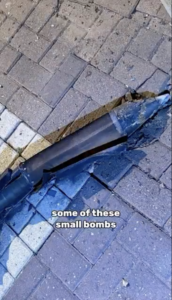
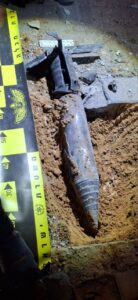
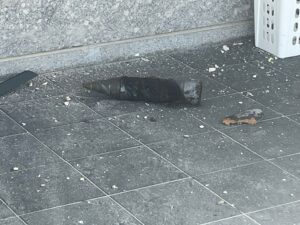
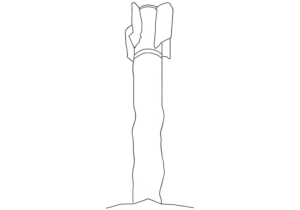
This image shows an unexploded Iranian submunition of unknown designation. Visually similar examples have been documented following Iranian ballistic missile strikes on Israel in June 2025 and March 2026. At least two variants are believed to exist, but publicly available details remain limited at time of review. (ARES)

Collection

The Iran War 2026

Verified munition images from all parties to the regional conflict sparked by U.S. and Israeli strikes on 28 February, 2026

View this collection
OSMP1437
Analyst Note:
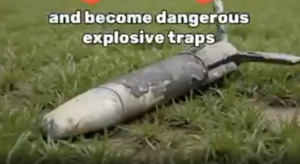
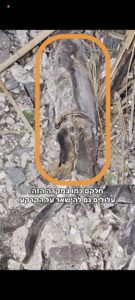
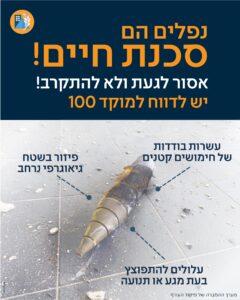
This image shows a unexploded Iranian submunition pictured in an awareness poster made by the Israel Defense Forces (IDF) Home Front Command. The poster warns people to not touch or disturb the submunition. The IDF reported that about 20 of these submunitions were deployed by a single Iranian ballistic missile, spreading over a radius of 8 kilometres. (ARES)
OSMP1436
Analyst Note:
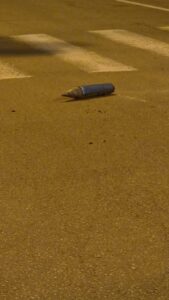
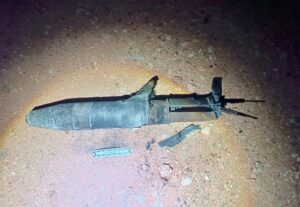
This image shows an unexploded submunition that was deployed by an Iranian medium-range ballistic missile over Israel. Inert variants of these submunitions were previously observed in an Iranian city following a failed missile test. (ARES)