Classification groups of key explosive munitions used in conflicts
Munition Category (8)
The impact or effect the munition is intended to have
Functional use (10)
The specific model of munition pictured
Tentative Model (278)
Search
The external organisation that documented the munition
Research Organisation (6)
Colour of the munition pictured
Base Colour (12)
Colour of all, or some, of the markings on the munition
Marking Colour (11)
Language or script of the marking on a munition
Marking Script (10)
Condition of the munition pictured
Condition (6)
Key features defining the operation mechanisms of a projectile
Mechanical Feature (10)
Whether a munition is guided or unguided
Guidance (2)
Where the munition is launched from and what it targets
Domain (7)
The type of fins visible on the munition
Fins Characteristic (6)
The nominal diameter of a projectile. For most modern munitions, this is expressed in millimetres (e.g. 82 mm mortar projectile), but older artillery gun projectiles may be described in inches.
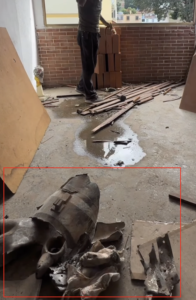
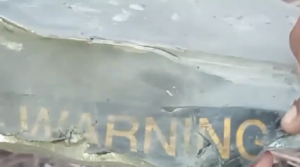
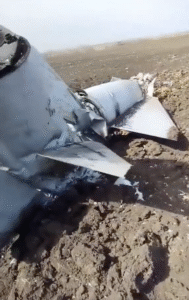
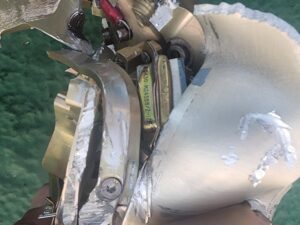
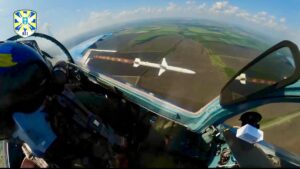
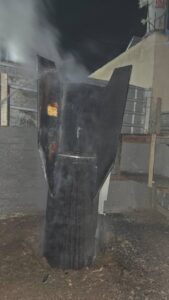
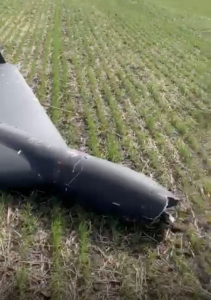
This image appears to shows the remnants of either a 9M38- or 9M317-series missile, however positive identification of this surface-to-air missile cannot be made based solely on the imagery in this source. The 9M38- and 9M317-series missiles are close in design and function, and are predominantly fired from the Buk family of surface-to-air missile (SAM) systems. The Buk-M2E SAM system is known to be in service in Venezuela, having been delivered under a Russian contract beginning in 2015. The source video for this entry shows the destroyed remains of a Buk-M2E launch vehicle, known as the 9A316E. (ARES)
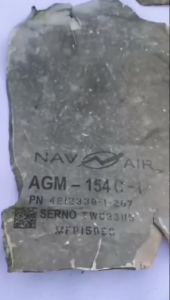
The AGM-154 Joint Standoff Weapon (JSOW) is a guided air-delivered ‘glide bomb’ that allows for long-range strikes using an unpowered munition. The AGM-154C and AGM-154C-1 variants (a remnant of the latter pictured here) carry a Bomb Royal Ordnance Augmented Charge (BROACH) multi-stage warhead which uses a WDU-44 shaped-charge warhead as its first stage, to help penetrate hardened targets, whilst the WDU-45 second stage comprises a conventional high explosive penetrator warhead (also called a ‘follow-through’ warhead). The AGM-154C-1 is described by the U.S. Navy as their “first air-to-ground Network-Enabled Weapon (NEW) capable of attacking stationary land and moving maritime targets. It includes GPS/INS guidance, terminal IR seeker and a Link 16 weapon data link. Integration of the Link-16 weapon data link and updated seeker software algorithms provide a capability against at-sea moving/relocatable targets.” (ARES)
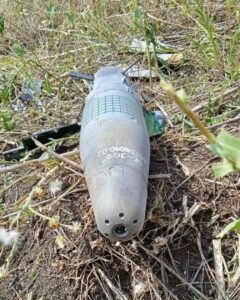
Markings on the forward section of this small, air-delivered bomb suggest that the designation is ‘BK-3OF’ (“БК-3ОФ”). The physical features of the munition suggest that it is laser-guided and likely carries a high explosive fragmentation (HE-FRAG) payload. This image shows the only known example, which was allegedly captured by Russian forces in conjunction with a Ukrainian UAV. (ARES)
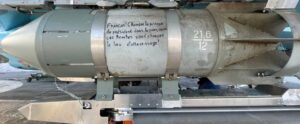
This Russian air-delivered cluster bomb is marked with a threatening message directed at the French people: «Français! Changer la politique du président dans le pays, sinon ces bombes vont changer le lieu d'atterrissage!» (“French people! Change the president’s policy in the country, otherwise these bombs will change their landing site!”). (ARES)
This image shows a Hydra-70 rocket fitted with an Advanced Precision Kill Weapon System (APKWS) guidance kit, converting it into a guided missile. In this case, the missile features an M151 high explosive (HE) warhead fitted with either an M427 or M423 point-detonating (PD) fuze. The rocket motor model cannot be determined from this source alone, but it is most likely to be a MK 66-series motor. The launcher appears to be a LAND-LGR4 model produced by Arnold Defense. (ARES)
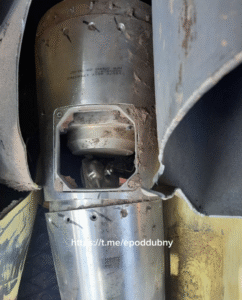
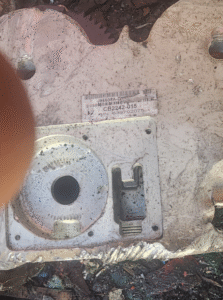
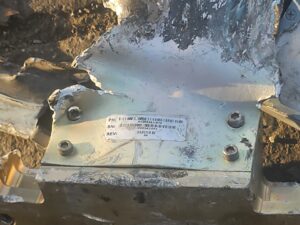
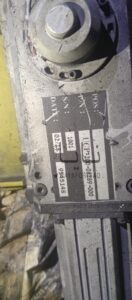
This munition remnant is marked with a manufacturer’s CAGE Code (“MFR-05DN8”) which indicates it was produced by Klune Industries. Klune Industries is a sub-contractor on the GMLRS contract. (ARES)
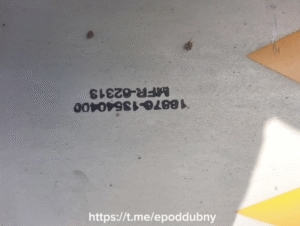
This munition remnant is marked with a manufacturer’s CAGE Code (“MFR-62313”) which indicates it was produced by Lockheed Martin. Lockheed Martin is the primary contractor that makes GMLRS missiles. (ARES)
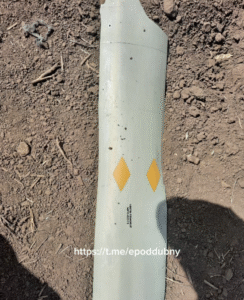
This image shows a remnant from an American M30 Guided Multiple Launch Rocket System(GMLRS) missile, which carries M77/M101 submunitions. The yellow diamond markings indicate a payload of explosive submunitions. (ARES)
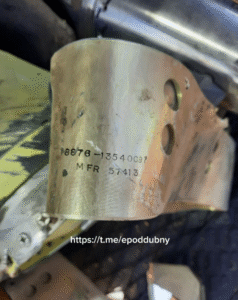
This munition remnant is marked with a manufacturer’s CAGE Code (“MFR-57413”) which indicates it was produced by the Maine Machine Products Company, a sub-contractor on the GMLRS contract. (ARES)
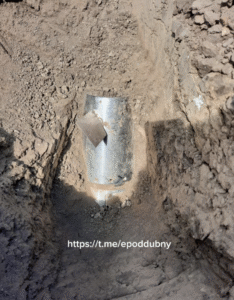
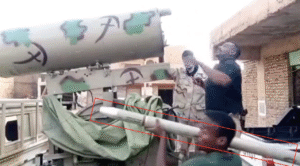
This images appears to show the remnants of a 122 mm rocket. It is unclear what the country of origin is, but it is most likely a 9M22-series or Type 81-series rocket. (ARES)
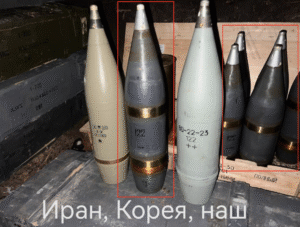
This image shows 122 mm high explosive (HE) artillery gun projectiles manufactured in three different states, L–R: Iran, North Korea, and Russia. Whilst these examples are distinct from one another—particularly in coloration, as well as the presence or absence of paint over the driving band and bourrelet—this is not always the case, and a combination of physical features and markings should be assessed before identification is made. (ARES)
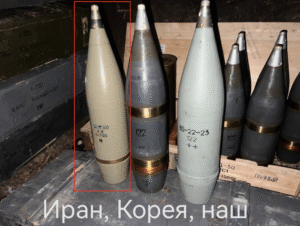
This image shows 122 mm high explosive (HE) artillery gun projectiles manufactured in three different states, L–R: Iran, North Korea, and Russia. Whilst these examples are distinct from one another—particularly in coloration, as well as the presence or absence of paint over the driving band and bourrelet—this is not always the case, and a combination of physical features and markings should be assessed before identification is made. (ARES)
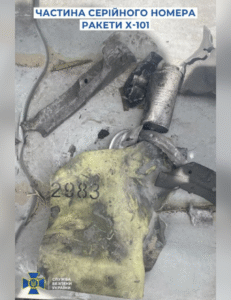
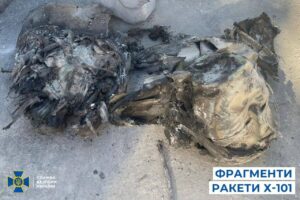
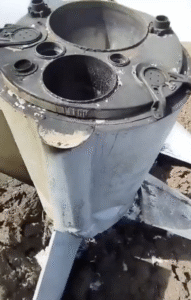
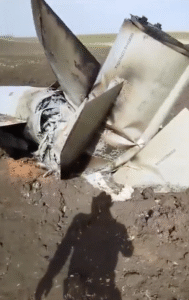
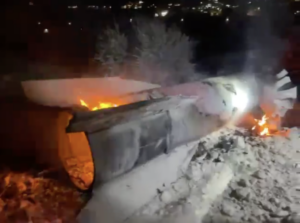
This image shows remnants of a Russian Kh-101 air-launched cruise missile. The remnant on the right is the rearmost tail section of the missile. (ARES)
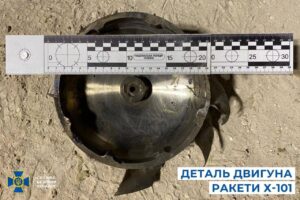
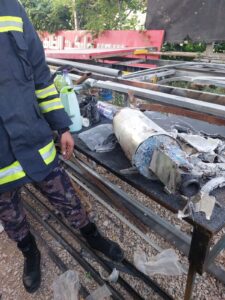
This image shows a remnant of the TRDD-50A(M) (ТРДД-50А(M)) turbojet engine, which powers Kh-101 and Kh-59M missiles. Other models of Russian cruise missiles are known to use other variants of the TRDD-50. (ARES)
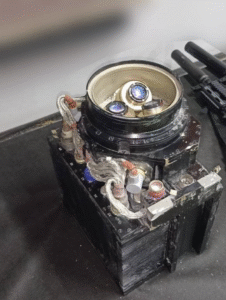
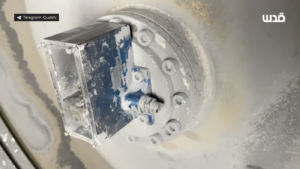
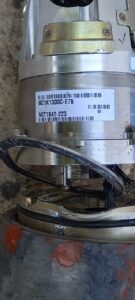
This image shows the three lenses that form the new version of the Kh-101 Digital Scene Matching Area Correlator (DSMAC) system. (The older version only had a single lens.) DSMAC systems take digital images of the ground as the missile passes overhead, and then compare those images to pre-captured images stored in the onboard memory. The DSMAC corrects the flight path as needed based on differences between the two sets of images. (ARES)
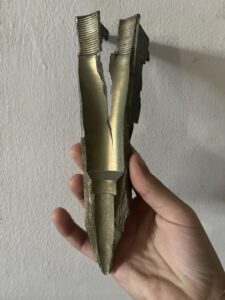
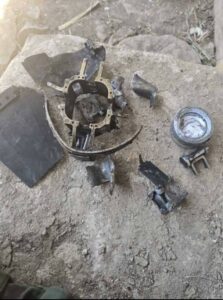
This image shows a remnant of the tail actuation section of a SPICE 250 guided bomb. The control fins are normally attached to this section, and the attachment point for one control fin is visible. (ARES)
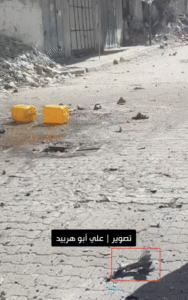
This image shows a variety of remnants from an Israeli SPICE 250 guided bomb. One of the bomb’s four control fins is visible at the bottom-left of the image. (ARES)
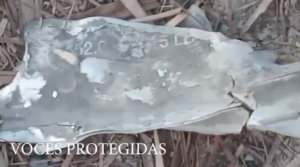
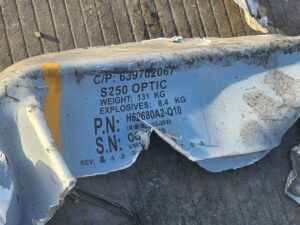
This image shows a remnant of the outer casing of the “S250 OPTIC” or SPICE 250 guided bomb, with the markings relatively intact. The markings on this remnant show that, while classified as a 250-pound bomb, the actual weight of this SPICE 250 variant is 288 pounds (131 kg) with only 18.5 pounds (8.4 kg) of explosive material. (ARES)
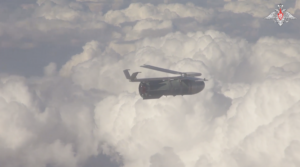
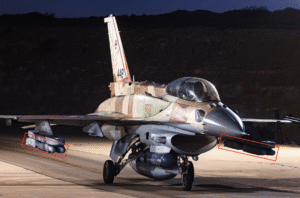
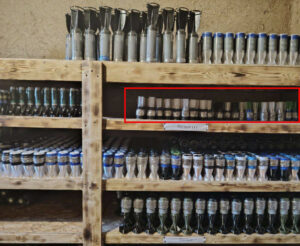
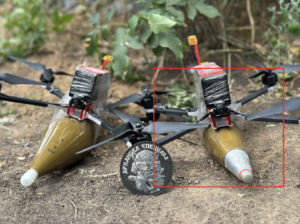
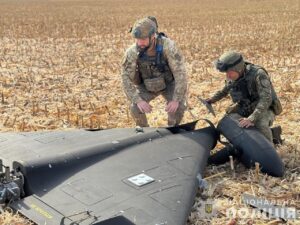
This image shows a variety of small air-delivered munitions that have been developed specifically for deployment via UAV. Some of these appear to be original designs, whilst others have been made by modifying existing munitions. This entry reflects those munitions outlined with the red box, but all of the munitions are generally of similar in size and format, and all have tailfin assemblies intended to orient the munition as it falls, just like more traditional air-delivered bombs. (ARES)
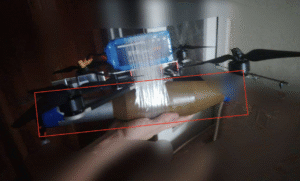
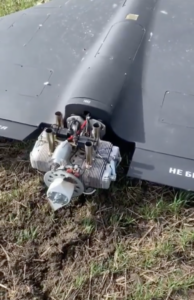
The munition in this image has been integrated into a commercial off-the-shelf (COTS) small UAV. This UAV (‘drone’) adds powered and guided delivery and converts the munition into a guided missile—regardless of the original, intended delivery method. (ARES)
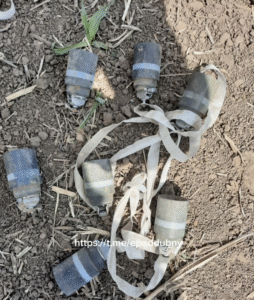
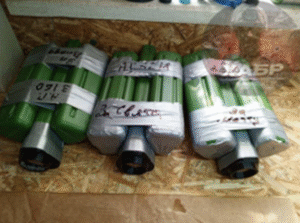
This image shows three sets of three PTM-1 series scatterable anti-vehicle mines taped together. While these mines have likely been repurposed from their original delivery munition to be delivered via UAV, this cannot be confirmed based off this image alone. (ARES)
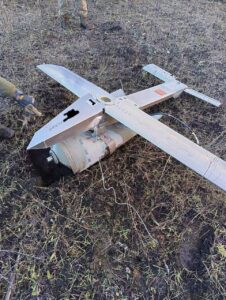
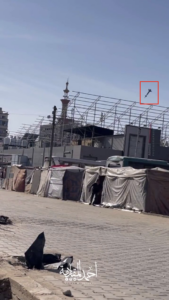
The warhead of the OWA UAV indicated in this image cannot be positively identified from this photograph alone. It appears to be the warhead section of either an OG-9 series or OG-15 series high explosive fragmentation (HE-FRAG) projectile, with a GO-2 or similar impact fuze fitted in the nose. (ARES)
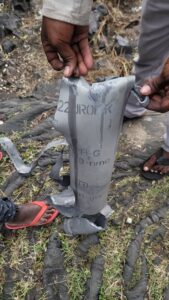
The JROF and JROF-K are Czech derivatives of the Soviet 122 mm ‘Grad’ series of surface-to-surface rockets. The JROF-K is the shorter, reduced-range variant, broadly analogous to the Soviet 9M22M. (ARES)
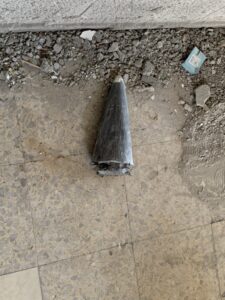
This image shows the nosecone from an Israeli SPICE 250 air-delivered bomb. Whilst generally similar in appearance to the nosecone of the GBU-39, the SPICE 250 nosecone is longer and narrower. (ARES)
This image shows a Mikholit glide bomb, with its warhead removed (green cylinder on the left side of the box). The fins that spring outward when deploye have been taped down. This Mikholit was reportedly recovered by the Israeli Defense Forces (IDF) from Hamas, who had captured the bomb after it failed to function when originally deployed by the IDF. (ARES)
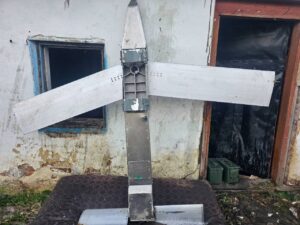
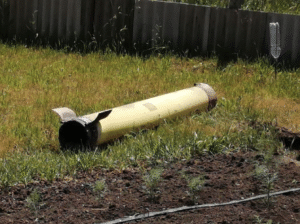
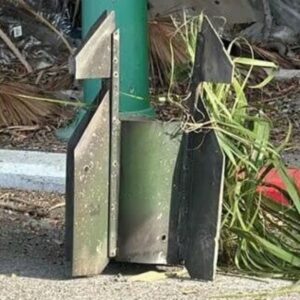
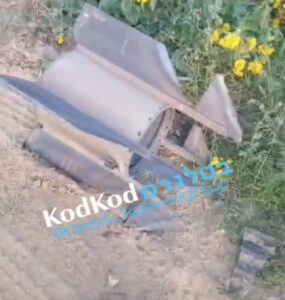
This image shows the rear fin section that is attached to a M-302/Khaibar-1/Fadi series rockets to add guidance capabilities. This rear fin section is installed, along with a forward control section between the warhead and the rocket motor. The guided munition, now classified as a missile, is referred to as a Nasr-1/Nasr-2. A similar, but larger, rear fin section is fitted to Zelzal rockets to convert them to guided munitions. (ARES).
This image shows the rocket motor of a Kheibar Shekan or Fattah-1 medium-range ballistic missile (MRBM). The Fattah-1 was publicly unveiled by Iran in June 2023, with very few images surfacing since that time. Due to the lack of available reference material, differentially identifying the Kheibar Shekan and Fattah-1 is difficult. The missile components displayed at unveilings and public displays are also often different from those used in production models. (ARES).
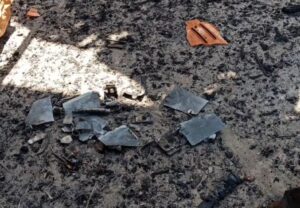
This image shows several remnants of a MAM-L bomb that are typically found after functioning. The actuated fins, as well as the fixed fins, are visible, along with various components of the control section that actuate the fins. The actuated fins attach to the control section, at the rear of the bomb, while the fixed fins attach to the middle of the bomb body. (ARES)
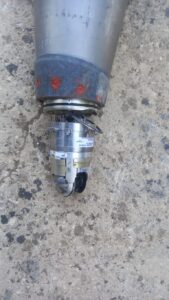
Pictured is the Stunner’s dual electro-optical/infrared nose sensors which, while in flight, identify and avoid decoys; identify the target; and guides the kinetic warhead on the final phase of its journey into the target. The sensors are housed in the unique ‘dolphin head’-shape of the missile, featuring a clear tip. The electro-optical sensor acquires the target during daylight operations, while the infrared sensor acquires the target in low-light conditions. The ground-based Battle Management and Control (BMC) system identifies the target’s flight path, calculates the point of interception, and transmits this information to the Stunner by encrypted datalink. The missiles utilise a vertical launch system to allow for a complete 360° response area. (ARES)
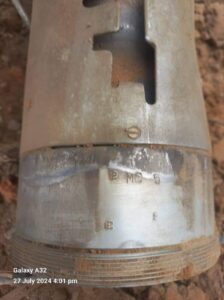
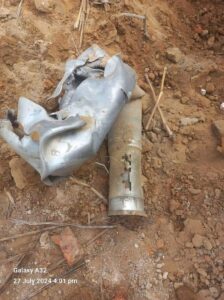
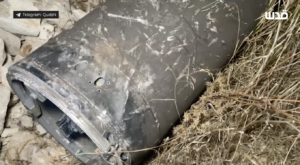
This image shows a remnant of the aft motor section, which includes the venturi nozzle, of a North Korean KN-23/KN-24/Hwasong-11 series missile. The KN-23/KN-24/Hwasong-11 has a generally similar appearance to the Russian 9M7 ‘Iskander’ series of ballistic missiles, but has differences in performance and in some aspects of the construction. (ARES)
This image shows an Iranian M344 106 mm recoilless gun projectile. The M344 is a high explosive anti-tank (HEAT) munition, containing a shaped charge that is designed to penetrate armour. (ARES)