Do not approach munitions
under any circumstances
Country or territory where the image was reported

Reported Location (51)

Year the image is reported to have been taken

Year (21)

Classification groups of key explosive munitions used in conflicts

Munition Category (8)

The impact or effect the munition is intended to have

Functional use (10)

Rely on the rapid expansion of gases released by a detonating high explosive compound inside the munition to generate explosive power
Blast Munition
Chemical weapons are munitions which deliver a chemical agent.
Chemical Munition
The specific model of munition pictured

Tentative Model (338)

Search

The external organisation that documented the munition

Research Organisation (6)

Colour of the munition pictured

Base Colour (12)

Colour of all, or some, of the markings on the munition

Marking Colour (11)

Language or script of the marking on a munition

Marking Script (9)

Condition of the munition pictured

Condition (6)

Key features defining the operation mechanisms of a projectile

Mechanical Feature (10)

Whether a munition is guided or unguided

Guidance (2)

Where the munition is launched from and what it targets

Domain (7)

The type of fins visible on the munition

Fins Characteristic (6)

The nominal diameter of a projectile. For most modern munitions, this is expressed in millimetres (e.g. 82 mm mortar projectile), but older artillery gun projectiles may be described in inches.

Calibre (75)

Weight class of the aerial bomb pictured

Weight Class (14)

1,101–1,200 of 1,470

Current Filter

Blast Munition
Use the rapid expansion of gases released by a detonating high explosive compound inside the munition to generate explosive power. Blast munitions are often considered general-purpose munitions and large examples can have powerful and widespread effects on targets such as structures and personnel.

Current Filter

Chemical Munition
Chemical weapons are munitions which deliver a chemical agent. These agents can be in gaseous, liquid, or solid form and can be deployed using a variety of munition types sometimes repurposed for chemical dispersion, including air-delivered bombs, rockets/missiles, mortar projectiles, and artillery projectiles. The use of these munitions can often result in widespread effects, and many are considered inherently indiscriminate. The 1997 Chemical Weapons Convention banned the development, production and use of chemical weapons. 193 countries have so far committed to the convention, including the United States, Russia, and China.
OSMP731
Analyst Note:
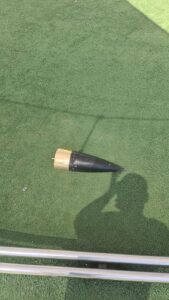
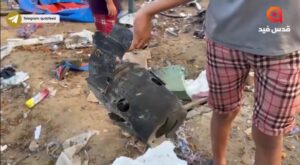
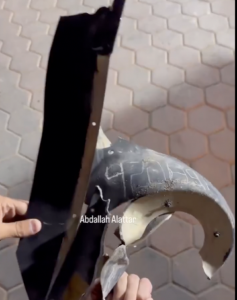
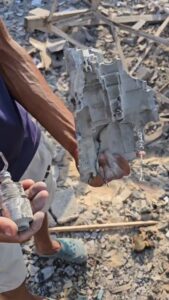
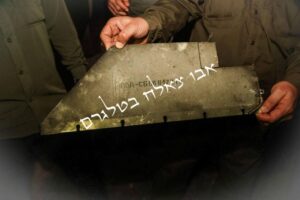
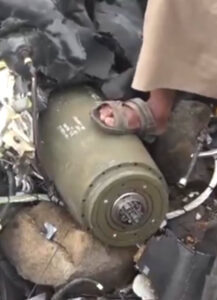
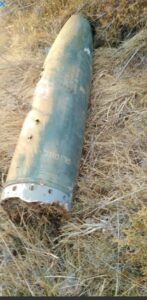
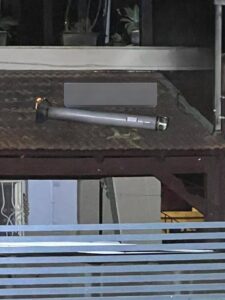
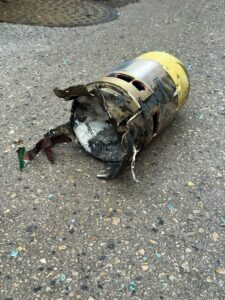
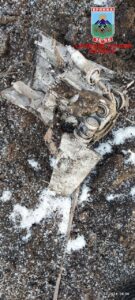
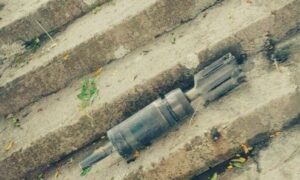
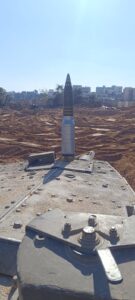
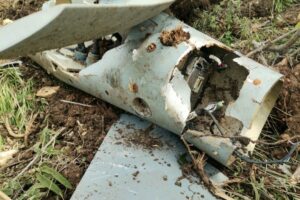
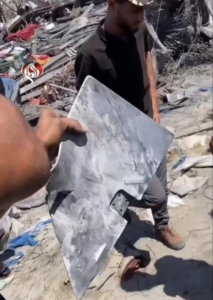
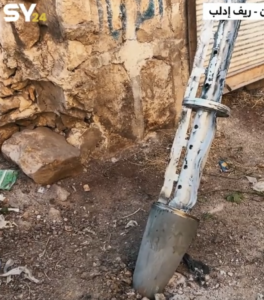
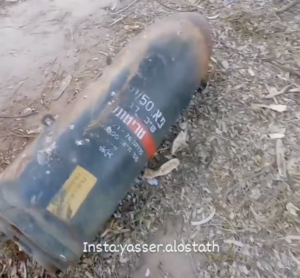
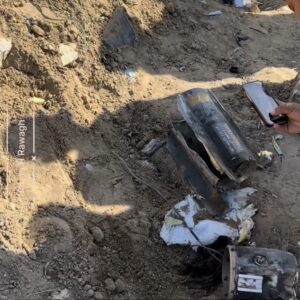
This image shows the nosecone from an Israeli Tamir surface-to-air missile. This component is often found as a remnant after the functioning of the missile. (ARES)
OSMP739
Analyst Note:
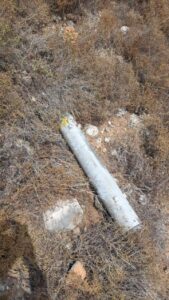
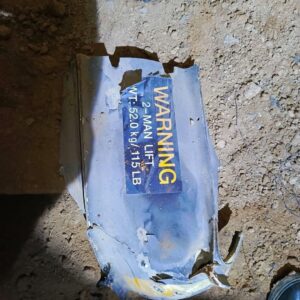
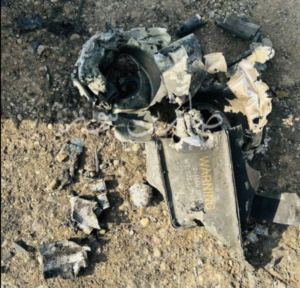
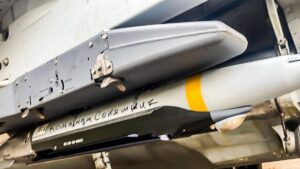
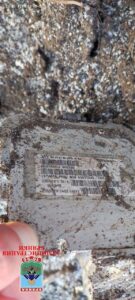
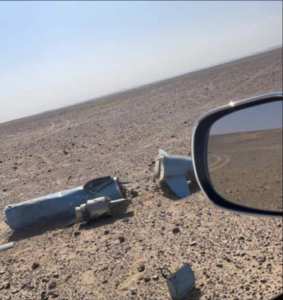
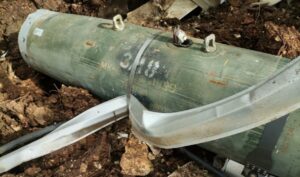
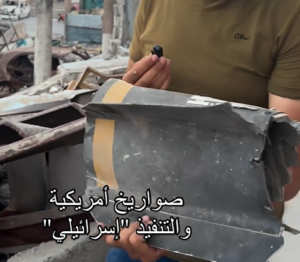
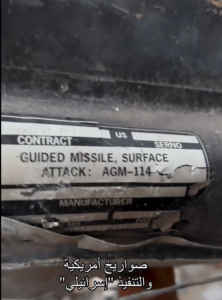
The AGM-179 Joint Air-to-Ground Missile (JAGM) is derived from the AGM-114 Hellfire series of air-to-surface missiles—and thus shares physical characteristics in terms of general construction, including rear fin placement. The marked weight of 52.0 kg (115 lbs) is generally believed to be an indicator that the rocket motor is from a JAGM; however, remnants marked with this weight have been observed from several years before the JAGM was initially fielded. (ARES)
OSMP727
Analyst Note:
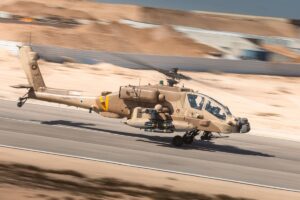
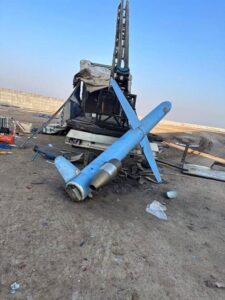
In this image, four AGM-114 Hellfire-series missiles can be seen fitted to an M299-series missile launcher, itself attached to the stub wings of this Israeli AH-64 Apache helicopter. In theory, the Apache could be armed with up to sixteen Hellfire missiles, but fewer are carried in practice to allow for other weapons and sensor payloads (ARES).
OSMP712
Analyst Note:
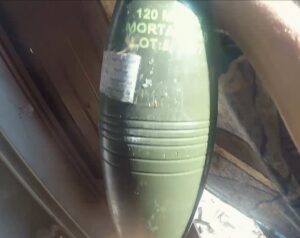
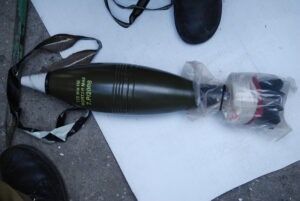
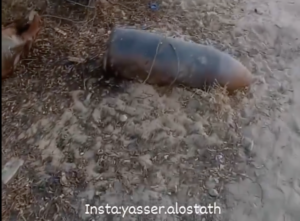
This Iranian M48 120 mm mortar projectile is marked to indicate it was manufactured in 2008. A plastic bag cable-tied to the tail of the munition protects the auxiliary, or supplemental, propellant charges fitted to the round. (ARES)
OSMP711
Analyst Note:
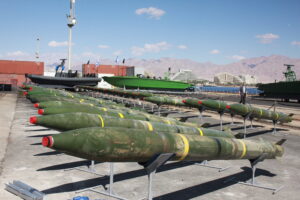
This Iranian copy of the Chinese Type 63 107 mm rocket is marked with a red stripe and text to indicate it is of the high explosive incendiary (“H.E.I”) type. Markings also show that it was produced in 2007. (ARES)
OSMP718
Analyst Note:
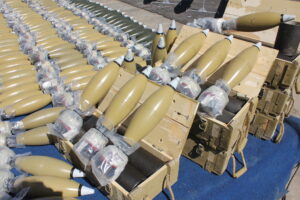
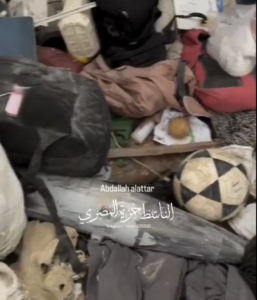
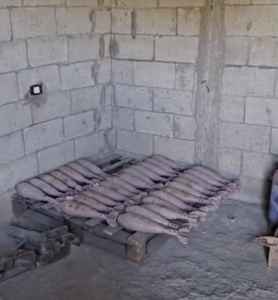
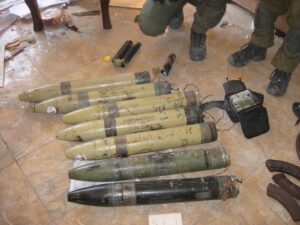
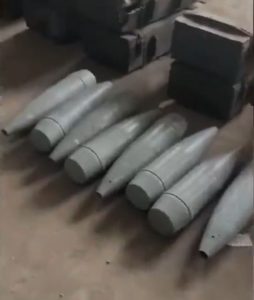
The physical features, colour scheme, and packaging of these 120 mm mortar projectiles are all consistent with Iranian manufacture, but the markings are mostly obscured in this image. (ARES)
OSMP696
Analyst Note:
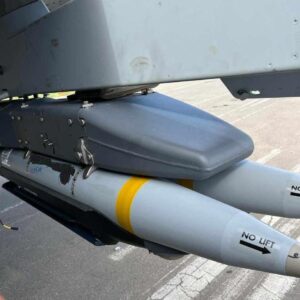
In this image, two GBU-39 Small Diameter Bombs are attached to a BRU-61/A bomb rack. The Ukrainian Air Force adapted this American-designed bomb rack to fit their Soviet-designed Mikoyan MiG-29 fighter aircraft. The BRU-61/A can carry up to four GBU-39 air-delivered bombs. (ARES)
OSMP685
Analyst Note:
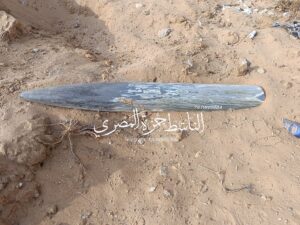
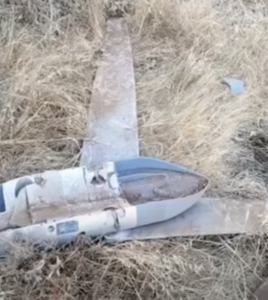
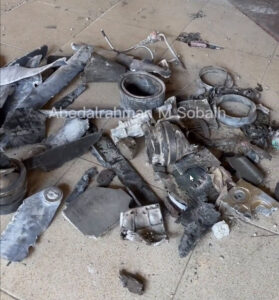
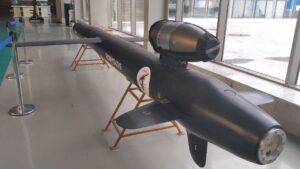
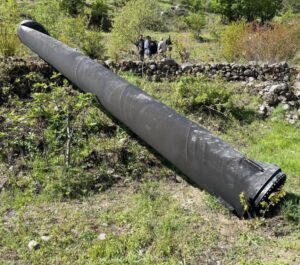
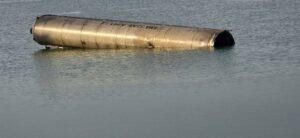
The Tamir Interceptor is the missile fired from Israel’s Iron Dome defence system to intercept incoming rockets, missiles, projectiles, and unmanned aerial vehicles (‘drones’). The Tamir uses a warhead with a relatively small explosive yield, which typically results in the guidance section, nosecone, and (spent) rocket motor falling to the ground relatively intact after functioning. (ARES)
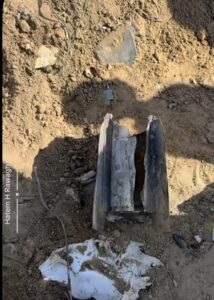
OSMP657
Analyst Note:
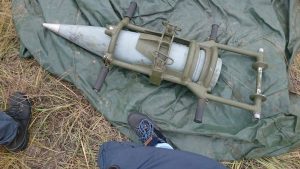
Some tank gun projectiles may have fins affixed to an extended ‘tail boom’, in a similar manner to a mortar projectile. Note, however, that the cylindrical tail assembly is not perforated as it would be for most mortar projectiles. Tank gun projectiles are also more likely to be generally cylindrical, rather than lachrymiform (teardrop-shaped). (ARES)
OSMP640
Analyst Note:
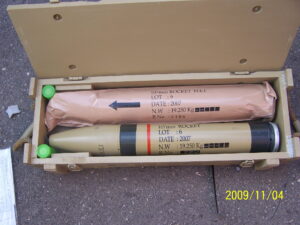
The M329 is a multi-purpose tank gun projectile designed to engage a range of targets other than tanks. It is one of the few cluster munitions that takes the form of a tank gun projectile, dispensing six explosive submunitions over a relatively small area. It has also been referred to as the ‘APAM 120’, describing its functional role (‘anti-personnel/anti-materiel’) and calibre (120 mm). (ARES)
OSMP539
Analyst Note:
This image depicts either a 9M27K or 9M27K1 cargo rocket (cluster munition). The 9M27K carries the 9N210 high explosive fragmentation (HE-FRAG) submunition, whilst the 9M27K1 carries the 9N235 HE-FRAG submunition (ARES).
OSMP554
Analyst Note:
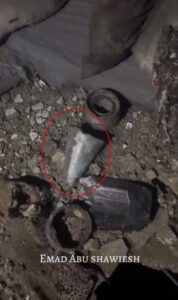
The circled remnant is the hardened steel nosecone of the GBU-39, which renders the munition capable of penetrating more than 3 feet (approx. 1 metre) of steel-reinforced concrete. It is one of several components that often survives the detonation of the munition. (ARES)
OSMP533
Analyst Note:
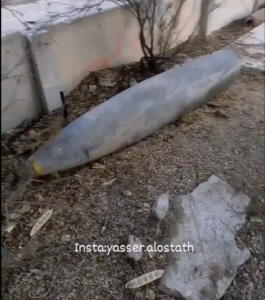
This image depicts an M117-series unguided aerial bomb. Belonging to a class of weapons referred to as ‘demolition bombs’—which use Tritonal or similar explosive compounds to generate a more powerful blast effect than TNT or Composition B—the M117 is an American design which dates to the Korean War era and is rarely seen in service with modern armed forces. (ARES)
OSMP537
2 Analyst Notes:
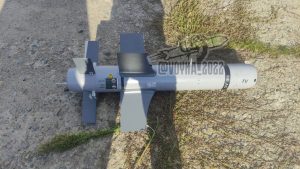
This munition is assessed to be one of the Small Diameter Bomb (SDB) I variants (GBU-39 series), rather than one of the SDB II 'StormBreaker' (GBU-53 series) munitions, on the basis of contextual information. 'Small Diameter Bomb' is the manufacturer's terminology, whilst 'GBU-39' is the U.S. Air Force designation (also used by many other operators). (ARES)
OSMP509
Analyst Note:
107mm spin-stabilized rockets of this design are often utilized by non-state actors in an indirect fire role. Like the original Chinese models that they are copied from, they do not require more than a simple electric power source and a rudimentary launch platform to achieve an acceptable level of accuracy. (ARES)
OSMP244
Analyst Note:
The various Iranian Qaem-series guided air-delivered bombs can be difficult to differentiate from one another. In this case, the wing (forward fin) assembly distinguishes this Qaem-5 from the visually similar Qaem-1. Note also that the name 'Qaem' has applied by Iran to other, unrelated munitions. (ARES)