




101–200 of 583
Analyst Note
28 November 2025
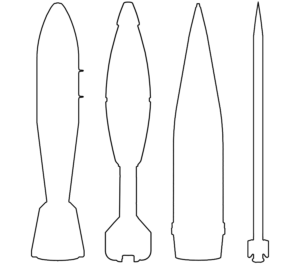
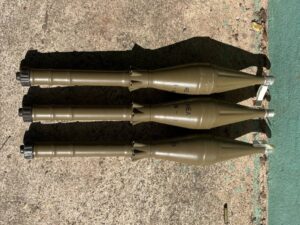
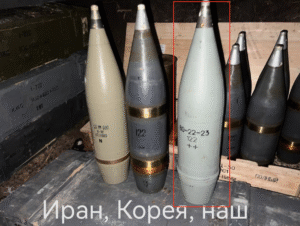
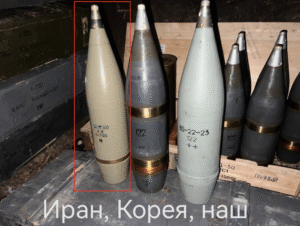
This image shows 122 mm high explosive (HE) artillery gun projectiles manufactured in three different states, L–R: Iran, North Korea, and Russia. Whilst these examples are distinct from one another—particularly in coloration, as well as the presence or absence of paint over the driving band and bourrelet—this is not always the case, and a combination of physical features and markings should be assessed before identification is made. (ARES)

Analyst Note
5 February 2026
Pictured here are a pair of 106 mm M344A1 High Explosive Anti-Tank (HEAT) projectiles fitted with M509A1 point-initiating, base-detonating (PIBD) fuzes. These are designed to be fired from M40-series 106 mm recoilless rifles. Note that, despite the nominal 106 mm designations, the M40 has a bore diameter of 105 mm. (ARES)
Analyst Note
31 December 2025
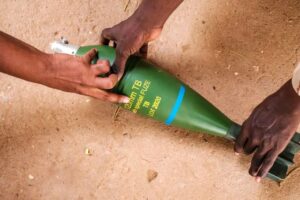
This munition, despite being adapated from the design of a 120 mm mortar projectile and closely resembling such, is actually a small air-delivered bomb intended to be dropped by UAV. The manufacturer clearly states that the munition should not be fired from a mortar. Additional data from the manufacturer states that it uses a UT M18 “special impact fuze”. (ARES)
Analyst Note
31 December 2025
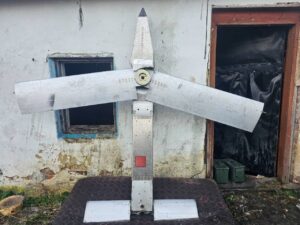
The UMPK guidance package is a ‘bolt-on’ kit that can be fitted to unguided air-delivered bombs to convert them to guided munitions. The UMPK kit also greatly extends the range of the munition to which it is fitted, allowing aircraft to strike from beyond the range of many air-defence systems. Currently only Russia manufacturers and uses these kits. (ARES)
Analyst Note
31 December 2025
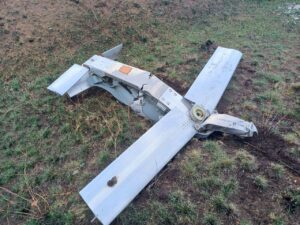
This image shows a russian air-delivered bomb fitted with a UMPK guidance kit. Not enough of the bomb is visible to positively identify the model, but it is most likely an OFAB-250-270 based on what can be seen of the tail section. (ARES)
Analyst Note
31 December 2025
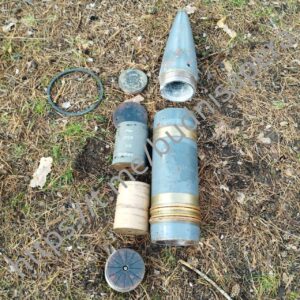
This image shows a North Korean 170 mm artillery projectile, as fired by the M-1978 Koksan self-propelled artillery gun. Very little is known of the M-1978 Koksan due to the secretive nature of North Korean arms development, but both high explosive and rocket-assisted high explosive projectiles are believed to be available. The designations ‘M-1978’ and ‘Koksan’ were applied by American military analysts identified the system in Koksan, North Korea, in 1978. (ARES)
Analyst Note
9 January 2026
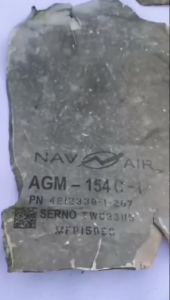
The AGM-154 Joint Standoff Weapon (JSOW) is a guided air-delivered ‘glide bomb’ that allows for long-range strikes using an unpowered munition. The AGM-154C and AGM-154C-1 variants (a remnant of the latter pictured here) carry a Bomb Royal Ordnance Augmented Charge (BROACH) multi-stage warhead which uses a WDU-44 shaped-charge warhead as its first stage, to help penetrate hardened targets, whilst the WDU-45 second stage comprises a conventional high explosive penetrator warhead (also called a ‘follow-through’ warhead). The AGM-154C-1 is described by the U.S. Navy as their “first air-to-ground Network-Enabled Weapon (NEW) capable of attacking stationary land and moving maritime targets. It includes GPS/INS guidance, terminal IR seeker and a Link 16 weapon data link. Integration of the Link-16 weapon data link and updated seeker software algorithms provide a capability against at-sea moving/relocatable targets.” (ARES)
Analyst Note
31 December 2025
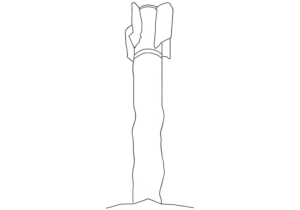
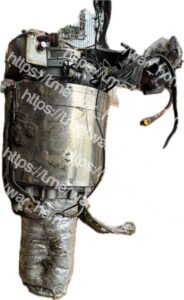
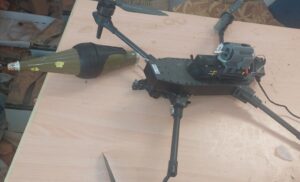
This image shows a one-way-attack (‘sacrificial’) UAV with the apparent warhead broken off. It is believed to have been attached to the grey mechanism located at the rear of the UAV, likely separating when the UAV was downed. (ARES)

Analyst Note
31 December 2025
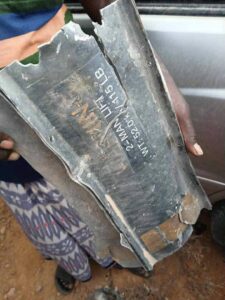
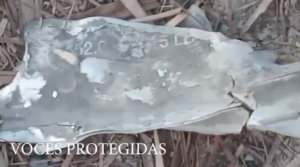
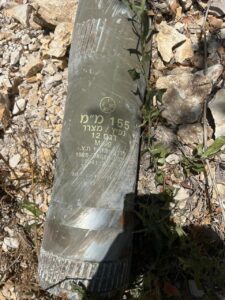
This image depicts remnants from a M999 (‘Barak Eitan’) 155 mm cluster munition. Reports indicate that the M999 artillery projectile carries nine M99 Dual-Purpose Improved Conventional Munition (DPICM) submunitions. (ARES)
Analyst Note
28 November 2025
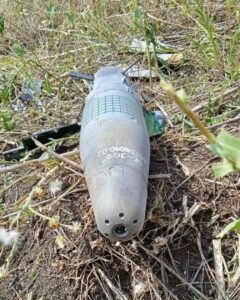
Markings on the forward section of this small, air-delivered bomb suggest that the designation is ‘BK-3OF’ (“БК-3ОФ”). The physical features of the munition suggest that it is laser-guided and likely carries a high explosive fragmentation (HE-FRAG) payload. This image shows the only known example, which was allegedly captured by Russian forces in conjunction with a Ukrainian UAV. (ARES)
Analyst Note
9 January 2026
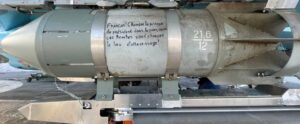
This Russian air-delivered cluster bomb is marked with a threatening message directed at the French people: «Français! Changer la politique du président dans le pays, sinon ces bombes vont changer le lieu d'atterrissage!» (“French people! Change the president’s policy in the country, otherwise these bombs will change their landing site!”). (ARES)



Analyst Note
9 January 2026
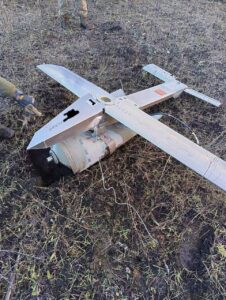
This sheet-metal body component is marked with a manufacturer’s CAGE Code (“MFR-59518”) which indicates it was produced by GlenDee Corp. of Moorpark, California, which does business as Metalagraphics, Inc. (MGI). (ARES)

Analyst Note
9 January 2026
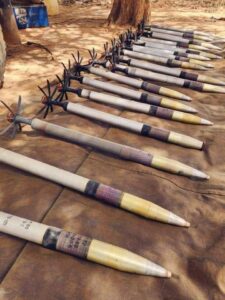
Moog Inc.—headquartered in East Aurora, New York, as marked on this munitions remnant—describes itself as a “worldwide designer, manufacturer, and integrator of precision control components and systems”. Moog supplies actuator and control components to the prime contractor on the Miniature Air-Launched Decoy (MALD) programme, Raytheon. (ARES)
Analyst Note
8 December 2025
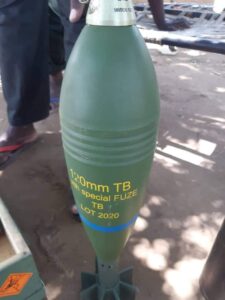
This image shows a ‘120mm TB’ air-delivered bomb that has been adapted from a 120 mm mortar projectile. It is claimed by the manufacturer that this thermobaric munition offers improved fragmentation and blast effects when compared with standard (high explosive) 120 mm mortar projectiles. The “with special FUZE” marking refers to the use of the UT M18 impact fuze. Note that this munition cannot be fired from a mortar, despite the munition body showing features consistent with this use (e.g., gas-check bands). Instead of a standard mortar projectile tailboom which would contain an ignition cartridge and be perforated by flash holes, this munition is fitted with a simplified, plastic tailfin assembly that is designed to stabilise the munition as it falls after being released by a UAV. (ARES)
Analyst Note
28 November 2025
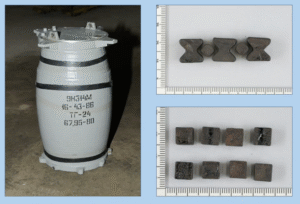
The 9N314M warhead shown here can be used in both 9M38- and 9M317-series missiles. In this particular case, according to the source, it was taken from a 9M38M1 missile. (ARES)
Analyst Note
28 November 2025
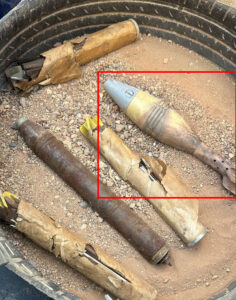
The physical features of this munition indicate that it is most likely an Iranian 60 mm ‘high explosive, long-range’ (“H.E. L.R.”) mortar projectile fitted with an AZ111A2 impact fuze. However, positive identification cannot be made based on the source imagery. (ARES)
Analyst Note
28 November 2025
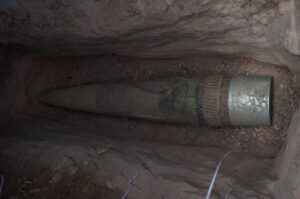
The munition depicted in this image is a type of aerodynamically optimised artillery projectile, in this case 155 mm in calibre, known as an ‘Extended Range Full-Bore (ERFB)’ design. This example is a cargo projectile fitted with a base-bleed (BB) base unit to further extend its range. This configuration is designated NR269, and reportedly contains 56 M46 dual-purpose (anti-personnel/anti-armour) submunitions. (ARES)
Analyst Note
28 November 2025
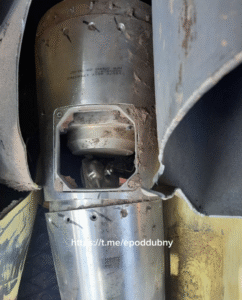
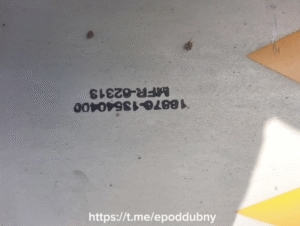
This munition remnant is marked with a manufacturer’s CAGE Code (“MFR-05DN8”) which indicates it was produced by Klune Industries. Klune Industries is a sub-contractor on the GMLRS contract. (ARES)
Analyst Note
21 November 2025
This munition remnant is marked with a manufacturer’s CAGE Code (“MFR-62313”) which indicates it was produced by Lockheed Martin. Lockheed Martin is the primary contractor that makes GMLRS missiles. (ARES)
Analyst Note
28 November 2025
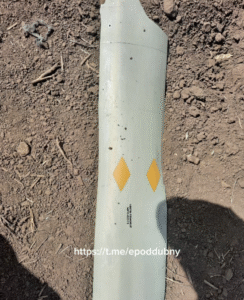
This image shows a remnant from an American M30 Guided Multiple Launch Rocket System(GMLRS) missile, which carries M77/M101 submunitions. The yellow diamond markings indicate a payload of explosive submunitions. (ARES)
Analyst Note
28 November 2025
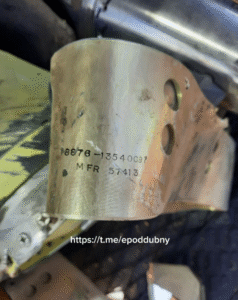
This munition remnant is marked with a manufacturer’s CAGE Code (“MFR-57413”) which indicates it was produced by the Maine Machine Products Company, a sub-contractor on the GMLRS contract. (ARES)
2 Analyst Notes
28 November 2025
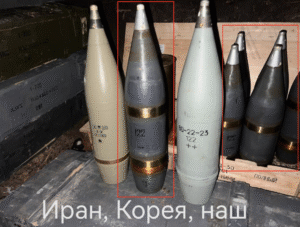
This image shows 122 mm high explosive (HE) artillery gun projectiles manufactured in three different states, L–R: Iran, North Korea, and Russia. Whilst these examples are distinct from one another—particularly in coloration, as well as the presence or absence of paint over the driving band and bourrelet—this is not always the case, and a combination of physical features and markings should be assessed before identification is made. (ARES)
2 Analyst Notes
25 November 2025
This image shows 122 mm high explosive (HE) artillery gun projectiles manufactured in three different states, L–R: Iran, North Korea, and Russia. Whilst these examples are distinct from one another—particularly in coloration, as well as the presence or absence of paint over the driving band and bourrelet—this is not always the case, and a combination of physical features and markings should be assessed before identification is made. (ARES)



Analyst Note
29 September 2025
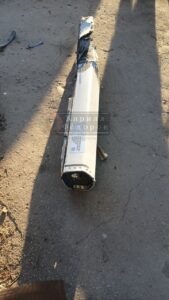
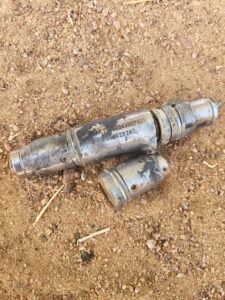
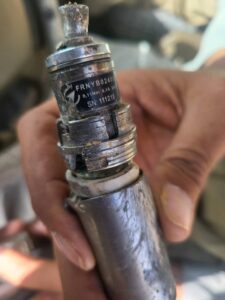
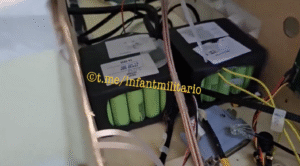
This photo shows some of the lithium-ion power banks found within a Gerbera UAV. These are used to power the onboard avionics, control surfaces, communications hardware, camera, and other components. The quantity and type of batteries fitted to the Gerbera will often vary based on the role for which the UAV has been configured—one-way attack (OWA; i.e., a ‘sacrificial’ munition), reconnaissance, signal relay, or decoy—and which specific hardware has been installed to effect this mission. (ARES)
Analyst Note
29 September 2025
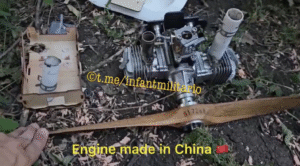
The DLE60 two-stroke petrol (gasoline) engine pictured here is the standard engine found on Gerbera UAVs. It is produced by the Chinese company Mile Haoxiang Technology Co., Ltd. and marketed specifically for use in UAVs. Although the Gerbera is manufactured in Russia, the engine and many other key components continue to be supplied from Chinese sources. (ARES)
Analyst Note
29 September 2025
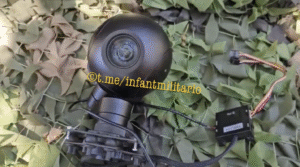
This image shows an A40 Pro camera, manufactured by the Chinese company Viewpro UAV and design specifically for use in UAVs. The black box to the right of the camera is the control box which manages video output, camera control, and power. The manufacturer claims this model has a 40× optical zoom, AI detection and tracking, and 3-axis gyro-stabilisation. The company further claims that it can customise the onboard AI recognition based on “target characteristics” provided by the client. Numerous Gerberas fitted with this model of camera are known to have been recovered by Ukrainian forces, although it is by no means the only camera model in use. (ARES)
Analyst Note
29 September 2025
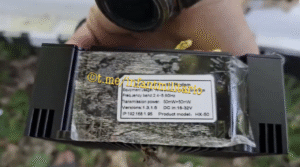
This image shows the back surface of a wireless communications module contained within a downed Gerbera UAV. Although labeled as an HX-50 model designed for fixed locations, Ukrainian military analysis indicates this is an XK-F358 mesh-network module more suitable for use in UAVs. See OSMP1646 for further details. (ARES)
Analyst Note
29 September 2025
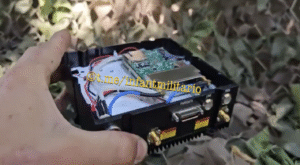
This image shows the front and interior surfaces of a wireless communications module recovered from a downed Gerbera UAV. Although labelled as an HX-50 industrial wireless modem (compatible with WiFi and 5G/4G networks and designed for fixed locations), analysis by Ukrainian military sources indicates that this component is, in fact, an XK-F358 mesh-network module which offers significantly more capabilities. Manufactured and sold by Shenzhen Xingkai Technology Co., Ltd., these modules are designed for, amongst other things, use in robots and unmanned vehicles. Gerbera UAVs have been found operating on a wide variety of frequencies and networks, and this type of module is well-suited to this use. (ARES)
Analyst Note
29 September 2025
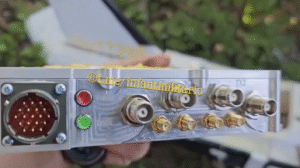
Pictured is a navigation/GPS module recovered from a downed Gerbera UAV. This particular model is used with the 4-antenna CRPA module seen in OSMP1648. The four RX ports on the bottom are normally directly connected to the CRPA (antenna) module, with other connections made to the UAV’s flight controller and power sources. Some Gerberas have been recovered with CRPA modules bearing a different number of antennas; different navigation modules have been observed on these. (ARES)
Analyst Note
29 September 2025
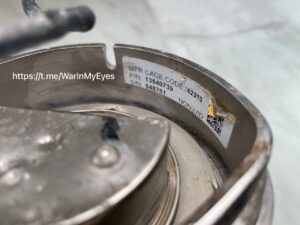
This munition remnant is marked with a manufacturer’s CAGE Code (“MFR CAGE CODE: 62313”) which indicates it was produced by Lockheed Martin. Lockheed Martin is the primary contractor that makes GMLRS missiles. (ARES)

Analyst Note
29 September 2025
This remnant shows a munition component marked with the CAGE Code for a sub-contractor who produced part of a larger munition. “64344” is the code for Unique Electronics Inc., a known sub-contractor working on Lockheed Martin’s GMLRS contract. One of the parts they make is the “CABLE ASSEMBLY W459“, as seen in this image. (ARES)

Analyst Note
15 September 2025
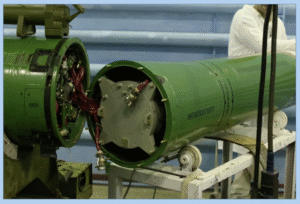
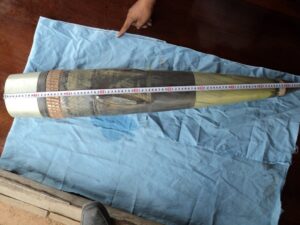
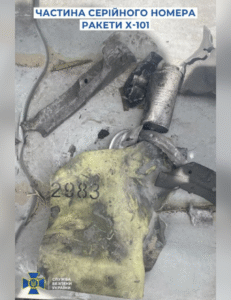
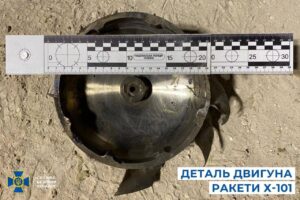
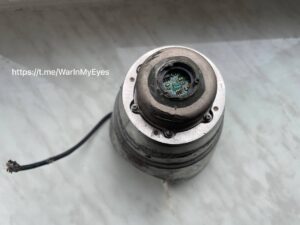
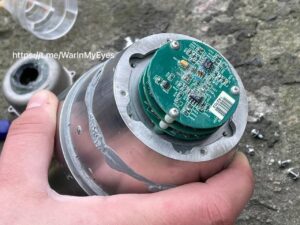
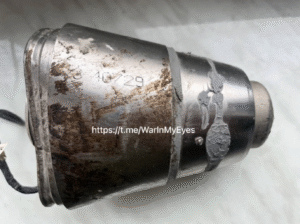
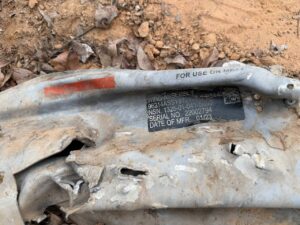
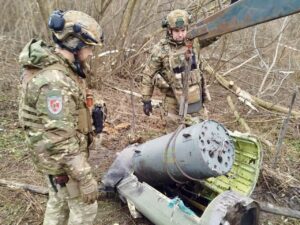
This image shows the three lenses that form the new version of the Kh-101 Digital Scene Matching Area Correlator (DSMAC) system. (The older version only had a single lens.) DSMAC systems take digital images of the ground as the missile passes overhead, and then compare those images to pre-captured images stored in the onboard memory. The DSMAC corrects the flight path as needed based on differences between the two sets of images. (ARES)

Analyst Note
15 September 2025
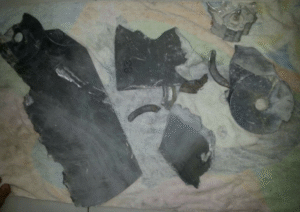
This image shows the second warhead present in some variants of the Kh-101 cruise missile. The inclusion of this additional warhead requires a smaller fuel tank in the missile, offering increased explosive weight in exchange for a reduced maximum range. (ARES)
Analyst Note
15 September 2025
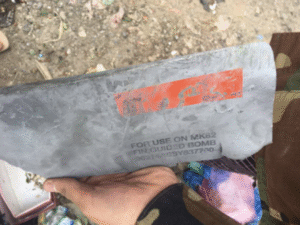
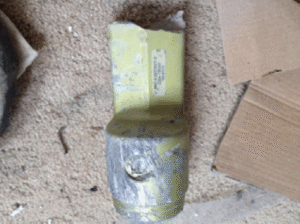
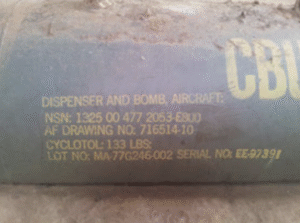
This image shows markings on an SUU-30H/B dispenser which comprises part of a CBU-52B/B Cluster Bomb Unit, including a National Stock Number (“NSN 1325 00 477 2053-E800”), design reference (“AF DRAWING NO: 716514-10”), total explosive weight of the submunitions (“CYCLOTOL: 133 LBS:”), lot number (“LOT NO: MA-77G246-002”), and serial number (“SERIAL NO: EE-97391”). This lot number indicates that this CBU-52B/B was manufactured at the Milan Army Ammunition Plant in the U.S. in July 1977. (ARES)
Analyst Note
15 September 2025
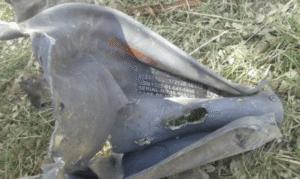
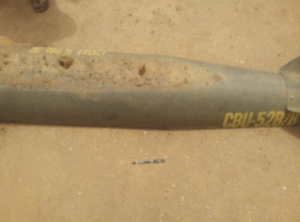
This image shows part of an SUU-30H/B dispenser (cargo munition) that comprises part of the CBU-52B/B ‘Cluster Bomb Unit’. A CBU-52B/B comprises a SUU-30H/B dispenser that is loaded with 217 BLU-61A/B anti-personnel submunitions. (ARES)
Analyst Note
15 September 2025
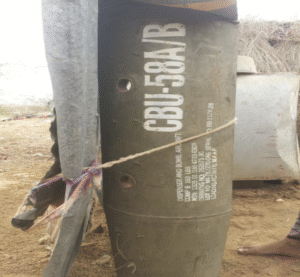
This image shows a remnant of an SUU-30H/B air-delivered dispenser (cargo munition), that comprised a CBU-58A/B ‘Cluster Bomb Unit’ (CBU). The CBU-58A/B carries 650 BLU-63A/B anti-personnel submunitions, that have a total explosive weight of 163 lbs (~74 kg) of COMP B explosive; this is reflected in the visible markings. (ARES)
Analyst Note
15 September 2025
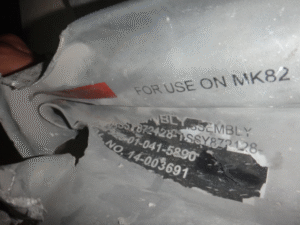
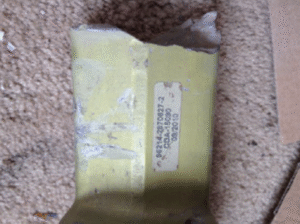
This image shows a remnant of a control actuator shaft from a Paveway guidance kit control section, found after a strike in Yemen in 2015. Markings giving the CAGE code for Raytheon (“96214”) and the part number (“2870627-2”) are both visible. The complete remnant can be seen in related entry 1559. (ARES)
Analyst Note
15 September 2025
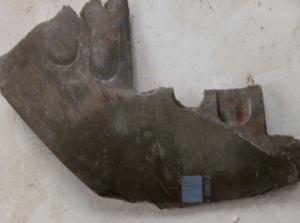
This image shows a remnant of the control fin of a GBU-24 (as seen partially marked), the designation for the combination of a Paveway III guidance kit paired with a 2,000-pound-class air-delivered bomb. This remnant is not enough to determine which model of bomb the kit was originally paired with. (ARES)
Analyst Note
15 September 2025
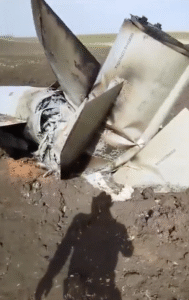
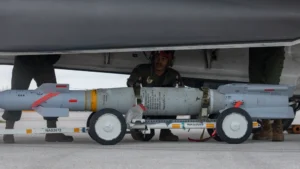
This image shows a BLU-111 500-pound-class bomb paired with a Paveway II guidance kit, and an MXU-650 series airfoil group, or tail kit. This combination is designated the GBU-12 series in U.S. service. (ARES)
Analyst Note
15 September 2025
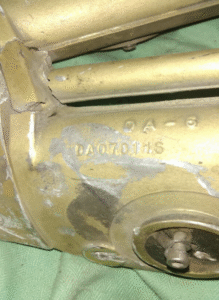
This image shows a close up view of an actuator assembly from an AGM-114 ‘Hellfire’ series missile. This assembly is what actuates the control fins, and the attachment point for one of the control fins is visible at the bottom right of the image. This assembly belongs to the control section, which is the rearmost section of the missile. (ARES)