
Classification groups of key explosive munitions used in conflicts
Munition Category (8)
The impact or effect the munition is intended to have
Functional use (10)
The specific model of munition pictured
Tentative Model (381)
Search
The external organisation that documented the munition
Research Organisation (6)
Colour of the munition pictured
Base Colour (12)
Colour of all, or some, of the markings on the munition
Marking Colour (11)
Language or script of the marking on a munition
Marking Script (9)
Condition of the munition pictured
Condition (6)
Key features defining the operation mechanisms of a projectile
Mechanical Feature (10)
Whether a munition is guided or unguided
Guidance (2)
Where the munition is launched from and what it targets
Domain (7)
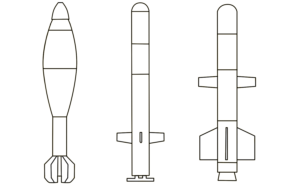
The type of fins visible on the munition
Fins Characteristic (5)
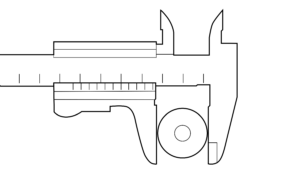
The nominal diameter of a projectile. For most modern munitions, this is expressed in millimetres (e.g. 82 mm mortar projectile), but older artillery gun projectiles may be described in inches.
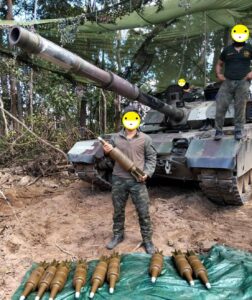
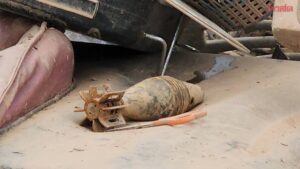
The tank visible in the background of the image appears to be a Chinese VT-4 (MBT-3000) model. The VT-4 is manufactured by Norinco and is intended primarily for export. (ARES)
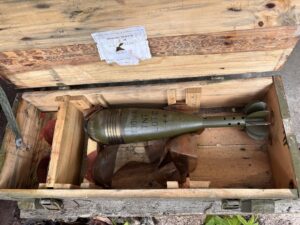
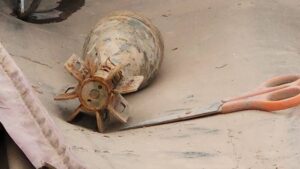
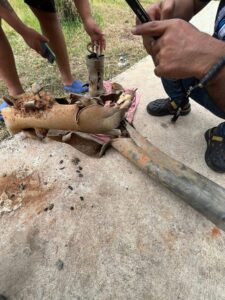
This image shows an M49-series 60 mm high explosive (HE) mortar projectile, or a copy thereof. Due to the state of the round the available imagery, the specific model or variant cannot be determined. The fuze is also not clearly visible. Most M49 mortar projectiles use an M525, M717, M935, or similar point-detonating (PD) fuze. (ARES)
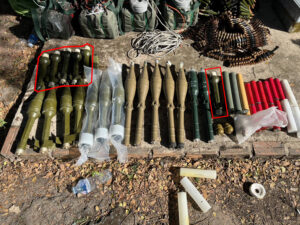
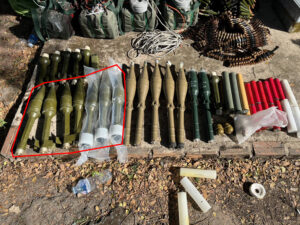
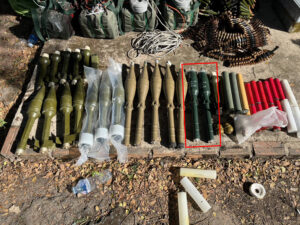
Based on the tail-fin assembly design and relative size, the item pictured appears to be a 122 mm rocket. However, it is unclear if this image shows a Russian 9M22-series (‘Grad’) rocket, a Chinese Type 81 rocket, or a similar variant from a different country of origin. (ARES)