








201–300 of 698
Current Filter
Air-to-Surface
Munitions that are delivered from above the surface of the earth, typically from an aerial vehicle, and designed to strike surface-based targets — whether on land or at sea.
Analyst Note
15 September 2025
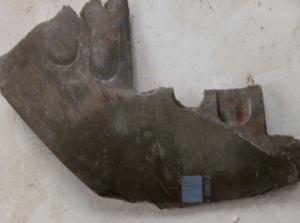
This image shows a remnant of a control fin from a Paveway III bomb guidance kit that is compatible with 2,000-pound-class air-delivered bombs. In U.S. service, this combination receives designations in the GBU-24 series. Based off this remnant alone, it cannot be determined which model of air-delivered bomb was paired with this particular guidance kit. (ARES)
Analyst Note
15 September 2025
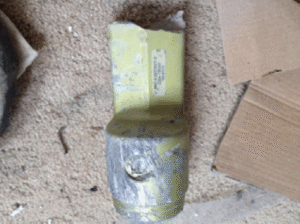
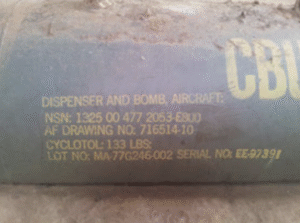
This image shows markings on an SUU-30H/B dispenser which comprises part of a CBU-52B/B Cluster Bomb Unit, including a National Stock Number (“NSN 1325 00 477 2053-E800”), design reference (“AF DRAWING NO: 716514-10”), total explosive weight of the submunitions (“CYCLOTOL: 133 LBS:”), lot number (“LOT NO: MA-77G246-002”), and serial number (“SERIAL NO: EE-97391”). This lot number indicates that this CBU-52B/B was manufactured at the Milan Army Ammunition Plant in the U.S. in July 1977. (ARES)
Analyst Note
15 September 2025
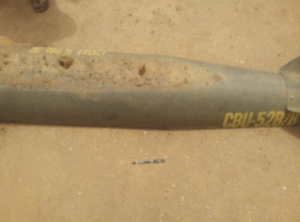
This image shows part of an SUU-30H/B dispenser (cargo munition) that comprises part of the CBU-52B/B ‘Cluster Bomb Unit’. A CBU-52B/B comprises a SUU-30H/B dispenser that is loaded with 217 BLU-61A/B anti-personnel submunitions. (ARES)
Analyst Note
15 September 2025
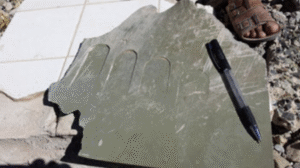
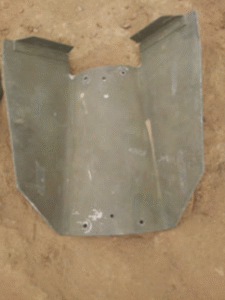
This image shows one of two tail fin sections that are attached to an SUU-30H/B air-delivered dispenser (cargo munition). Similar tail fins are used in other variants of the SUU-30 series dispensers. The SUU-30H/B can be used in various ‘Cluster Bomb Units’ including variants of the CBU-52, CBU-58, and CBU-71 munitions. (ARES)
Analyst Note
15 September 2025
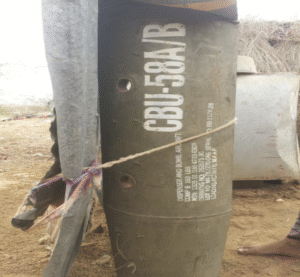
This image shows a remnant of an SUU-30H/B air-delivered dispenser (cargo munition), that comprised a CBU-58A/B ‘Cluster Bomb Unit’ (CBU). The CBU-58A/B carries 650 BLU-63A/B anti-personnel submunitions, that have a total explosive weight of 163 lbs (~74 kg) of COMP B explosive; this is reflected in the visible markings. (ARES)
Analyst Note
15 September 2025
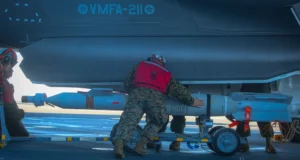
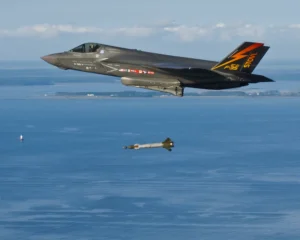
This image shows a GBU-12 series guided bomb being loaded onto a F-35B belonging to Marine Fighter Attack Squadron 211. Two of the control fins have not yet been installed in the Paveway’s guidance control section. (ARES)
Analyst Note
15 September 2025
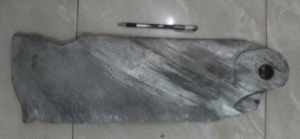
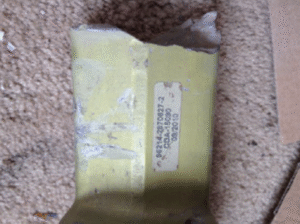
This image shows a remnant of a control actuator shaft from a Paveway guidance kit control section, found after a strike in Yemen in 2015. Markings giving the CAGE code for Raytheon (“96214”) and the part number (“2870627-2”) are both visible. The complete remnant can be seen in related entry 1559. (ARES)
Analyst Note
15 September 2025
This image shows a remnant of the control fin of a GBU-24 (as seen partially marked), the designation for the combination of a Paveway III guidance kit paired with a 2,000-pound-class air-delivered bomb. This remnant is not enough to determine which model of bomb the kit was originally paired with. (ARES)
Analyst Note
15 September 2025
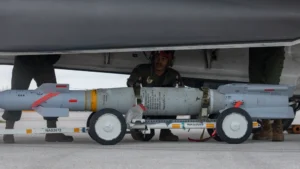
This image shows a BLU-111 500-pound-class bomb paired with a Paveway II guidance kit, and an MXU-650 series airfoil group, or tail kit. This combination is designated the GBU-12 series in U.S. service. (ARES)
Analyst Note
16 September 2025
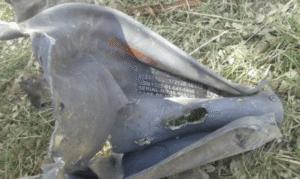
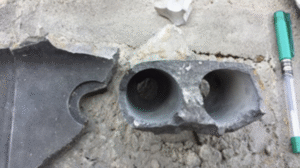
This image shows remnants of an MXU-series airfoil group, or tail section, that is paired with Paveway-series bomb guidance kits. The remnant on the right is one of two retractor mechanisms that are present inside the MXU-series airfoil group. (ARES)
Analyst Note
15 September 2025
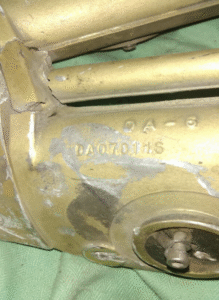
This image shows a close up view of an actuator assembly from an AGM-114 ‘Hellfire’ series missile. This assembly is what actuates the control fins, and the attachment point for one of the control fins is visible at the bottom right of the image. This assembly belongs to the control section, which is the rearmost section of the missile. (ARES)
Analyst Note
15 September 2025
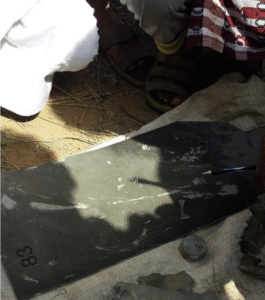
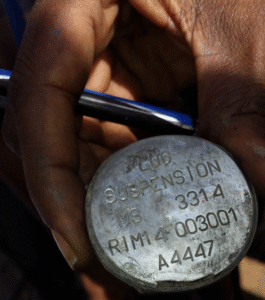
This image shows the bottom of an MS 3314 suspension lug, which is installed on the MK 81 250-pound-class, MK 82 500-pound-class, and MK 83 1,000-pound-class air-delivered bombs. The remnants of the guidance kit in the related entry indicate that, in this case, the lug was fitted to a MK 83 1,000-pound-class bomb. “A4447” is the CAGE code for the manufacturer of the suspension lug, RWM Italia. (ARES)
Analyst Note
15 September 2025
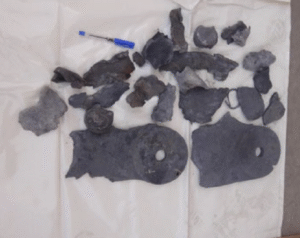
This image shows various remnants of an air-delivered bomb and a Paveway guidance kit. The blue pen provides a scale indicator, which is necessary to identify which variant of aerofoil (‘airfoil’) group the tail fins belonged to. In this case, they are most likely from an MXU-650-series airfoil group, which are paired with MK-82 500-pound-class bombs. (ARES)
Analyst Note
15 September 2025
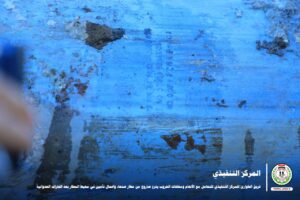
This image shows some of the markings on a MK 84 2000-pound-class air-delivered bomb, including model designation (“BOMB MK 84 MOD 4”), weight class (“2000 LBS”), part number (“PART NO 30…03 923AS105”), and production lot (“LOT NO GDT 17 …00…”). Many countries produce MK 80-series bombs, so markings such as lot numbers can determine the country of production. “GDT 17” in the lot number indicates that this munition was produced by General Dynamics Ordnance and Tactical Systems, an American company, in 2017. The Israeli Air Force announced they carried out the specific strike associated with this image, which indicates that this specific bomb was transferred to the Israeli Air Force. (ARES)
Analyst Note
15 September 2025
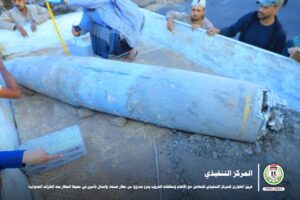
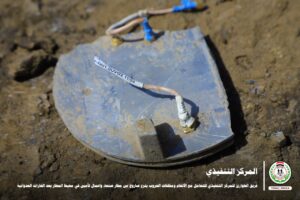
This image shows a remnant of a JDAM tail kit that was paired with a MK 84 2,000-pound-class air-delivered bomb. The CAGE code (“OUVG2”) for Aeroantenna Technology, an American manufacturer of GPS components for guidance systems, is visible on the wiring. (ARES)


Analyst Note
26 April 2026
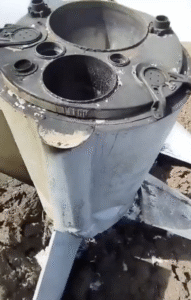
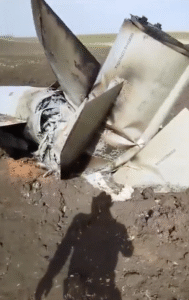
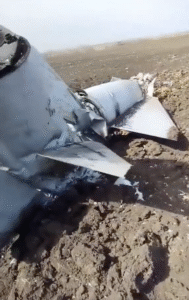
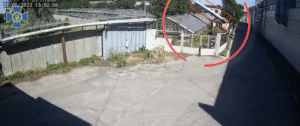
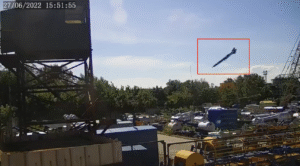
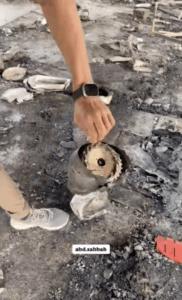
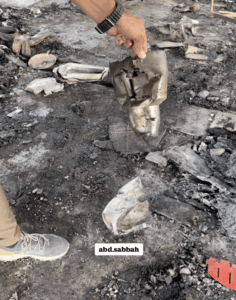
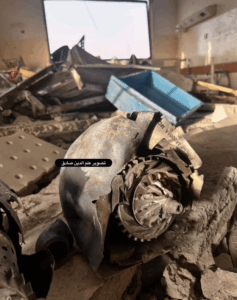
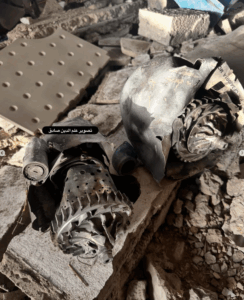
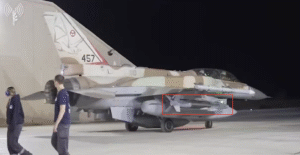
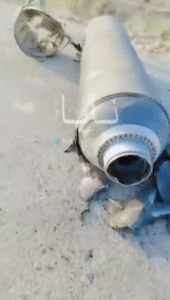
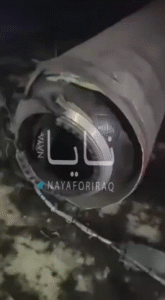
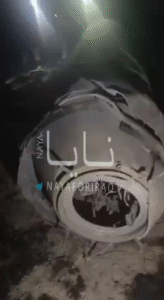
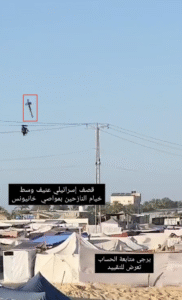
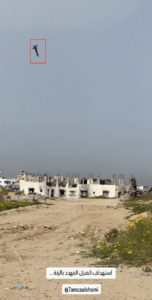
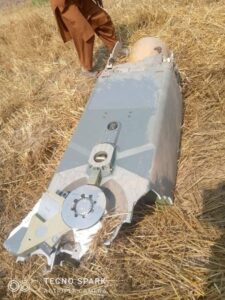
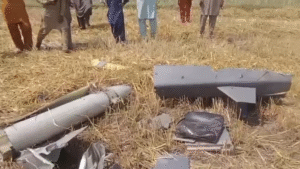
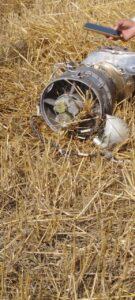
This image shows the remnants of an unknown Israeli munition that was used in a strike on Nasser hospital. Reporting on these strikes often refers to this munition as a ‘drone’. The turbojet engine, along with possible wing remnants, indicate that this could be a one-way-attack (OWA) UAV or ‘loitering munition’ missile, consistent with reporting. This same model of munition has been used multiple times in strikes in Gaza, as well as Lebanon and Syria. There is no publicly acknowledged Israeli munition that closely fits these remnants. Entries 1384, 1385, 1386, and 1389 capture other incidents in which this munition was used. (ARES)
Analyst Note
15 September 2025
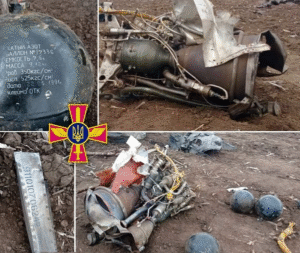
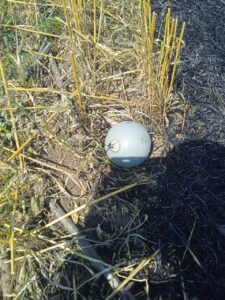
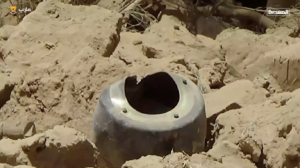
This image shows a Russian spherical submunition of unknown designation. Whilst this specific example was delivered by a cluster munition variant of the Kh-59MK2 missile, this submunition is known to also be delivered by variants of the Kh-69. A similar, but different, spherical submunition is delivered by some variants of the Kh-101. (ARES)
Analyst Note
27 May 2025
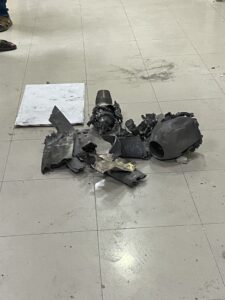
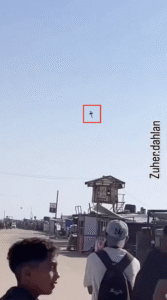
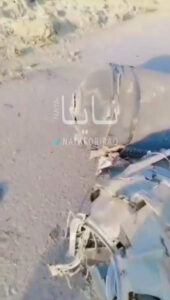
This image shows the remnants of an unknown Israeli munition that was used in a strike that hit the Nasser hospital in Gaza. The turbojet engine, along with possible wing remnants indicate that this could be a one-way attack UAV or ‘loitering munition’, consistent with some reporting on the strikes. This same model of munition has been used in multiple strikes in Gaza, as well as in Lebanon and Syria. There is no publicly disclosed Israeli munition that neatly matches these remnants. OSMP entries 1384, 1385, 1386, and 1389 show other incidents in which this munition appears to have been used. (ARES)
Analyst Note
15 September 2025
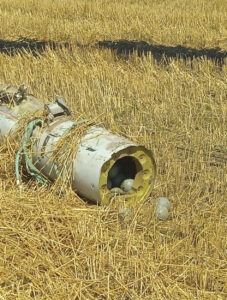
This image shows part of a Russian Kh-59MK2 missile that is fitted with a cluster munition warhead. Some of the grey spherical submunitions are visible, both inside and outside the warhead. (ARES)
Analyst Note
14 July 2025
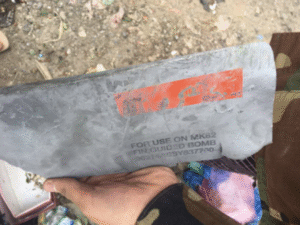
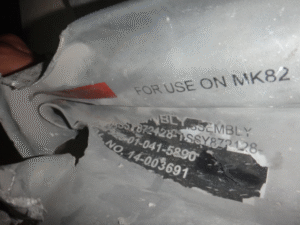
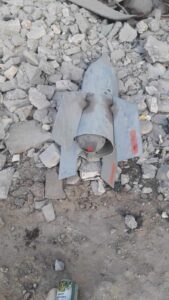
This image shows a remnant of the guidance control unit from a Paveway- or Lizard-series bomb guidance kit. The guidance control fins are marked “FOR USE ON MK82” indicating that this guidance control unit was paired with a MK 82-series 500-pound-class bomb. (ARES)
Analyst Note
15 September 2025
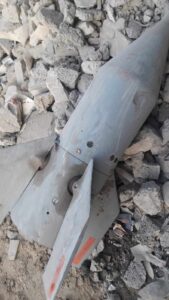
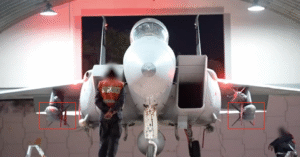
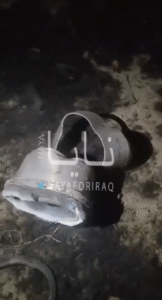
This image shows remnants of two different rocket motors from AGM-114 series Hellfire missiles. While it cannot be determined by these entries alone, images of the damage from the strike associated with this image, gathered by Mwatana, indicate that both of these AGM-114 missiles were the kinetic AGM-114R9X variant. (ARES)
Analyst Note
15 September 2025
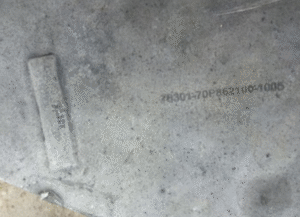
This image shows one of the actuated fins of a Joint Direct Attack Munition (JDAM) tail kit. The manufacturer CAGE code (“76301”) and the part number (“70P862100-1005”) are visible. This CAGE code corresponds to Boeing, the manufacturer of the JDAM guidance kit, while the part number corresponds to a fin of a JDAM kit compatible with MK-84 and BLU-109 2,000-pound-class air-delivered bombs. (ARES).
Analyst Note
12 July 2025
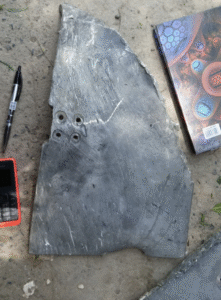
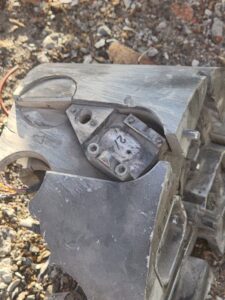
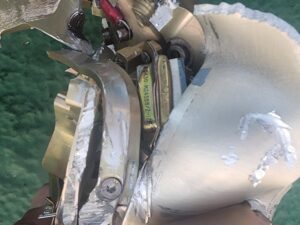
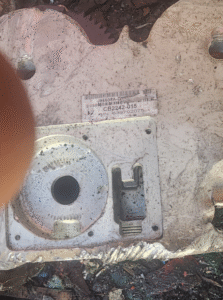
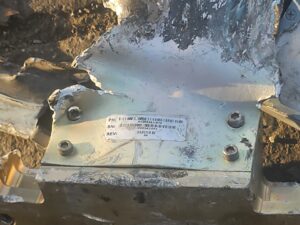
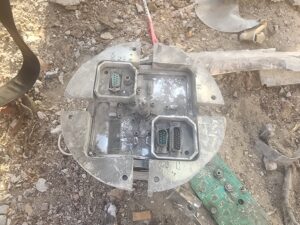
This image shows a remnant of the tail actuation section of a SPICE 250 guided bomb. The control fins are normally attached to this section, and the attachment point for one control fin is visible. (ARES)
Analyst Note
14 July 2025
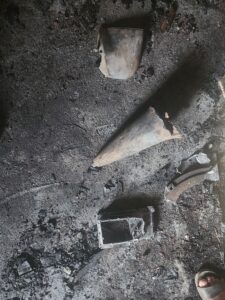
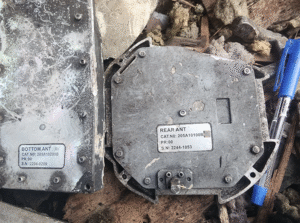
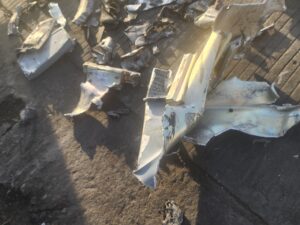
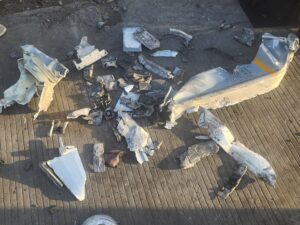
This image shows a variety of remnants from an Israeli SPICE 250 guided bomb. One of the bomb’s four control fins is visible at the bottom-left of the image. (ARES)
Analyst Note
14 July 2025
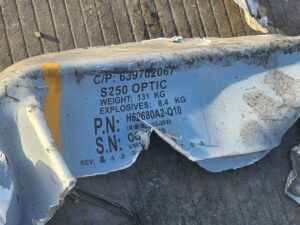
This image shows a remnant of the outer casing of the “S250 OPTIC” or SPICE 250 guided bomb, with the markings relatively intact. The markings on this remnant show that, while classified as a 250-pound bomb, the actual weight of this SPICE 250 variant is 288 pounds (131 kg) with only 18.5 pounds (8.4 kg) of explosive material. (ARES)
Analyst Note
22 June 2025
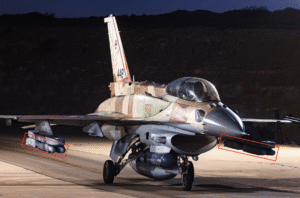
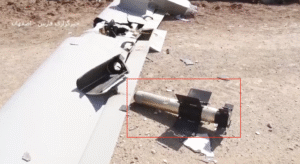
This image shows a Mikholit that was ejected from the weapons pod of an Israeli Hermes 900 drone that was downed in Iran. This Hermes 900 drone had two weapons pod, each capable of carrying 4 Mikholit bombs. (ARES)
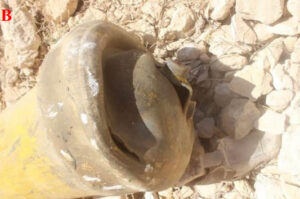
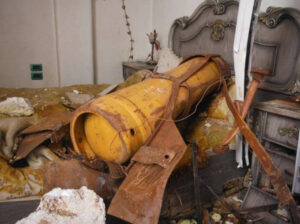
Analyst Note
19 July 2025
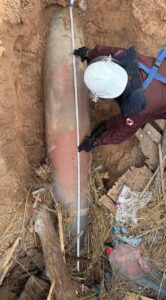
This image shows one of the two improvised air-delivered munitions (IADMs) containing a chemical payload used in an attack by the Syrian Arab Air Force on 7 April 2018 in Douma, Syria. This image shows how the IADM comprises a cradle surrounding an industrial gas cylinder. These cradles typically incorporate fins, wheels, and lifting lugs. The fins and the wheels of the cradle can be seen in this image (ARES)
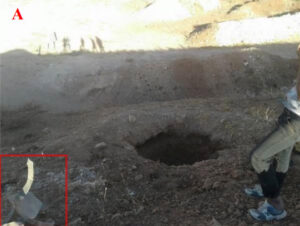
Analyst Note
19 July 2025
This image shows an impact crater, as well as remnants of the frame or ‘cradle’ (red box) that was fitted to the gas cylinder. Cradles associated with this type of Syrian Government chemical munition typically feature fins to help orient the cylinder as it falls, and features to assist with loading the cylinders into aircraft for deployment, such as wheels and lifting lugs. (ARES)
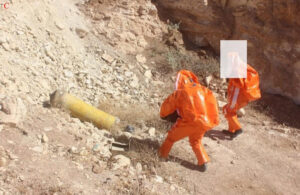
Analyst Note
19 July 2025
This image shows an industrial gas cylinder that was reportedly dropped by a helicopter over Kafr Zeita on 1 October 2016. The gas cylinder ruptured on impact with the ground, dispersing its payload of chlorine gas. (ARES)
Analyst Note
12 January 2025
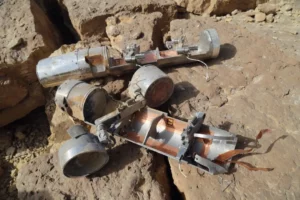
This image shows two BLU-108 submunitions. Each BLU-108 contains 4 smaller submunitions, or ‘skeets’. The BLU-108 at the top has deployed all four skeets, while the bottom example has two skeets still attached. The BLU-108 is fitted with a parachute that is deployed after the submunition separates from its dispenser (e.g., the CBU-97 Sensor Fuzed Weapon) to slow its descent, as well as a rocket motor that is thereafter fired to increase the munition’s altitude before it deploys the skeets. Each skeet is able to independently seek out targets using an infrared sensor. (ARES)


Analyst Note
3 June 2025
This image shows the largely intact Microturbo TRI-60-30 turbojet engine from a Storm Shadow/SCALP-EG missile. (ARES)
Analyst Note
26 May 2025
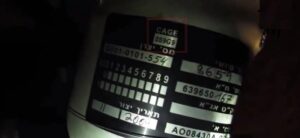
The Commercial and Government Entity (CAGE) code marked on this data plate (“0S9G9”) is a now-obsolete code assigned to Israel Aerospace Industries (IAI), the manufacturer of the Mikholit air-delivered bomb. (ARES)
Analyst Note
26 May 2025
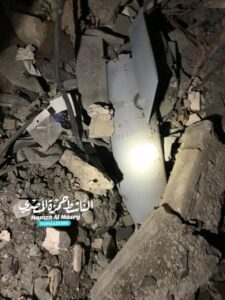
This image shows the guidance control unit from an Israeli 'Chameleon 3’ bomb guidance kit. This kit appears similar to those in the Israeli Lizard series of guidance kits, which are derived from the American-designed Paveway kit series. (ARES).
Analyst Note
26 May 2025
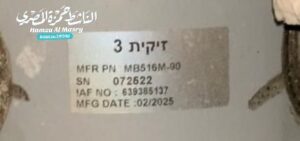
This is the data plate fitted to an Israeli Air Force bomb guidance kit. It reads “3 זִקִית” (‘Zikit 3’, or ‘Chameleon 3’ in English). As of May 2025, there is no public information available about this model of bomb guidance kit, but it appears to be a derivative or variant of the Israeli Lizard series, which are derived from the American Paveway bomb guidance kit. (ARES)