



101–200 of 574
Current Filter
Unguided Munition
Munitions incapable of altering their flight path once fired, instead following a relatively predictable trajectory (typically a ballistic trajectory). Unguided munitions are generally less precise, and cheaper, than guided alternatives.
Analyst Note
8 December 2025
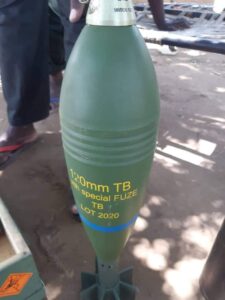
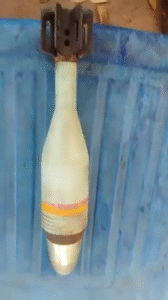
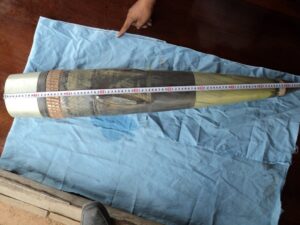
This image shows a ‘120mm TB’ air-delivered bomb that has been adapted from a 120 mm mortar projectile. It is claimed by the manufacturer that this thermobaric munition offers improved fragmentation and blast effects when compared with standard (high explosive) 120 mm mortar projectiles. The “with special FUZE” marking refers to the use of the UT M18 impact fuze. Note that this munition cannot be fired from a mortar, despite the munition body showing features consistent with this use (e.g., gas-check bands). Instead of a standard mortar projectile tailboom which would contain an ignition cartridge and be perforated by flash holes, this munition is fitted with a simplified, plastic tailfin assembly that is designed to stabilise the munition as it falls after being released by a UAV. (ARES)
Analyst Note
28 November 2025
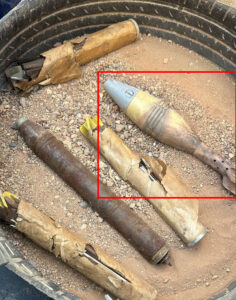
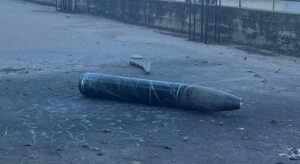
The physical features of this munition indicate that it is most likely an Iranian 60 mm ‘high explosive, long-range’ (“H.E. L.R.”) mortar projectile fitted with an AZ111A2 impact fuze. However, positive identification cannot be made based on the source imagery. (ARES)
Analyst Note
28 November 2025
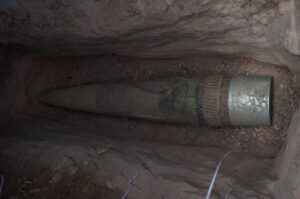
The munition depicted in this image is a type of aerodynamically optimised artillery projectile, in this case 155 mm in calibre, known as an ‘Extended Range Full-Bore (ERFB)’ design. This example is a cargo projectile fitted with a base-bleed (BB) base unit to further extend its range. This configuration is designated NR269, and reportedly contains 56 M46 dual-purpose (anti-personnel/anti-armour) submunitions. (ARES)

Analyst Note
28 November 2025
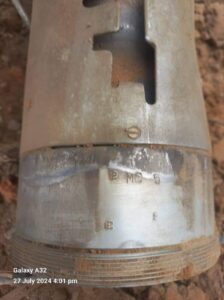
This image shows the base of a 155 mm Extended Range Full-Bore (ERFB) projectile, fitted with either a base-bleed (BB) or a base-bleed, rocket-assisted (BB/RA) base unit. Although munitions of this type are capable of carrying submunitions and this image is associated with an incident about which claims of cluster munitions use have been made, there is not enough of the projectile visible in the source images to determine what type of payload was carried by this particular round. (ARES)
Analyst Note
28 November 2025
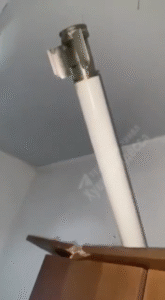
This image shows the rear section of a Hydra-70 rocket. The Hydra-70 uses the MK 66 series of rocket motors, visible here, but can be fitted with at least 11 different warheads. They can also be fitted with the Advanced Precision Kill Weapon System (APKWS) ‘bolt-on’ guidance kit, converting an unguided rocket into a guided missile. From the available imagery, it is not clear with which warhead or guidance section this munition may have been fitted. (ARES)
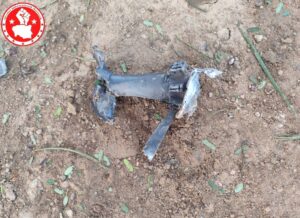
Analyst Note
28 November 2025
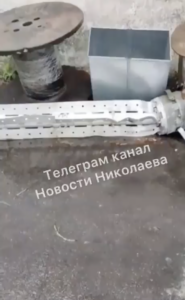
This image shows the venturi and tailfin assembly from a 57 mm S-5 series rocket. The S-5 series of rockets are commonly used around the world in a variety of roles, including air-to-surface and surface-to-surface. Unfortunately, from this image alone the specific model and country of origin cannot be determined. (ARES)
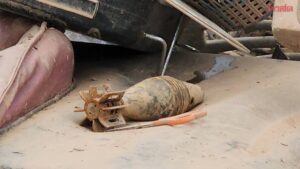
Analyst Note
28 November 2025
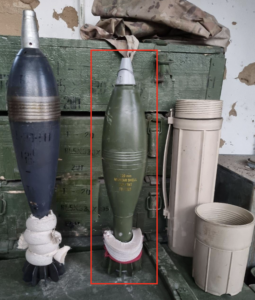
This image shows an M49-series 60 mm high explosive (HE) mortar projectile, or a copy thereof. Due to the state of the round the available imagery, the specific model or variant cannot be determined. The fuze is also not clearly visible. Most M49 mortar projectiles use an M525, M717, M935, or similar point-detonating (PD) fuze. (ARES)
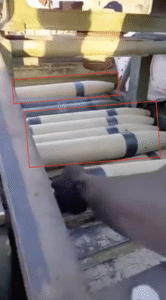
Analyst Note
28 November 2025
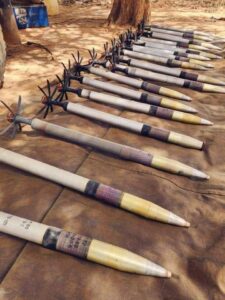
This image shows several 107 mm rockets of the Type 63 pattern. Whilst developed by China, munitions of this design are now produced by several countries around the world, including Iran, North Korea, and Sudan. The state-owned Military Industry Corporation (MIC) of Sudan produces a copy of the Type 63 known as the TAKA-01, TAKA-1, or TAKA-107. (ARES)

Analyst Note
28 November 2025
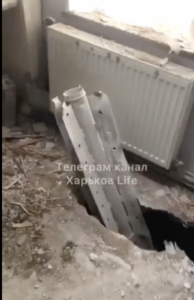
Based on the tail-fin assembly design and relative size, the item pictured appears to be a 122 mm rocket. However, it is unclear if this image shows a Russian 9M22-series (‘Grad’) rocket, a Chinese Type 81 rocket, or a similar variant from a different country of origin. (ARES)
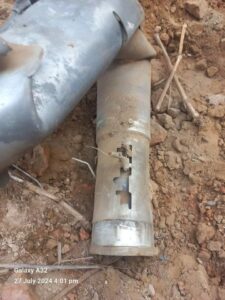
Analyst Note
28 November 2025
This images appears to show the remnants of a 122 mm rocket. It is unclear what the country of origin is, but it is most likely a 9M22-series or Type 81-series rocket. (ARES)
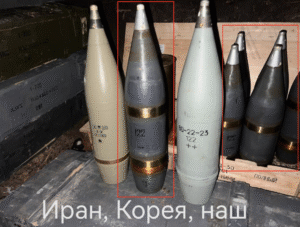
2 Analyst Notes
28 November 2025
This image shows 122 mm high explosive (HE) artillery gun projectiles manufactured in three different states, L–R: Iran, North Korea, and Russia. Whilst these examples are distinct from one another—particularly in coloration, as well as the presence or absence of paint over the driving band and bourrelet—this is not always the case, and a combination of physical features and markings should be assessed before identification is made. (ARES)
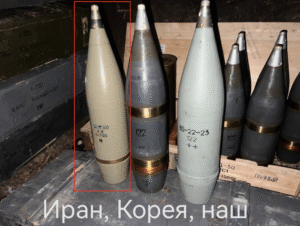
2 Analyst Notes
25 November 2025
This image shows 122 mm high explosive (HE) artillery gun projectiles manufactured in three different states, L–R: Iran, North Korea, and Russia. Whilst these examples are distinct from one another—particularly in coloration, as well as the presence or absence of paint over the driving band and bourrelet—this is not always the case, and a combination of physical features and markings should be assessed before identification is made. (ARES)
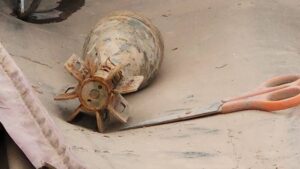

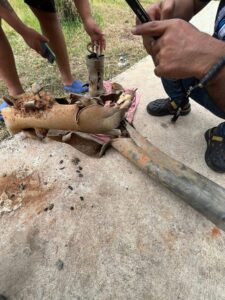


Analyst Note
19 September 2025
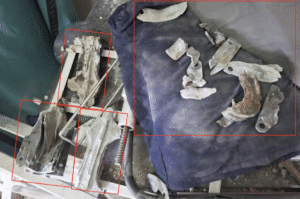
This image shows parts from at least three fin-stabilised tank gun projectiles, including the tail assemblies and several folding fins. These are components that often survive relatively intact following the functioning of such munitions. The specific morphology of the remnants pictured is consistent with Israeli 120 mm tank gun projectiles. Contextual information suggests that the remnants are most likely to be from M339 high explosive ‘multi-purpose’ projectiles. (ARES)
Analyst Note
15 September 2025
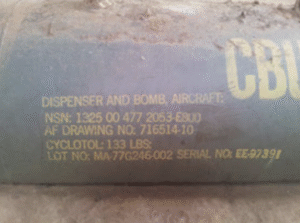
This image shows markings on an SUU-30H/B dispenser which comprises part of a CBU-52B/B Cluster Bomb Unit, including a National Stock Number (“NSN 1325 00 477 2053-E800”), design reference (“AF DRAWING NO: 716514-10”), total explosive weight of the submunitions (“CYCLOTOL: 133 LBS:”), lot number (“LOT NO: MA-77G246-002”), and serial number (“SERIAL NO: EE-97391”). This lot number indicates that this CBU-52B/B was manufactured at the Milan Army Ammunition Plant in the U.S. in July 1977. (ARES)
Analyst Note
15 September 2025
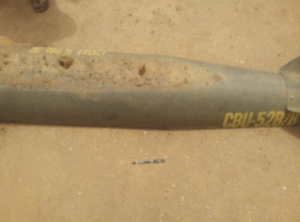
This image shows part of an SUU-30H/B dispenser (cargo munition) that comprises part of the CBU-52B/B ‘Cluster Bomb Unit’. A CBU-52B/B comprises a SUU-30H/B dispenser that is loaded with 217 BLU-61A/B anti-personnel submunitions. (ARES)
Analyst Note
15 September 2025
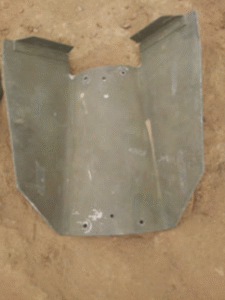
This image shows one of two tail fin sections that are attached to an SUU-30H/B air-delivered dispenser (cargo munition). Similar tail fins are used in other variants of the SUU-30 series dispensers. The SUU-30H/B can be used in various ‘Cluster Bomb Units’ including variants of the CBU-52, CBU-58, and CBU-71 munitions. (ARES)
Analyst Note
15 September 2025
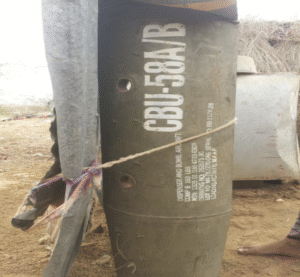
This image shows a remnant of an SUU-30H/B air-delivered dispenser (cargo munition), that comprised a CBU-58A/B ‘Cluster Bomb Unit’ (CBU). The CBU-58A/B carries 650 BLU-63A/B anti-personnel submunitions, that have a total explosive weight of 163 lbs (~74 kg) of COMP B explosive; this is reflected in the visible markings. (ARES)
Analyst Note
15 September 2025
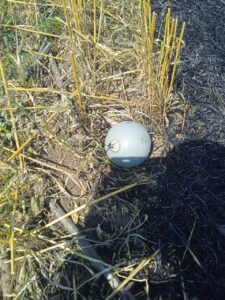
This image shows a Russian spherical submunition of unknown designation. Whilst this specific example was delivered by a cluster munition variant of the Kh-59MK2 missile, this submunition is known to also be delivered by variants of the Kh-69. A similar, but different, spherical submunition is delivered by some variants of the Kh-101. (ARES)
Analyst Note
19 July 2025
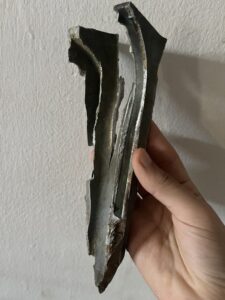
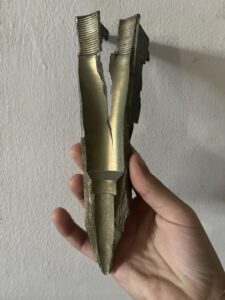
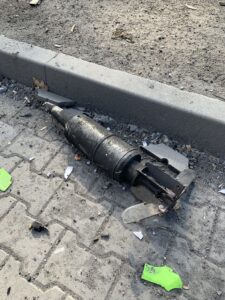
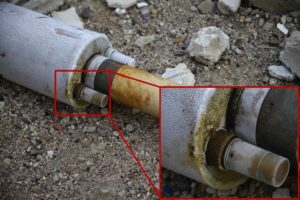
This image shows a improvised rocket-assisted munition (IRAM). This particular munition consists of a 107 mm rocket motor with an industrial gas cylinder fitted in place of the standard warhead. The frost present on the cylinder indicates a pressurised gas was released. The yellow–green residue is consistent with a payload of chlorine gas. (ARES)
Analyst Note
19 July 2025
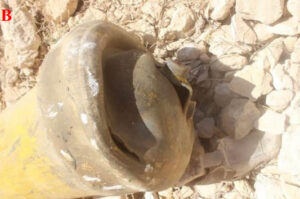
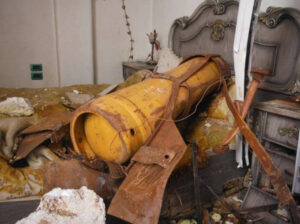
This image shows one of the two improvised air-delivered munitions (IADMs) containing a chemical payload used in an attack by the Syrian Arab Air Force on 7 April 2018 in Douma, Syria. This image shows how the IADM comprises a cradle surrounding an industrial gas cylinder. These cradles typically incorporate fins, wheels, and lifting lugs. The fins and the wheels of the cradle can be seen in this image (ARES)
Analyst Note
19 July 2025
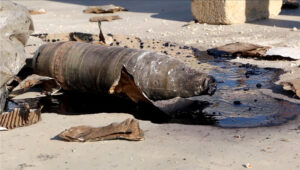
This image shows a conventional 122 mm high explosive artillery projectile that has been modified to carry a chemical payload. It is one of several used in an attack by the so-called ‘Islamic State’ on the town of Marea, Syria. The black substance on the ground is suggestive of low-purity sulphur mustard, a chemical warfare agent. (ARES)
Analyst Note
19 July 2025
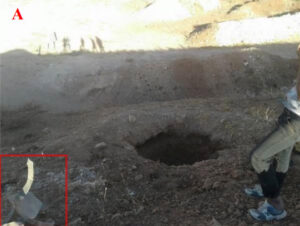
This image shows an impact crater, as well as remnants of the frame or ‘cradle’ (red box) that was fitted to the gas cylinder. Cradles associated with this type of Syrian Government chemical munition typically feature fins to help orient the cylinder as it falls, and features to assist with loading the cylinders into aircraft for deployment, such as wheels and lifting lugs. (ARES)
Analyst Note
19 July 2025
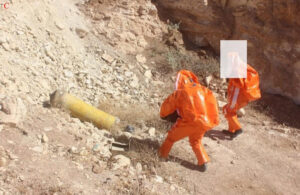
This image shows an industrial gas cylinder that was reportedly dropped by a helicopter over Kafr Zeita on 1 October 2016. The gas cylinder ruptured on impact with the ground, dispersing its payload of chlorine gas. (ARES)
Analyst Note
19 July 2025
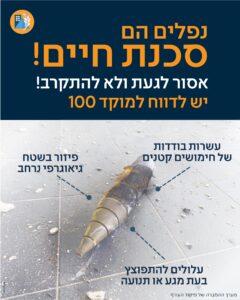
This image shows a unexploded Iranian submunition pictured in an awareness poster made by the Israel Defense Forces (IDF) Home Front Command. The poster warns people to not touch or disturb the submunition. The IDF reported that about 20 of these submunitions were deployed by a single Iranian ballistic missile, spreading over a radius of 8 kilometres. (ARES)
Analyst Note
19 July 2025
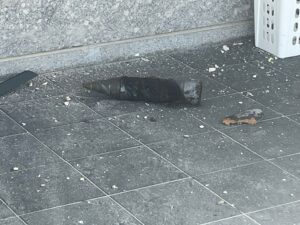
This image shows an unexploded submunition that was deployed by an Iranian medium-range ballistic missile over Israel. Inert variants of these submunitions were previously observed in an Iranian city following a failed missile test. (ARES)
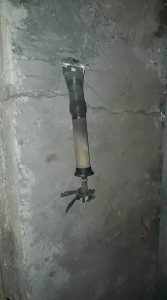
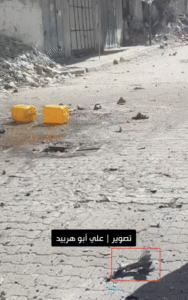
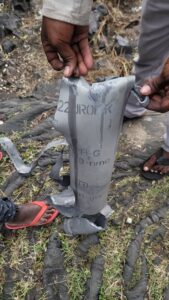
Analyst Note
27 May 2025
The JROF and JROF-K are Czech derivatives of the Soviet 122 mm ‘Grad’ series of surface-to-surface rockets. The JROF-K is the shorter, reduced-range variant, broadly analogous to the Soviet 9M22M. (ARES)
Analyst Note
30 April 2025
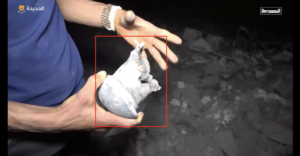
This image shows a MXU-735 solid nose plug that can be installed in the nose fuze well of a MK 80-series aerial bomb in place of a fuze. (ARES)
Analyst Note
20 March 2025
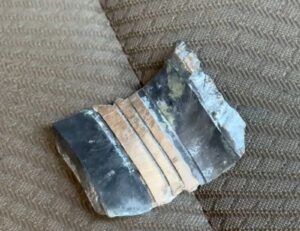
This image shows a fragment of an Israeli 120 mm tank gun projectile, with its distinctive obturating band configuration. The additional remnants shown in the related OSMP entry permit distinguishing this projectile from other potential Israeli models, identifying it as the M339 tank gun projectile. (ARES)
Analyst Note
9 January 2025
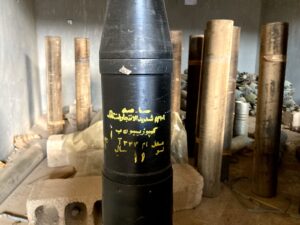
This image shows an Iranian M344 106 mm recoilless gun projectile. The M344 is a high explosive anti-tank (HEAT) munition, containing a shaped charge that is designed to penetrate armour. (ARES)



Analyst Note
29 January 2025
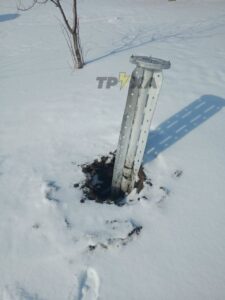
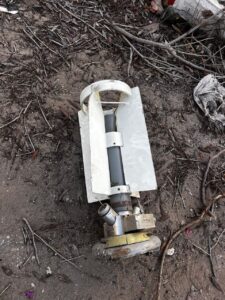
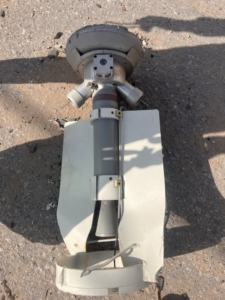
This image shows the functioned rocket motor of an Israeli Carpet rocket. The Carpet uses a fuel-air explosive (FAE) warhead which is designed to function mines and improvised explosive devices (IEDs), clearing a target area for the advance of friendly forces. These rockets are fired from the Carpet rocket launcher, which is loaded with up to 20 rockets and can be fitted to a variety of vehicles. (ARES)
Analyst Note
16 January 2025
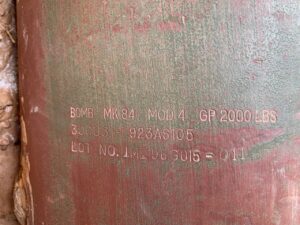
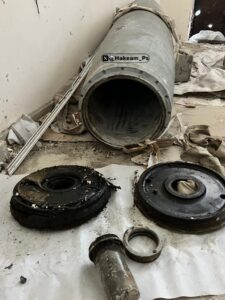
This image shows a MK 84 2,000-pound bomb that has had its fuze and baseplate removed in order to access the explosive filler. The fuze, fuze retaining ring, and baseplate can be seen on the white sheet.
The explosive material used to fill the bomb has been removed, possibly to be repurposed in improvised explosive devices or craft-produced munitions. Unexploded ordnance is often ‘harvested’ for these purposes. (ARES)
Analyst Note
17 December 2024
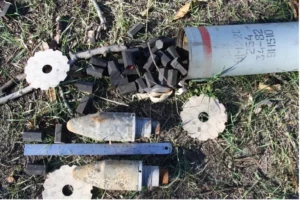
This image shows a 9M22S rocket with some of its unfunctioned payload of 180 ML-5 incendiary elements. Each ML-5 is a hexagonal prism formed from a hollow shell of magnesium that is filled with an incendiary composition. These elements are ignited by the ejection charge of the rocket’s warhead upon functioning. Two fuzes are also visible at the bottom of the image, immediately above and below the ruler. (ARES)
Analyst Note
9 January 2025
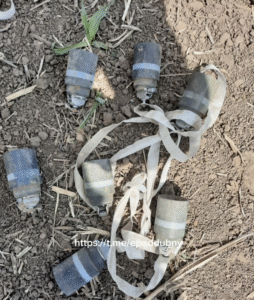
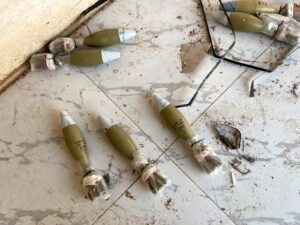
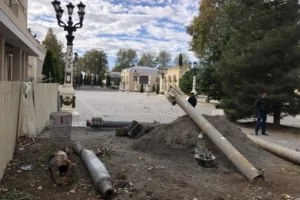
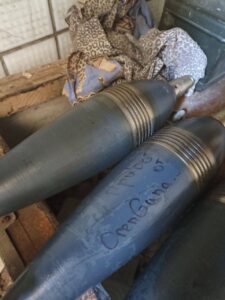
This image shows three North Korean 120 mm high explosive (HE) mortar projectiles. (ARES).
Analyst Note
9 January 2025
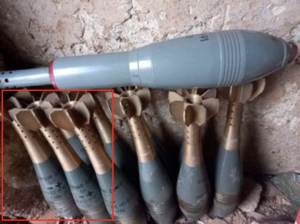
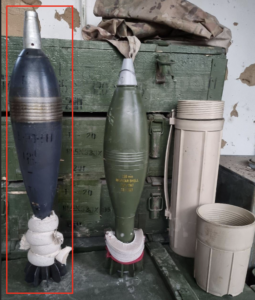
This image shows a North Korean 120 mm high explosive (HE) mortar projectile next to an Iranian 120 mm HE mortar projectile. Despite both being the same calibre, the overall shapes and dimensions of the two projectiles are noticeably different. Factors such as payload weight and range can be affected significantly by projectile shape. (ARES)

Analyst Note
12 January 2025
The ZAB-250-200 (ЗАБ-250-200) unguided air-delivered bomb is loaded with 48 kg of a napalm-like thickened incendiary mixture, 8 kg of cotton scraps soaked in kerosene (paraffin), and 4 kg of pyrotechnic composition to aid with ignition. (ARES)
Analyst Note
17 December 2024
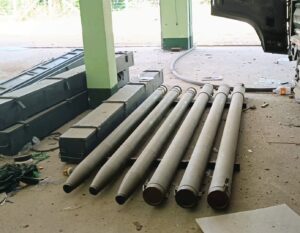
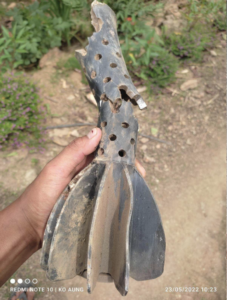
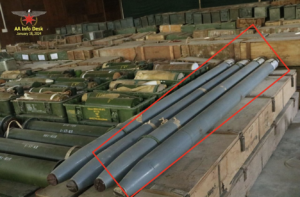
Whilst there are no visible markings explicitly identifying the model of the 122 mm rockets in this image, they are sitting atop a box marked “R-122” and exhibit physical features consistent with North Korean R-122 rockets. It should be noted that rockets marked with the generic “R-122” model name have been observed in both ‘long’ and ‘short’ overall lengths and painted in different colours. (ARES)
Analyst Note
17 December 2024
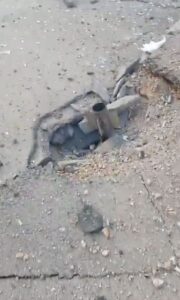
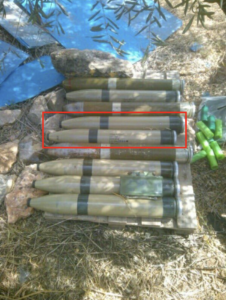
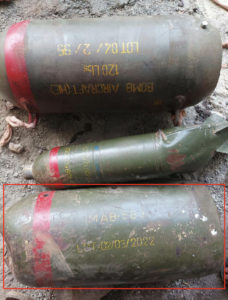
Whilst relatively little is known about Burmese air-delivered bombs from publicly available sources, researchers (including those at ARES and Myanmar Witness) have been collecting evidence based on munitions’ physical features and markings. Combined with information from confidential sources, this has allowed for the tentative identification of several models. (ARES)