
Do not approach munitions
under any circumstances
Country or territory where the image was reported

Reported Location (52)

A large country in the Middle East experiencing ongoing violence

Iraq
The areas internationally recognised as the basis of a future independent Palestinian state

Palestinian Territories
A large country in the Middle East experiencing civil war since 2011
Syria
Year the image is reported to have been taken

Year (22)

Classification groups of key explosive munitions used in conflicts

Munition Category (8)

The impact or effect the munition is intended to have

Functional use (10)

The specific model of munition pictured

Tentative Model (346)

Search

The external organisation that documented the munition

Research Organisation (6)

Colour of the munition pictured

Base Colour (12)

Colour of all, or some, of the markings on the munition

Marking Colour (11)

Language or script of the marking on a munition

Marking Script (10)

Condition of the munition pictured

Condition (6)

Key features defining the operation mechanisms of a projectile

Mechanical Feature (10)

Whether a munition is guided or unguided

Guidance (2)

Where the munition is launched from and what it targets

Domain (7)

The type of fins visible on the munition

Fins Characteristic (6)

The nominal diameter of a projectile. For most modern munitions, this is expressed in millimetres (e.g. 82 mm mortar projectile), but older artillery gun projectiles may be described in inches.

Calibre (77)

Weight class of the aerial bomb pictured

Weight Class (14)

1–100 of 378

Current Filter

Iraq
A large country in the Middle East affected by conflict since a 2003 US-led invasion to overthrow dictatorial President Saddam Hussein. Since 2013 the Iraqi military, with the military support of a US-led Coalition, has fought the so-called Islamic State, while conflict between often sectarian militias continues. Turkey also conducts regular strikes against Kurdish militants in northern Iraq.

Current Filter

Palestinian Territories
The areas internationally recognised as the basis of a future independent Palestinian state, primarily the West Bank, east Jerusalem and the Gaza Strip. Israel has fought multiple wars with the Hamas militant group, which controlled Gaza.

Current Filter

Syria
A large country in the Middle East experiencing civil war since 2011. During that time multiple nations have directly or indirectly supported differing sides, with airstrikes conducted by the United States, Russia, Turkey, Israel and others.
OSMP2355
Analyst Note:
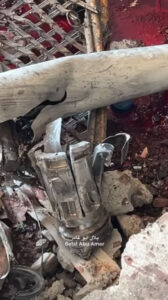
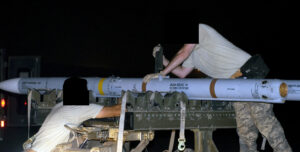
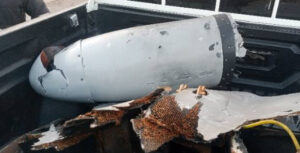
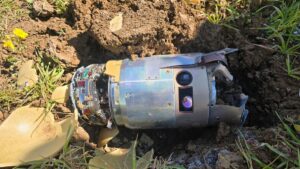
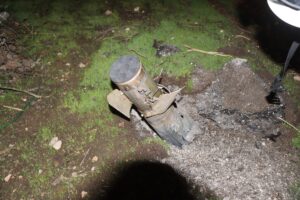
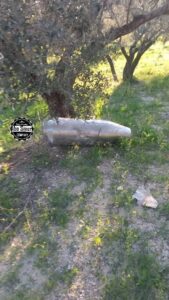
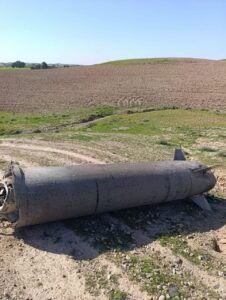
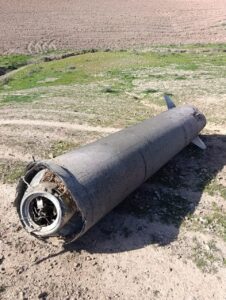
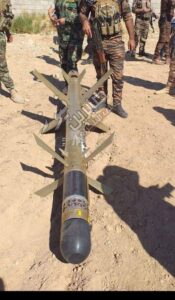
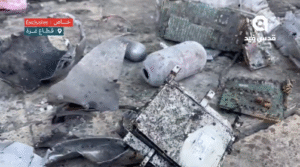
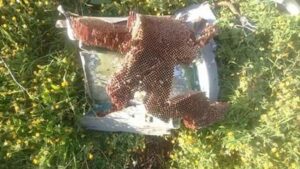
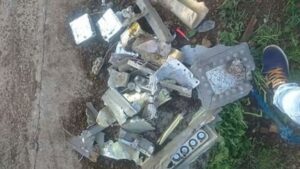
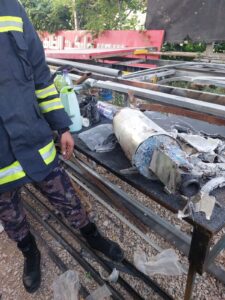
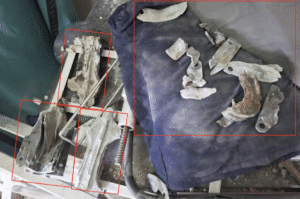
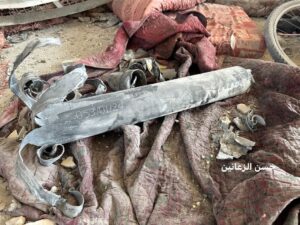
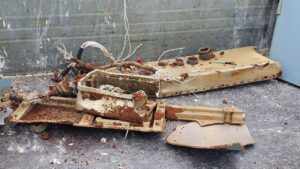
This image shows remnants of a Guided Advanced Tactical Rocket (GATR) alongside the remnants of a Hydra-70 series rocket. Developed and produced by Elbit Systems of Israel, GATR adds advanced capabilities, including guidance, to ‘dumb’ Hydra-70 rockets, in similar fashion to the U.S. APKWS system. GATR replaces the fins typically found in Hydra-70 series rockets with those of a new design. (ARES)
OSMP2361
Analyst Note:
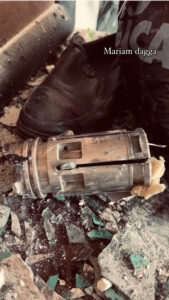
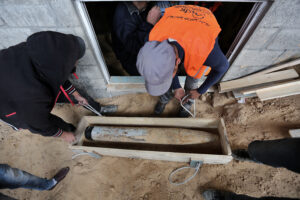
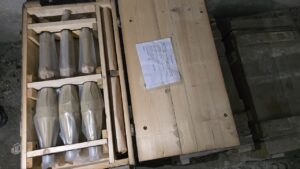
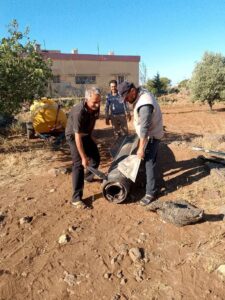
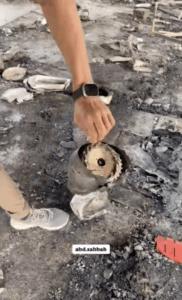
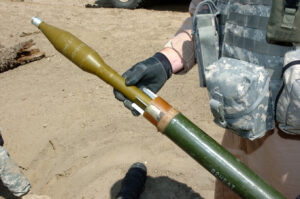
This image shows a Chinese Type 70-series rocket being removed from its launch tube. The example in the picture is a high explosive anti-tank (HEAT) variant likely designed for export; other Type 70 HEAT variants are known, as is a bounding high explosive fragmentation (HE/FRAG) variant. This family of rockets is fired from the Type 70 and Type 70-1 shoulder-fired launchers. The each rocket is contained in a disposable launch tube which is attached to the rear of the launcher and discarded after firing. (ARES)
OSMP2328
Analyst Note:
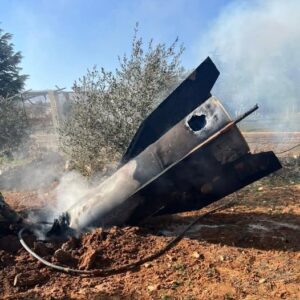
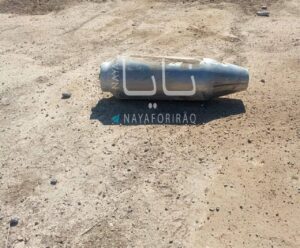
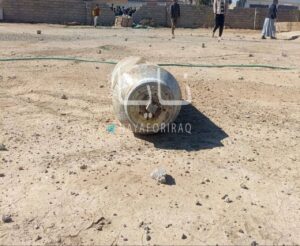
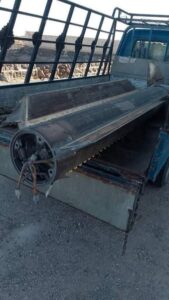
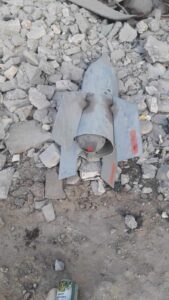
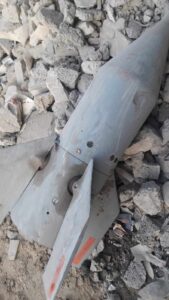
From early 2026, rockets marked “KP-M-112mm” began appearing in media reports from Syria. The manufacturer and country of origin of these is not yet known. Visually, these munitions closely resemble the Chinese Type 63 family of rockets (which includes the Iranian FAJR 1, often seen in Syria). However, the markings indicate an apparent 112 mm diameter, which is larger than the 107 mm of the Type 63 family. There are other, minor differences in construction that are externally visible. (ARES)
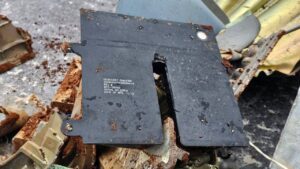
OSMP2186
Analyst Note:
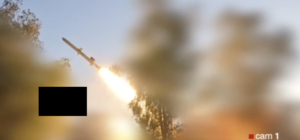
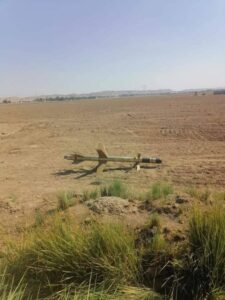
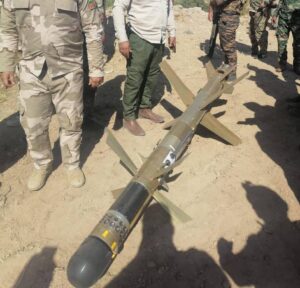
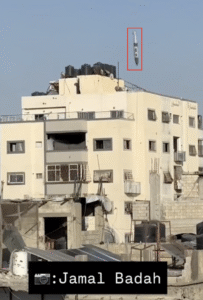
This image shows the launch of an Iranian Paveh surface-to-surface cruise missile in Iraq. The munition was fired by Iranian proxy forces and reportedly targeting Israel. Some sources indicate the Paveh has been renamed the ‘Jamal-10’, whilst others claim it is being locally produced in Iraq by Iranian proxy forces. With an estimated 75% of the missile’s components coming from outside Iran, distributed production is certainly possible. The missile has two large wings located forward of the munition’s midpoint, three smaller fins towards the tail, and four actuated fins around the tail. The initial launch is accomplished with a solid-propellant rocket motor, which gives way to a turbo jet flight motor mounted on top of the missile, towards the tail. (ARES)
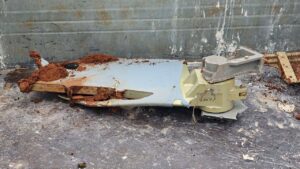
OSMP2257
Analyst Note:
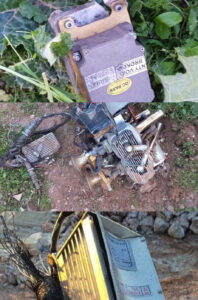
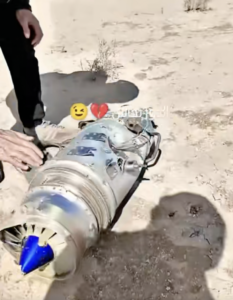
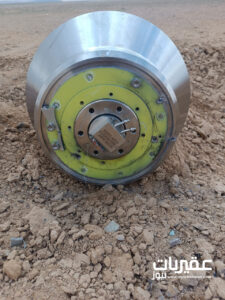
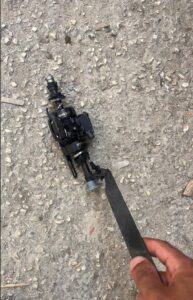
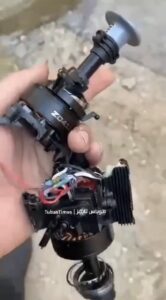
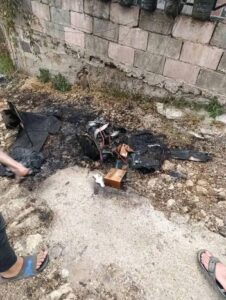
The component pictured here is a small turbofan engine from a Tomahawk missile. Missiles are vertically launched from the Typhon Missile System (named for a monster of Greek mythology), which is also capable of launching the Standard SM-6 guided missile. The Tomahawk missile is ejected from its launch tube under gas pressure, then the solid propellant of the booster motor section (Mk 135 booster produced by L3Harris) propels the missile until the turbofan engine (F107-WR-402 for Block III/IV or F415 for Block IV/V, both produced by Williams International) in the propulsion section is initiated and the booster motor section drops away. The propulsion section also supports the four tail fins, which are released by the two-piece continuity shroud upon launch. (ARES)
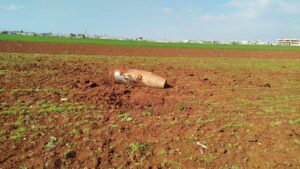
OSMP1837
Analyst Note:
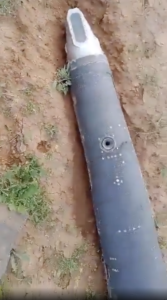
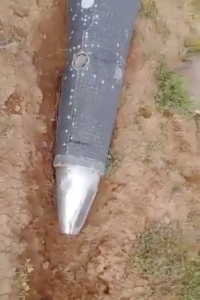
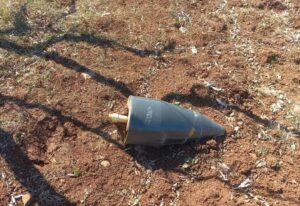
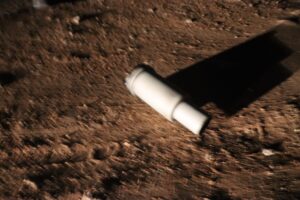
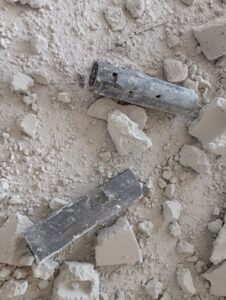
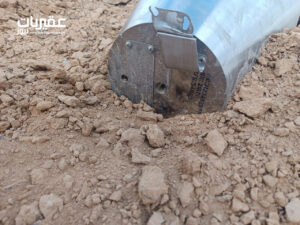
Considered with additional contextual materials, it is assessed that this image shows the rocket motor section from a 122 mm incendiary rocket, specifically the 9M22S or 9M28S models. Both rockets carry the same warhead, but use rocket motors of different lengths; not enough of this motor is visible to positively identify the model. (ARES)
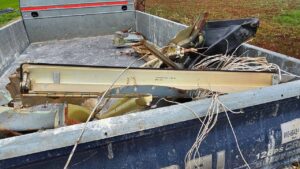
OSMP1835
Analyst Note:
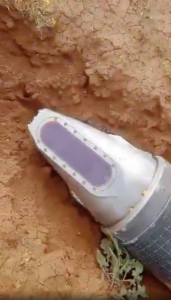
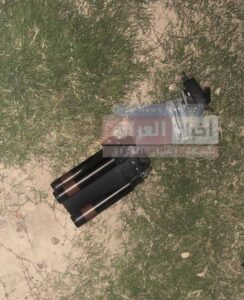
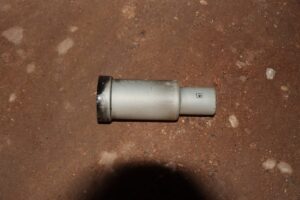
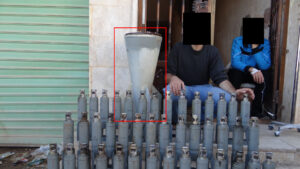
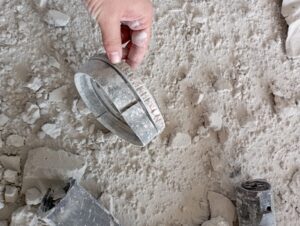
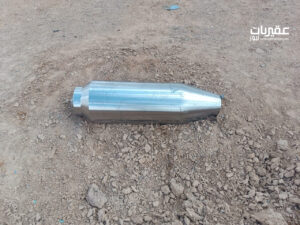
This image shows a stepped component positioned at the front of the warheads carried by 122mm 9M22S and 9M28S incendiary rockets. This structure helps to push the ML-5 incendiary elements out of the rear of warhead once the fuze in the nose functions. It is a relatively distinctive component, and commonly found in the vicinity of where the incendiary elements fall. (ARES)

OSMP2024
Analyst Note:
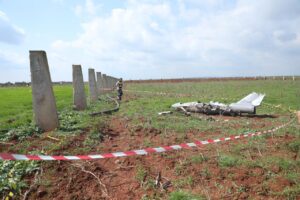
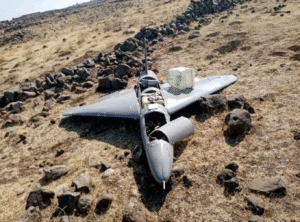
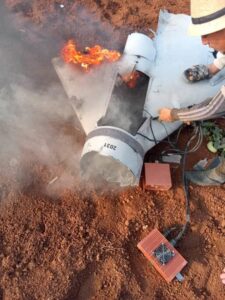
This image shows a Low-Cost Unmanned Combat Attack System (LUCAS). The LUCAS one-way attack UAV is a U.S.-made, cost-effective ‘kamikaze drone’. LUCAS munitions can connect to one another via a mesh network, allowing multiple LUCAS drones to communicate in flight. The white square object connected to the munition by a cable appears to be a Starlink antenna, consistent with reported communication capabilities. Elon Musk has claimed that LUCAS operates only via Starshield, a Starlink-derived satellite network intended for government use. (ARES)
Collection

The Iran War 2026

Verified munition images from all parties to the regional conflict sparked by U.S. and Israeli strikes on 28 February, 2026

View this collection
OSMP1960
Analyst Note:
The Iranian 358 surface-to-air missile is reportedly a ‘loitering munition’, designed for engaging drones and rotary-wing aircraft. It employs a combination of ground-based and onboard thermal cameras to scan a designated area, and then uses an infrared imaging seeker in the nose to locate and lock onto targets. The missile carries a 10 kg fragmentation warhead, which is functioned by a 360-degree laser proximity sensor. (ARES)
Collection

Ірансько-ізраїльський конфлікт. Червень 2025 року

Десятки перевірених зображень боєприпасів, використаних Іраном та Ізраїлем під час конфлікту між Ізраїлем та Іраном у червні 2025 року

View this collection

Collection

Ізраїль і Газа 2023 – 2026

7 жовтня 2023 року бойовики ХАМАС прорвали міцно укріплений кордон між Ізраїлем і Сектором Газа, атакувавши численні міста і села. За повідомленнями, в Ізраїлі загинуло понад 1000 осіб, а понад 250 було взято в заручники і перевезено до Гази

View this collection
OSMP1678
Analyst Note:
In this case, the tentative identification of this munition is possible based on an analysis of its silhouette, particularly the distinctive detachable warhead compartment that can be seen hanging from the base of the munition's body. In many cases, such an identification technique would not be possible to apply with confidence. (ARES)
OSMP1381
Analyst Note:
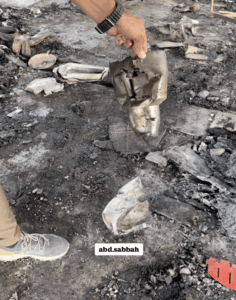
This image shows the damaged rocket motor section of a ballistic missile that was fired by the Houthis in Yemen towards Israel and likely intercepted. The Houthis employ ballistic missiles that are supplied by Iran, and given different names. In Houthi service, the Iranian Kheibar Shekan missile is known as the Hatem-2. (ARES)
OSMP1650
Analyst Note:
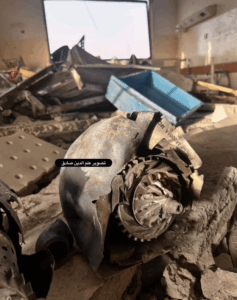
This image shows parts from at least three fin-stabilised tank gun projectiles, including the tail assemblies and several folding fins. These are components that often survive relatively intact following the functioning of such munitions. The specific morphology of the remnants pictured is consistent with Israeli 120 mm tank gun projectiles. Contextual information suggests that the remnants are most likely to be from M339 high explosive ‘multi-purpose’ projectiles. (ARES)
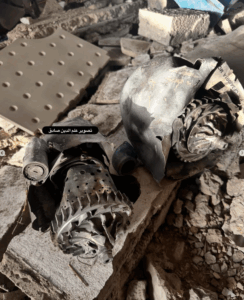
OSMP1457
Analyst Note:
This image shows an Israeli-made 122 mm rocket motor found following a strike on Amr School in Gaza City. Although it is not possible to be definitive from this image alone, it is likely that this rocket motor was part of an Israeli ‘Bar’ missile, a guided munition designed for precision strikes in urban areas that uses a 122 mm rocket motor. (ARES)
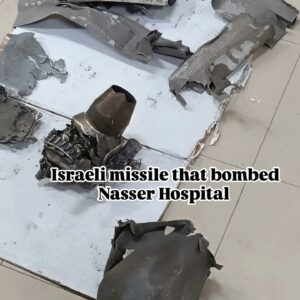
OSMP1224
Analyst Note:
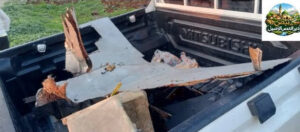
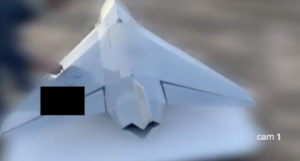
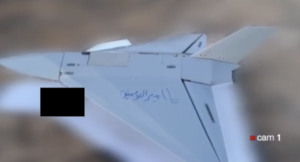
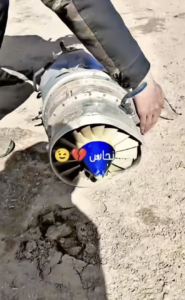
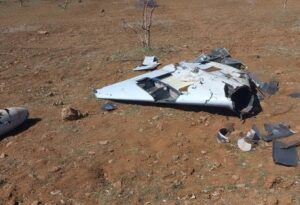
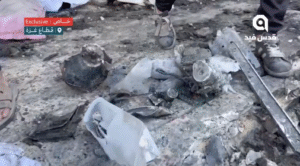
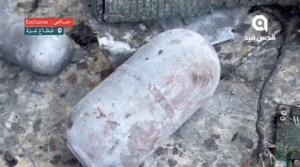
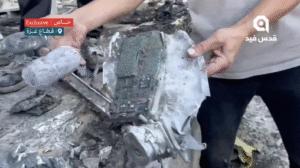
This image shows the remnants of an unknown Israeli munition that was used in a strike on Nasser hospital. Reporting on these strikes often refers to this munition as a ‘drone’. The turbojet engine, along with possible wing remnants, indicate that this could be a one-way-attack (OWA) UAV or ‘loitering munition’ missile, consistent with reporting. This same model of munition has been used multiple times in strikes in Gaza, as well as Lebanon and Syria. There is no publicly acknowledged Israeli munition that closely fits these remnants. Entries 1384, 1385, 1386, and 1389 capture other incidents in which this munition was used. (ARES)
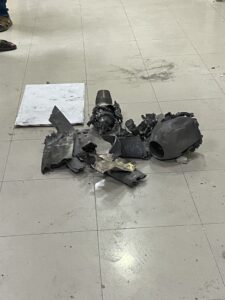
OSMP1225
Analyst Note:
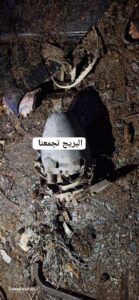
This image shows the remnants of an unknown Israeli munition that was used in a strike that hit the Nasser hospital in Gaza. The turbojet engine, along with possible wing remnants indicate that this could be a one-way attack UAV or ‘loitering munition’, consistent with some reporting on the strikes. This same model of munition has been used in multiple strikes in Gaza, as well as in Lebanon and Syria. There is no publicly disclosed Israeli munition that neatly matches these remnants. OSMP entries 1384, 1385, 1386, and 1389 show other incidents in which this munition appears to have been used. (ARES)