
1–100 of 316
Current Filter
Palestinian Territories
The areas internationally recognised as the basis of a future independent Palestinian state, primarily the West Bank, east Jerusalem and the Gaza Strip. Israel has fought multiple wars with the Hamas militant group, which controlled Gaza.

Current Filter
Syria
A large country in the Middle East experiencing civil war since 2011. During that time multiple nations have directly or indirectly supported differing sides, with airstrikes conducted by the United States, Russia, Turkey, Israel and others.

Analyst Note:
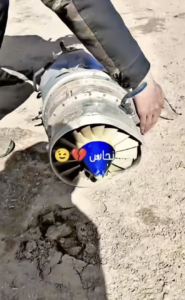
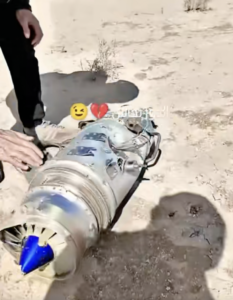
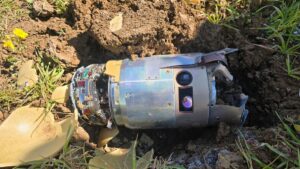
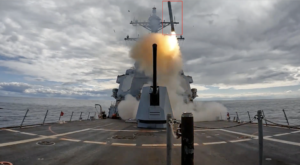
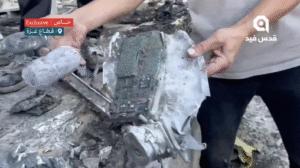
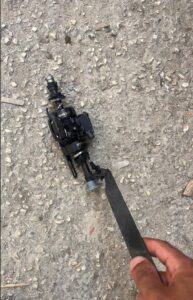
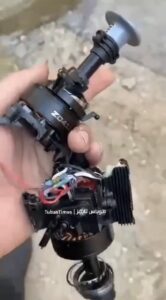
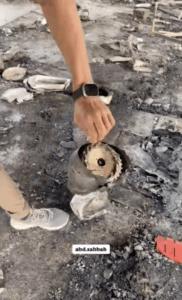
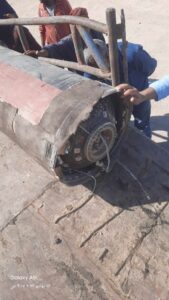
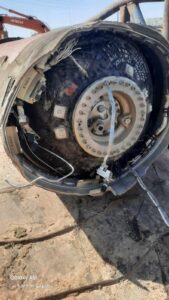
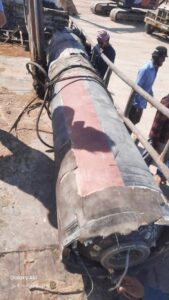
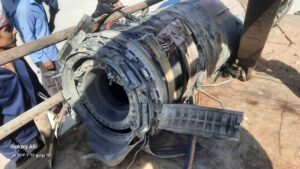
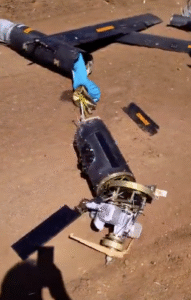
The component pictured here is a small turbofan engine from a Tomahawk missile. Missiles are vertically launched from the Typhon Missile System (named for a monster of Greek mythology), which is also capable of launching the Standard SM-6 guided missile. The Tomahawk missile is ejected from its launch tube under gas pressure, then the solid propellant of the booster motor section (Mk 135 booster produced by L3Harris) propels the missile until the turbofan engine (F107-WR-402 for Block III/IV or F415 for Block IV/V, both produced by Williams International) in the propulsion section is initiated and the booster motor section drops away. The propulsion section also supports the four tail fins, which are released by the two-piece continuity shroud upon launch. (ARES)
Analyst Note:
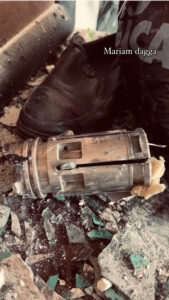
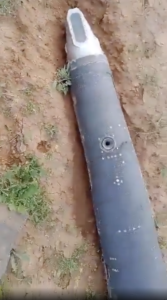
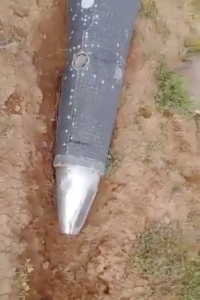
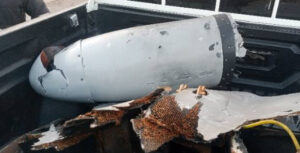
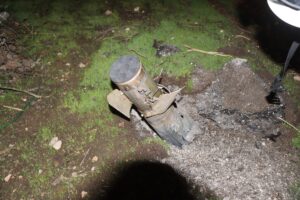
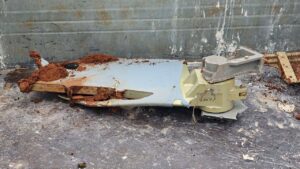
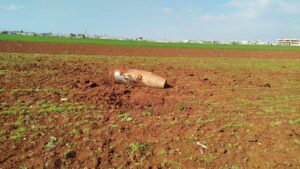
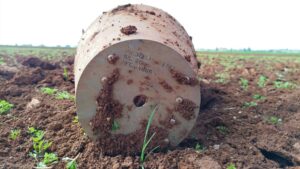
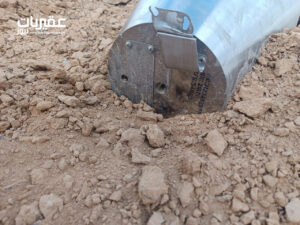
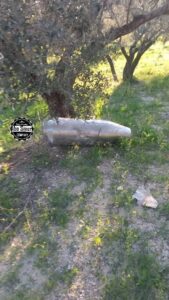
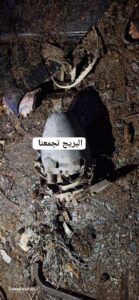
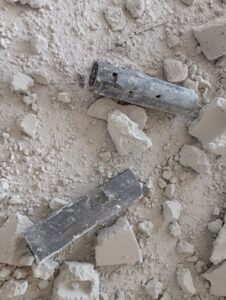
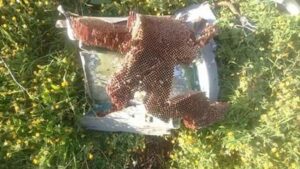
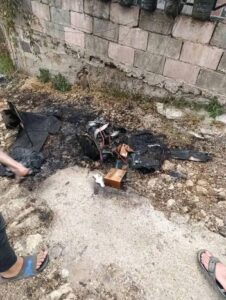
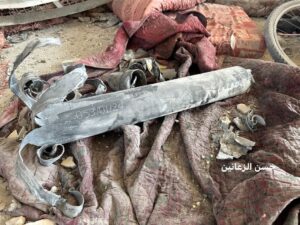
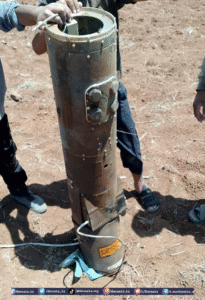
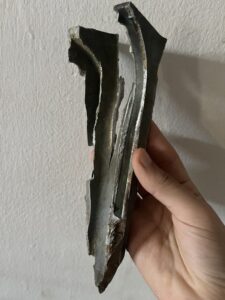
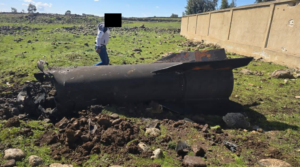
Considered with additional contextual materials, it is assessed that this image shows the rocket motor section from a 122 mm incendiary rocket, specifically the 9M22S or 9M28S models. Both rockets carry the same warhead, but use rocket motors of different lengths; not enough of this motor is visible to positively identify the model. (ARES)
Analyst Note:
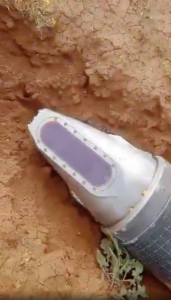
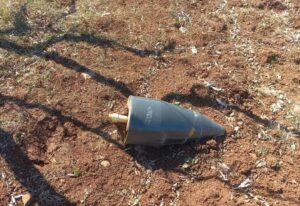
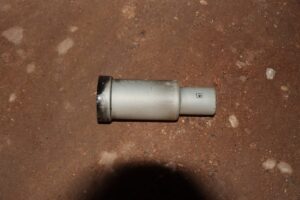
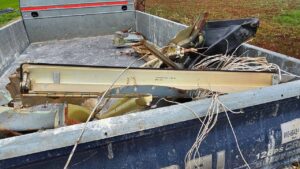
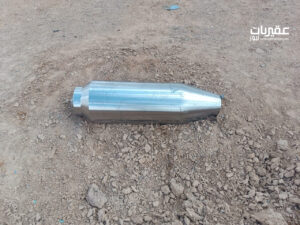
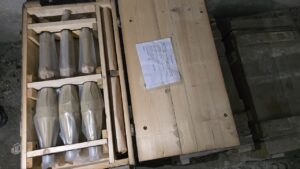
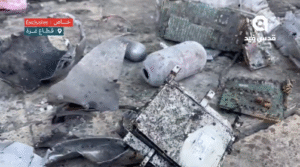
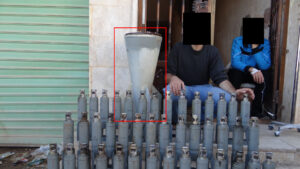
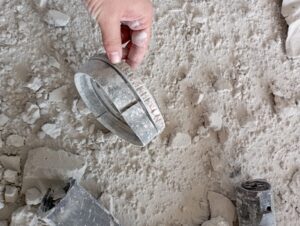
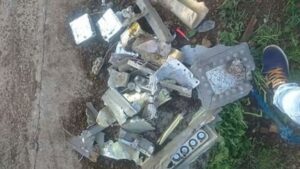
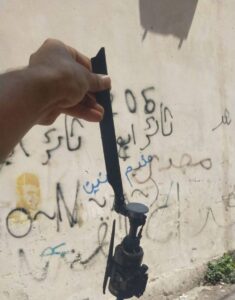
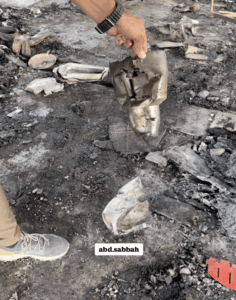
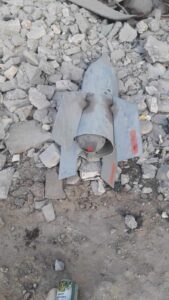
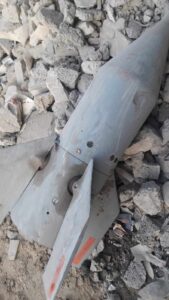
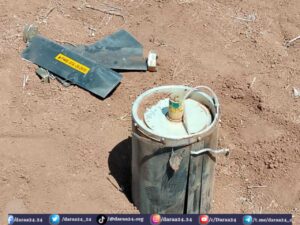
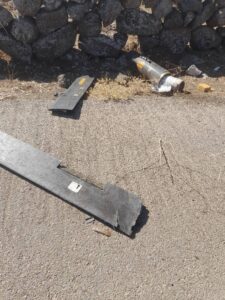
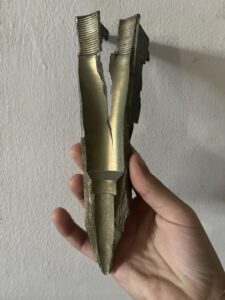
This image shows a stepped component positioned at the front of the warheads carried by 122mm 9M22S and 9M28S incendiary rockets. This structure helps to push the ML-5 incendiary elements out of the rear of warhead once the fuze in the nose functions. It is a relatively distinctive component, and commonly found in the vicinity of where the incendiary elements fall. (ARES)
Collection
The Iran War 2026
Verified munition images from all parties to the regional conflict sparked by U.S. and Israeli strikes on 28 February, 2026
Collection
Ірансько-ізраїльський конфлікт. Червень 2025 року
Десятки перевірених зображень боєприпасів, використаних Іраном та Ізраїлем під час конфлікту між Ізраїлем та Іраном у червні 2025 року
Collection
Ізраїль і Газа 2023 – 2026
7 жовтня 2023 року бойовики ХАМАС прорвали міцно укріплений кордон між Ізраїлем і Сектором Газа, атакувавши численні міста і села. За повідомленнями, в Ізраїлі загинуло понад 1000 осіб, а понад 250 було взято в заручники і перевезено до Гази
Analyst Note:
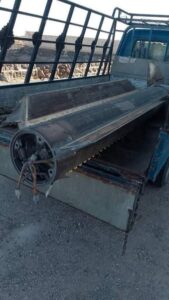
This image shows a Mk 104 Dual Thrust Rocket Motor (DTRM), the second-stage rocket motor for the SM-2, SM-3 Blk I, and SM-6 missiles. Based on the strakes or fins attached to this Mk 104, it can be determined that it was part of an SM-3 Blk I series missile. (ARES)
Analyst Note:
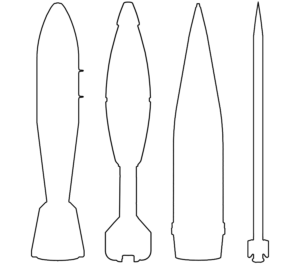
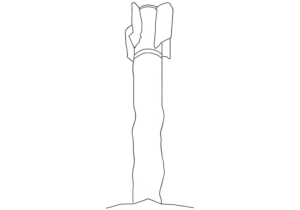
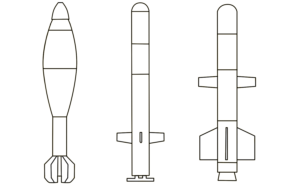
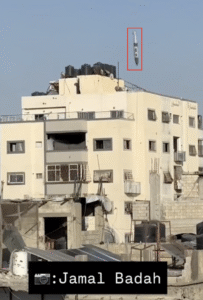
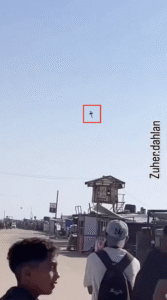
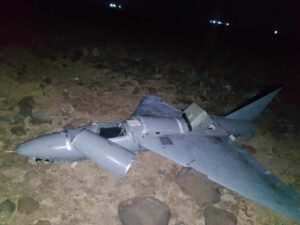
In this case, the tentative identification of this munition is possible based on an analysis of its silhouette, particularly the distinctive detachable warhead compartment that can be seen hanging from the base of the munition's body. In many cases, such an identification technique would not be possible to apply with confidence. (ARES)
Analyst Note:
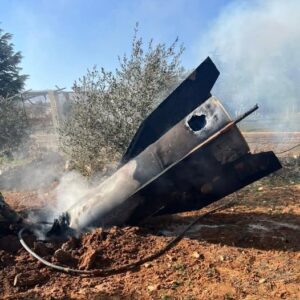
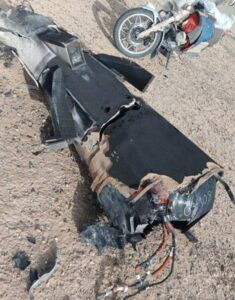
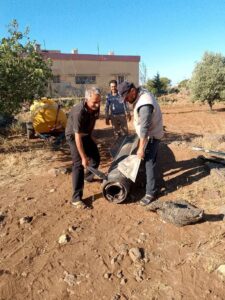
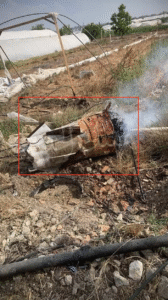
This image shows the damaged rocket motor section of a ballistic missile that was fired by the Houthis in Yemen towards Israel and likely intercepted. The Houthis employ ballistic missiles that are supplied by Iran, and given different names. In Houthi service, the Iranian Kheibar Shekan missile is known as the Hatem-2. (ARES)
Analyst Note:
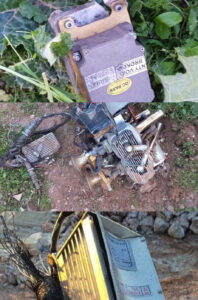
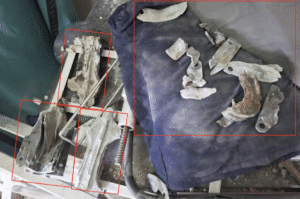
This image shows parts from at least three fin-stabilised tank gun projectiles, including the tail assemblies and several folding fins. These are components that often survive relatively intact following the functioning of such munitions. The specific morphology of the remnants pictured is consistent with Israeli 120 mm tank gun projectiles. Contextual information suggests that the remnants are most likely to be from M339 high explosive ‘multi-purpose’ projectiles. (ARES)
Analyst Note:
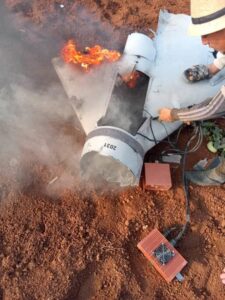
This image shows a remnant of the Mado MD550 engine which is used to power the Shahed-136 series one-way attack drone. (ARES)
Analyst Note:
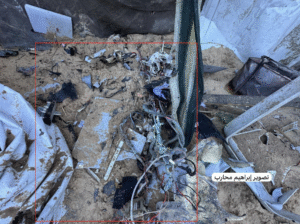
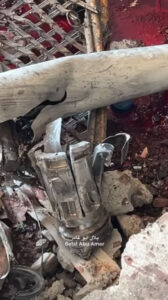
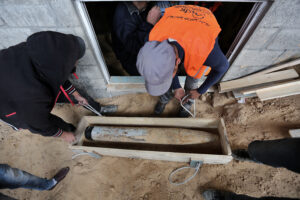
This image shows an Israeli-made 122 mm rocket motor found following a strike on Amr School in Gaza City. Although it is not possible to be definitive from this image alone, it is likely that this rocket motor was part of an Israeli ‘Bar’ missile, a guided munition designed for precision strikes in urban areas that uses a 122 mm rocket motor. (ARES)
Analyst Note:
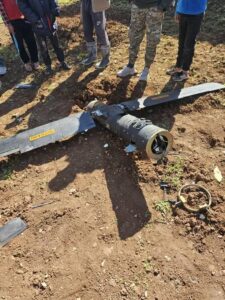
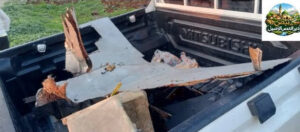
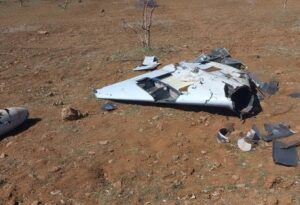
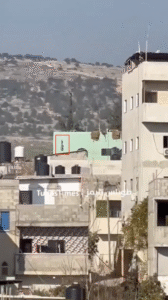
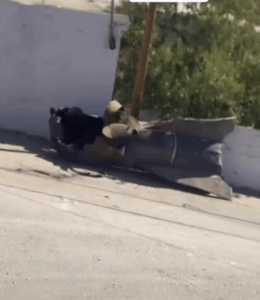
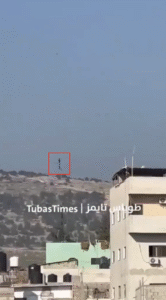
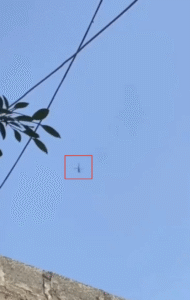
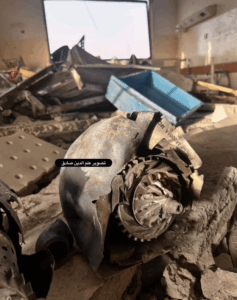
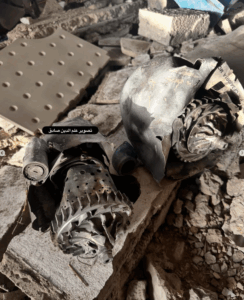
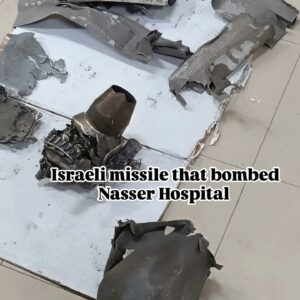
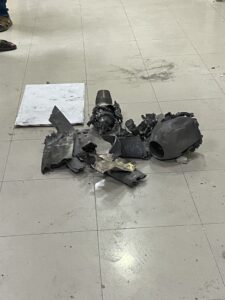
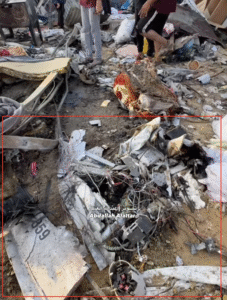
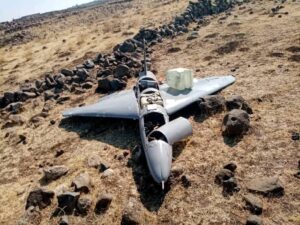
This image shows the remnants of an unknown Israeli munition that was used in a strike on Nasser hospital. Reporting on these strikes often refers to this munition as a ‘drone’. The turbojet engine, along with possible wing remnants, indicate that this could be a one-way-attack (OWA) UAV or ‘loitering munition’ missile, consistent with reporting. This same model of munition has been used multiple times in strikes in Gaza, as well as Lebanon and Syria. There is no publicly acknowledged Israeli munition that closely fits these remnants. Entries 1384, 1385, 1386, and 1389 capture other incidents in which this munition was used. (ARES)
Analyst Note:
This image shows the remnants of an unknown Israeli munition that was used in a strike that hit the Nasser hospital in Gaza. The turbojet engine, along with possible wing remnants indicate that this could be a one-way attack UAV or ‘loitering munition’, consistent with some reporting on the strikes. This same model of munition has been used in multiple strikes in Gaza, as well as in Lebanon and Syria. There is no publicly disclosed Israeli munition that neatly matches these remnants. OSMP entries 1384, 1385, 1386, and 1389 show other incidents in which this munition appears to have been used. (ARES)
Analyst Note:
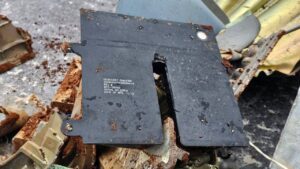
This image shows a remnant of the guidance control unit from a Paveway- or Lizard-series bomb guidance kit. The guidance control fins are marked “FOR USE ON MK82” indicating that this guidance control unit was paired with a MK 82-series 500-pound-class bomb. (ARES)
Collection
Iran-Israel conflict June 2025
Dozens of verified images of munitions used by Iran and Israel during the June 2025 Israel-Iran conflict
Analyst Note:
This image shows the top of the booster of an Arrow 3 interceptor missile, where it connects to the kill vehicle. The Arrow 3 was jointly developed by the United States and Israel, and first entered service in 2017. The date of manufacture marking (“DATE OF MFG: 05/2018”) indicates that this booster was produced in the year after the Arrow 3 first entered service. (ARES)
Analyst Note:
This image shows the booster of an Israeli Arrow 3 interceptor missile. The Arrow 3 is designed to engage ballistic missiles and is capable of exo-atmospheric interceptions. Once the booster is expended, it separates from the ‘kill vehicle’. The kill vehicle has a sustainer motor that propels it towards the incoming ballistic missile, and uses kinetic impact, rather than an explosive warhead, to disable or destroy its target. This is sometimes called the ‘hit-to-kill’ principle. (ARES)
Analyst Note:
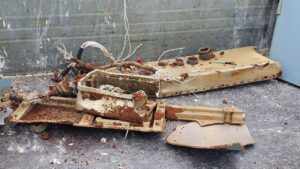
This image shows a remnant of the control section of the Arrow 2 ‘kill vehicle’, including the control fins. The blast-fragmentation warhead is located in the front section of the kill vehicle, forward of the control section, and is absent here due to the functioned state of the munition. (ARES)
Analyst Note:
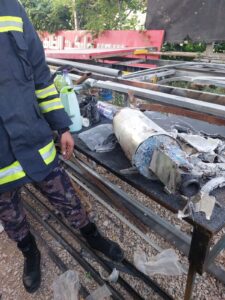
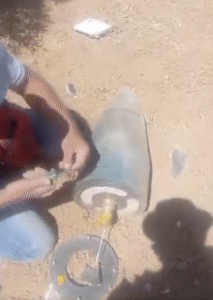
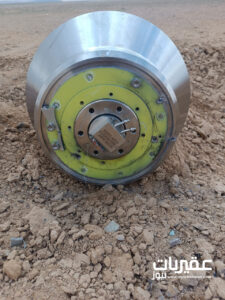
This image shows a improvised rocket-assisted munition (IRAM). This particular munition consists of a 107 mm rocket motor with an industrial gas cylinder fitted in place of the standard warhead. The frost present on the cylinder indicates a pressurised gas was released. The yellow–green residue is consistent with a payload of chlorine gas. (ARES)
Analyst Note:
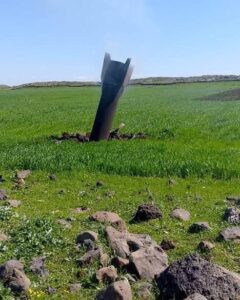
This image shows one of the two improvised air-delivered munitions (IADMs) containing a chemical payload used in an attack by the Syrian Arab Air Force on 7 April 2018 in Douma, Syria. This image shows how the IADM comprises a cradle surrounding an industrial gas cylinder. These cradles typically incorporate fins, wheels, and lifting lugs. The fins and the wheels of the cradle can be seen in this image (ARES)
Analyst Note:
This image shows a conventional 122 mm high explosive artillery projectile that has been modified to carry a chemical payload. It is one of several used in an attack by the so-called ‘Islamic State’ on the town of Marea, Syria. The black substance on the ground is suggestive of low-purity sulphur mustard, a chemical warfare agent. (ARES)