
Do not approach munitions
under any circumstances
Country or territory where the image was reported

Reported Location (48)

A large Farsi-speaking country in the Middle East which has seen a number of conflicts in recent decades.
Iran
The areas internationally recognised as the basis of a future independent Palestinian state

Palestinian Territories
A large country in the Middle East experiencing civil war since 2011
Syria
Year the image is reported to have been taken

Year (20)

Classification groups of key explosive munitions used in conflicts

Munition Category (8)

The impact or effect the munition is intended to have

Functional use (10)

The specific model of munition pictured

Tentative Model (366)

Search

The external organisation that documented the munition

Research Organisation (6)

Colour of the munition pictured

Base Colour (12)

Colour of all, or some, of the markings on the munition

Marking Colour (11)

Language or script of the marking on a munition

Marking Script (9)

Condition of the munition pictured

Condition (6)

Key features defining the operation mechanisms of a projectile

Mechanical Feature (10)

Whether a munition is guided or unguided

Guidance (2)

Where the munition is launched from and what it targets

Domain (7)

The type of fins visible on the munition

Fins Characteristic (5)

The nominal diameter of a projectile. For most modern munitions, this is expressed in millimetres (e.g. 82 mm mortar projectile), but older artillery gun projectiles may be described in inches.

Calibre (72)

Weight class of the aerial bomb pictured

Weight Class (14)

1–100 of 403

Current Filter

Iran
A large Farsi-speaking country in the Middle East which has seen a number of conflicts in recent decades. Following the 1979 revolution, Iran became an Islamic republic. Since then Iran has militarily supported various allies and proxies across the region, including Hezbollah in Lebanon. In 2025 the country fought a twelve-day war with Israel, with Iran's nuclear and ballistic missile programs heavily damaged - as well as the first large-scale American strikes inside Iran.

Current Filter

Palestinian Territories
The areas internationally recognised as the basis of a future independent Palestinian state, primarily the West Bank, east Jerusalem and the Gaza Strip. Israel has fought multiple wars with the Hamas militant group, which controlled Gaza.

Current Filter

Syria
A large country in the Middle East experiencing civil war since 2011. During that time multiple nations have directly or indirectly supported differing sides, with airstrikes conducted by the United States, Russia, Turkey, Israel and others.
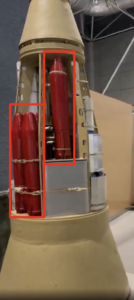
OSMP2211
Analyst Note:
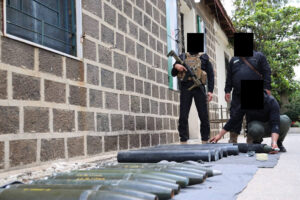
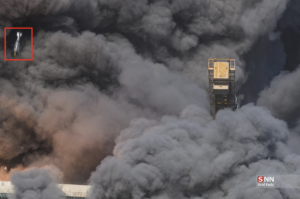
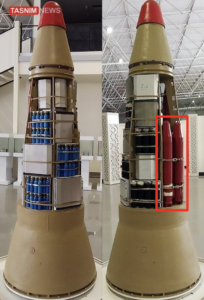
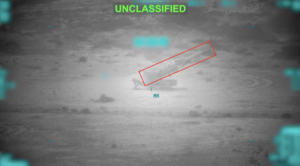
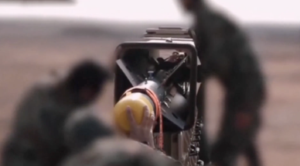
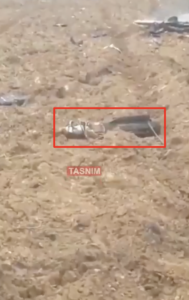
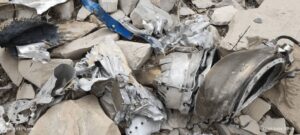
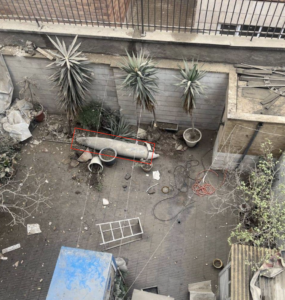
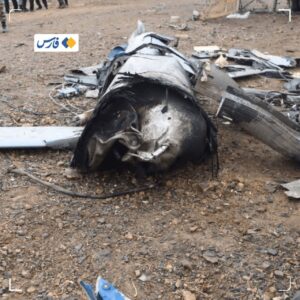
This image shows the ‘manoeuvrable re-entry vehicle’ (MaRV; a detachable, steerable payload section) of an Iranian ballistic missile loaded with submunitions. It appears there are three different models of submunition loaded into the MaRV (black, blue, and red). The black and blue submunitions are most likely anti-personnel designs, whilst the red submunitions (indicated by a red box) are likely designed with penetrating or shaped-charge warheads to target vehicles or structures. Some submunitions may utilise time-delay fuzing, allowing for random detonations over several hours or days to hamper clearance efforts, denying use of the afflicted area. Reports have shown Iran has used ballistic missiles with mixed submunition loads, and suggest that this type of warhead can scatter its payload up to a radius of 8 km. (ARES)
OSMP2257
Analyst Note:
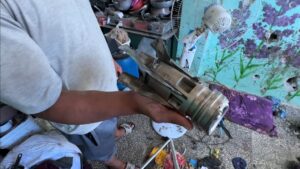
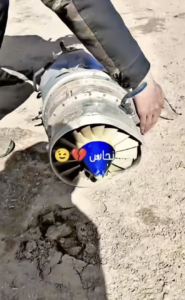
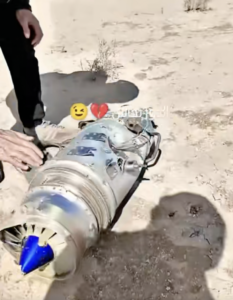
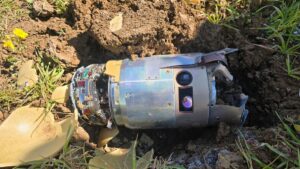
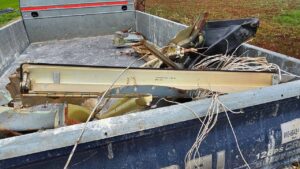
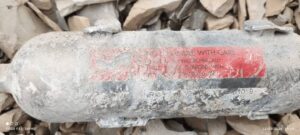
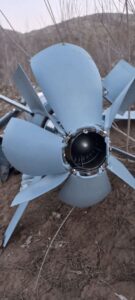
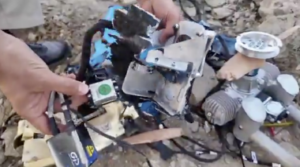
The component pictured here is a small turbofan engine from a Tomahawk missile. Missiles are vertically launched from the Typhon Missile System (named for a monster of Greek mythology), which is also capable of launching the Standard SM-6 guided missile. The Tomahawk missile is ejected from its launch tube under gas pressure, then the solid propellant of the booster motor section (Mk 135 booster produced by L3Harris) propels the missile until the turbofan engine (F107-WR-402 for Block III/IV or F415 for Block IV/V, both produced by Williams International) in the propulsion section is initiated and the booster motor section drops away. The propulsion section also supports the four tail fins, which are released by the two-piece continuity shroud upon launch. (ARES)
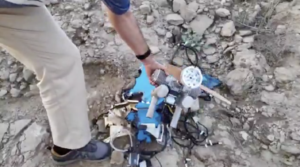
OSMP2107
Analyst Note:
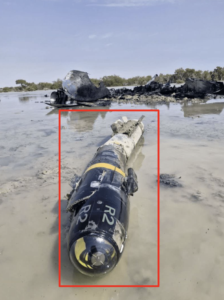
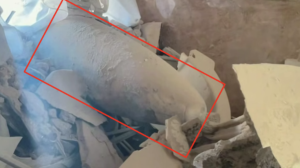
This image shows an AGM-114R2 Hellfire II missile. The AGM-114R2 is an enhanced version of the the AGM-114R multi-role missile, which is designed to engage a wide variety of targets. The Hellfire R-series missile are equipped with a multi-purpose warhead that can engage armoured or unarmoured vehicles on land or sea, as well as personnel in the open or in buildings. Reports indicate that the AGM-114R2 features improvements to its guidance software and tracking to increase accuracy against moving targets, as well as incorporating an adjustable height-of-burst (HOB) capability which allows it to detonate at a pre-determined height above the ground. (ARES)
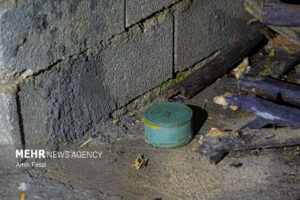
OSMP2232
Analyst Note:
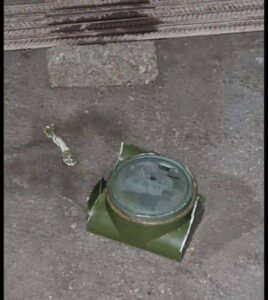
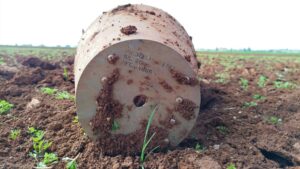
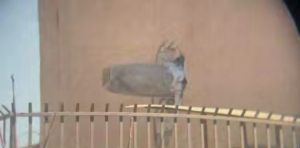
A BLU-91/B GATOR anti-vehicle landmine is seen in this image, with the remains of an aeroballistic adaptor visible. BLU-91/B mines can be deployed from cluster bombs or from vehicle-mounted dispensers, however the presence of the square aeroballistic adaptor here indicates that this example was deployed from an air-delivered cluster bomb. (ARES)
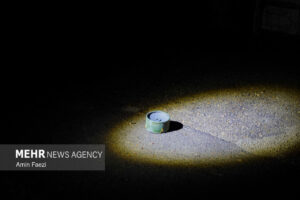
OSMP2155
Analyst Note:
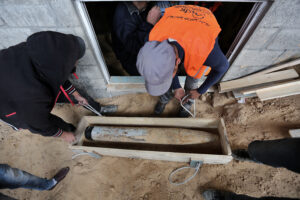
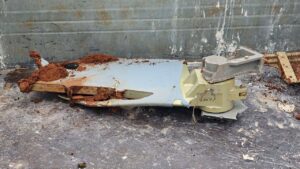
This image depicts what appears to be a WDU-42/B penetrator warhead as used in the AGM-158 JASSM series of missiles. The WDU-42/B is a 1,000-pound-class blast/fragmentation penetrator warhead designed to destroy hardened or reinforced targets. At the rear of the warhead, an FMU-156/B fuze is visible. This fuze is pre-programmed before launch according to the type of intended target. (ARES)
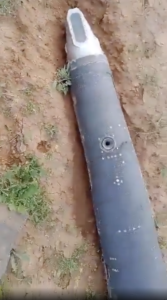
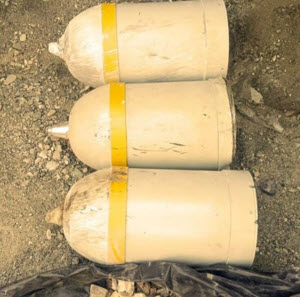
OSMP1837
Analyst Note:
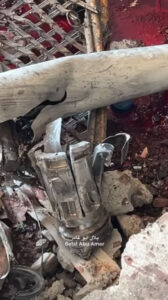
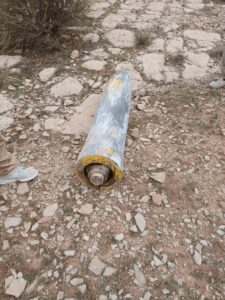
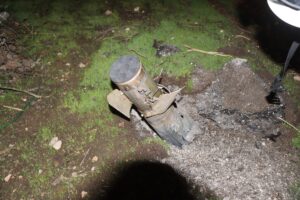
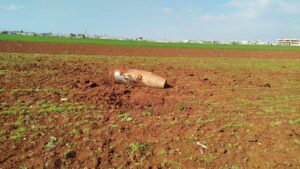
Considered with additional contextual materials, it is assessed that this image shows the rocket motor section from a 122 mm incendiary rocket, specifically the 9M22S or 9M28S models. Both rockets carry the same warhead, but use rocket motors of different lengths; not enough of this motor is visible to positively identify the model. (ARES)
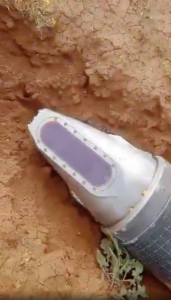
OSMP1835
Analyst Note:
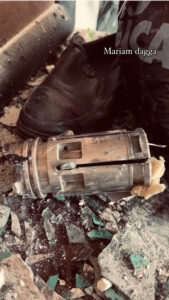
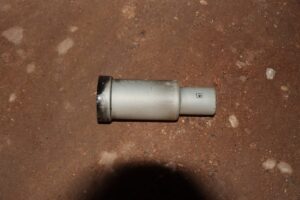
This image shows a stepped component positioned at the front of the warheads carried by 122mm 9M22S and 9M28S incendiary rockets. This structure helps to push the ML-5 incendiary elements out of the rear of warhead once the fuze in the nose functions. It is a relatively distinctive component, and commonly found in the vicinity of where the incendiary elements fall. (ARES)
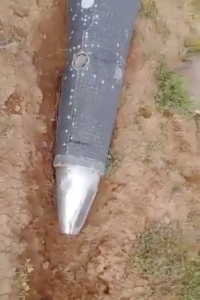
OSMP2126
Analyst Note:
This image shows a DC motor from a Tomahawk missile, manufactured by Globe Motors of Dayton, Ohio, in the United States (part # 471A118 and serial # 7250). Globe Motors was acquired by Allied Motion in August 2013, and has since been renamed Allied Motion at Dayton. This DC motor is used as an actuator to assist in steering the Tomahawk to its target based upon input from the aviation section in the forward body assembly. Such motors often survive detonation and can serve as diagnostic remnants. (ARES)
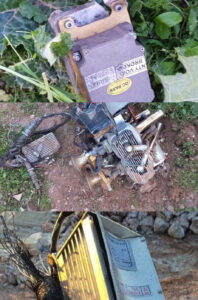
OSMP2064
Analyst Note:
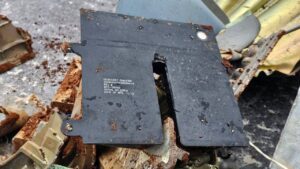
The component shown in this image is a GPS antenna for the AGM-158 Joint Air-to-Surface Standoff Missile (JASSM). It is marked to indicate its manufacturer (“Ball Aerospace & Technologies Corp.”; now operating as BAE Systems’ Space & Mission Systems division) and with other key information, including a part number and contract number. (ARES)
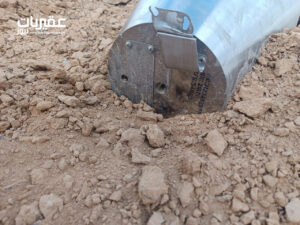
OSMP2035
Analyst Note:
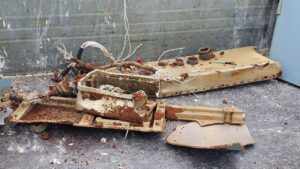
The munition remnant pictured here is marked with a Federal Stock Number (FSN; predecessor to the National Stock Number, or NSN, found on more modern munitions) that indicates it is part of a MIM-23B Improved HAWK surface-to-air missile. Other details, including the manufacturer (“Raytheon Company”), are also visible. The FSN was replaced by the NSN in 1974, indicating that this munition must have been manufactured before that time. This is consistent with the recorded U.S. export of the MIM-23B to Iran in 1972. (ARES)
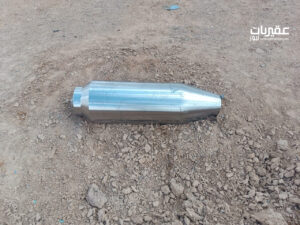
OSMP2042
Analyst Note:
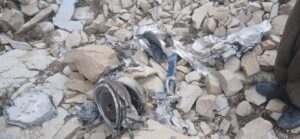
This image shows remnants from a MIM-23 Homing All the Way Killer (HAWK) surface-to-air missile. U.S. government documents show that MIM-23B Improved HAWK systems were exported to Iran in 1972. Iran has since manufactured a reverse-engineered version of the system. (ARES)
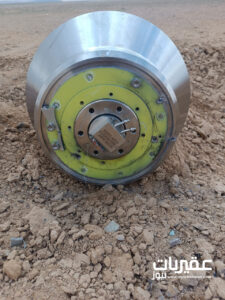
Collection

The Iran War 2026

Verified munition images from all parties to the regional conflict sparked by U.S. and Israeli strikes on 28 February, 2026

View this collection