Colour of all, or some, of the markings on the munition
Marking Colour (11)
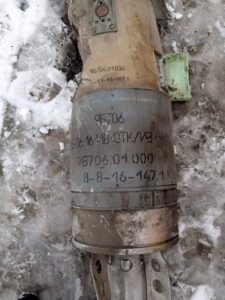
Language or script of the marking on a munition
Marking Script (10)
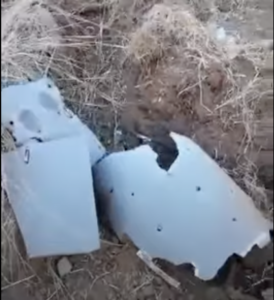
Condition of the munition pictured
Condition (6)
Key features defining the operation mechanisms of a projectile
Mechanical Feature (10)
Whether a munition is guided or unguided
Guidance (2)
Where the munition is launched from and what it targets
Domain (7)
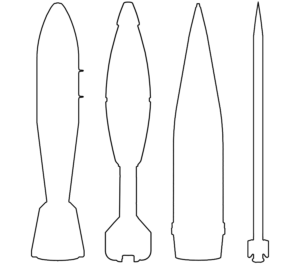
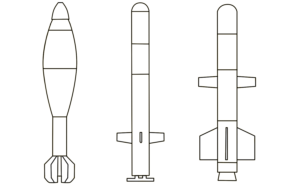
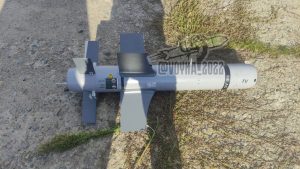
The type of fins visible on the munition
Fins Characteristic (6)
The nominal diameter of a projectile. For most modern munitions, this is expressed in millimetres (e.g. 82 mm mortar projectile), but older artillery gun projectiles may be described in inches.
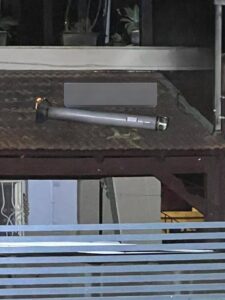
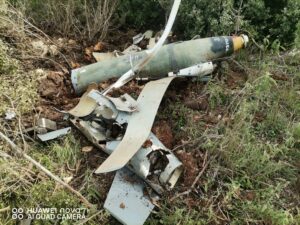
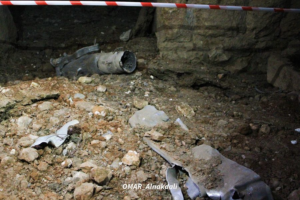
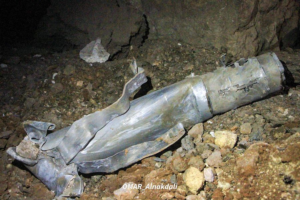
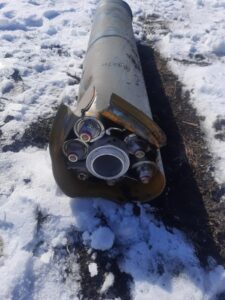
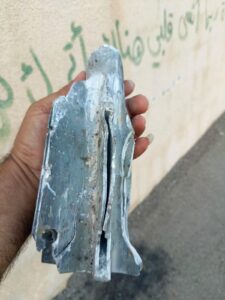
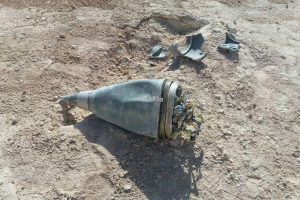
The Tamir Interceptor is the missile fired from Israel’s Iron Dome defence system to intercept incoming rockets, missiles, projectiles, and unmanned aerial vehicles (‘drones’). The Tamir uses a warhead with a relatively small explosive yield, which typically results in the guidance section, nosecone, and (spent) rocket motor falling to the ground relatively intact after functioning. (ARES)
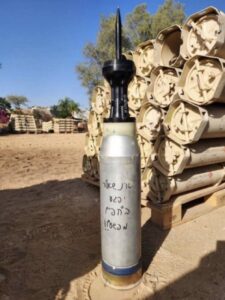
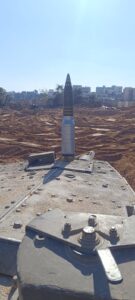
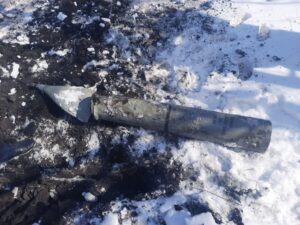
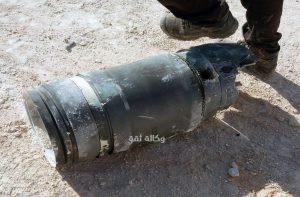
This is an Israeli 120 mm tank gun round, of the ‘armour-piercing, fin-stabilised discarding sabot – tracer’ (APFSDS-T) type. The physical features identify it as either the M322 or M338.
The projectile (penetrator) of this round has no explosive content and relies on kinetic energy to penetrate armoured targets. When a projectile is of a smaller calibre than the gun’s bore, a sabot is sometimes used to ensure the projectile is centred in the bore and to trap the gas from the propellant of the cartridge and propel the projectile. In flight, the sabot separates into two or more pieces, sometimes called ‘petals’, often found along the line of fire before the impact point. (ARES)
The M329 is a multi-purpose tank gun projectile designed to engage a range of targets other than tanks. It is one of the few cluster munitions that takes the form of a tank gun projectile, dispensing six explosive submunitions over a relatively small area. It has also been referred to as the ‘APAM 120’, describing its functional role (‘anti-personnel/anti-materiel’) and calibre (120 mm). (ARES)
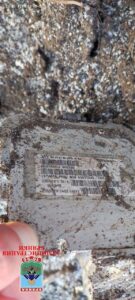
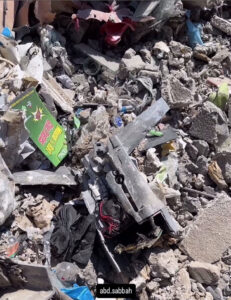
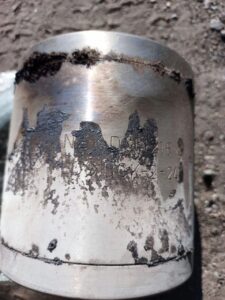
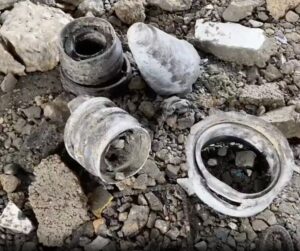
The remnants shown in these linked images have been falsely identified in Russian sources as chemical munitions. This image clearly exhibits the marking “NBK DM 1216”—the ‘NBK’ standing for the German Nebelkörper (‘smoke element’)—identifying this as one of four DM 1216 hexachloroethane/zinc (HC) smoke elements dispensed by the German DM 105 155 mm artillery gun projectile. Video of the incident shows all four elements being ejected from the base of the projectile in flight. (ARES)
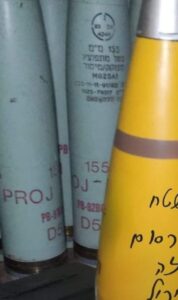
The M825A1 155 mm smoke projectile makes use of white phosphorus (WP) to generate a brilliant white smoke. Whilst WP does have incendiary effects, the method of dispersal in the case of the M825A1 is optimised for screening and marking purposes. (ARES)
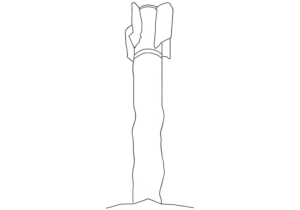
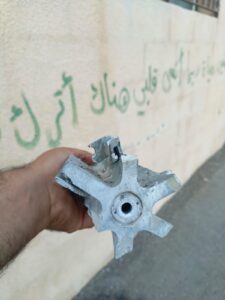
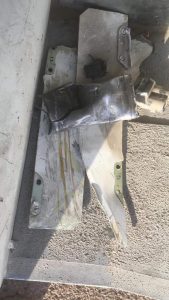
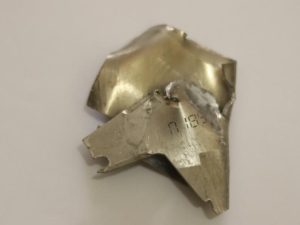
The remnant pictured here is part of a Small Diameter Bomb actuator assembly (‘Tail Actuation Section’), which moves the four tail-fin control surfaces which alter the course of the munition in flight. (ARES)
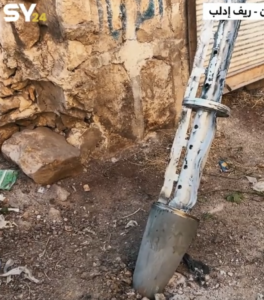
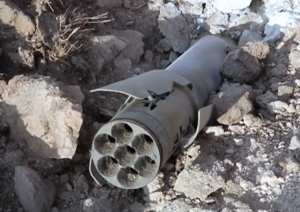
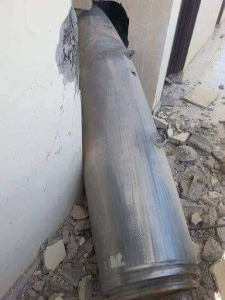
This image depicts either a 9M27K or 9M27K1 cargo rocket (cluster munition). The 9M27K carries the 9N210 high explosive fragmentation (HE-FRAG) submunition, whilst the 9M27K1 carries the 9N235 HE-FRAG submunition (ARES).
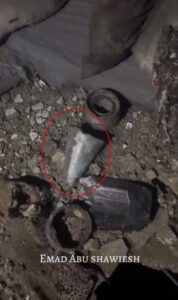
The circled remnant is the hardened steel nosecone of the GBU-39, which renders the munition capable of penetrating more than 3 feet (approx. 1 metre) of steel-reinforced concrete. It is one of several components that often survives the detonation of the munition. (ARES)
Contextual information suggests that this is likely a 9M22S unguided incendiary rocket (see External Research section), but this cannot be confirmed on the basis of this image alone. (ARES)
This munition is assessed to be one of the Small Diameter Bomb (SDB) I variants (GBU-39 series), rather than one of the SDB II 'StormBreaker' (GBU-53 series) munitions, on the basis of contextual information. 'Small Diameter Bomb' is the manufacturer's terminology, whilst 'GBU-39' is the U.S. Air Force designation (also used by many other operators). (ARES)
The various Iranian Qaem-series guided air-delivered bombs can be difficult to differentiate from one another. In this case, the wing (forward fin) assembly distinguishes this Qaem-5 from the visually similar Qaem-1. Note also that the name 'Qaem' has applied by Iran to other, unrelated munitions. (ARES)
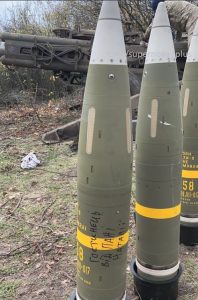
Once fired, four canards will deploy from the forward (ogival) section of these M982 Excalibur guided artillery projectiles. The narrow-shaped ports through which the canards deploy are a good indicator of a guided or extended-range artillery projectile. (ARES)
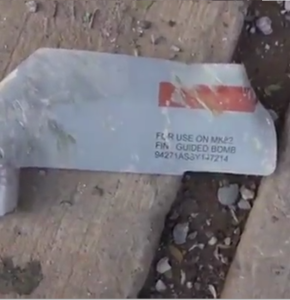
Many guided (or otherwise complex) munitions like this one are marked with additional information on individual assemblies or components. This can include information on sub-contractors that produced or integrated specific parts of a munition. (ARES)
The MK 84 series of unguided air-delivered bombs can be converted to precision guided munitions by being fitted with guidance kits such as the Joint Direct Attack Munition (JDAM), SPICE 2000, or Paveway series. This MK 84 is also marked with a variant designation “MOD 4”. (ARES)
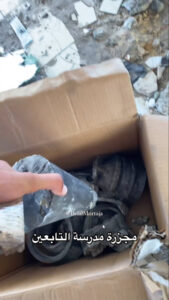
The image is of "a high-velocity shell fired from the main armament of a battle tank," Desmond Travers, former director of the Institute for International Criminal Investigations, told Airwars and AFP. "The calibre appears to be 120 mm, and the shell is fin-stabilised. The maximum effective range is five kilometers, but a skilled tank crew member should be able to hit a target the size of a car." (Airwars)
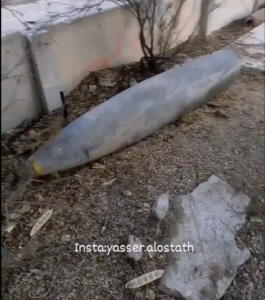
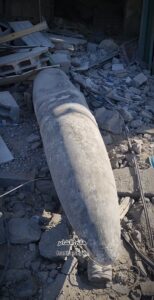
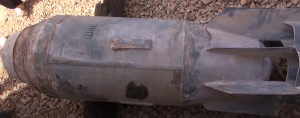
The M-54 ‘high-drag’ series of Soviet/Russian air-delivered bombs can be distinguished by two key identification features: 1.) the ballistic ring located in the forward portion of the bomb (missing in this example); and 2.) the presence of two or four rectangular, longitudinal ‘levelling bars’ (two can be seen in this example). (ARES)
Russian air-delivered cluster bombs, such as this one, are often named using a designation that is a compound of the names of the cargo (carrier) bomb and the submunition it carries. For example, this RBK-500 unguided, air-delivered cluster bomb carries 268 PTAB-1M HEAT submunitions, and is thus designated the 'RBK-500 PTAB-1M'. (ARES)
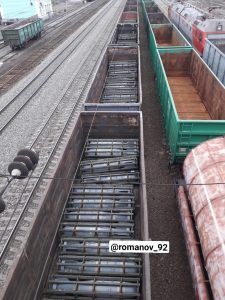
Cargo rockets often use an internal frame to manage the correct carriage and expulsion of submunitions. These internal frames frequently survive largely intact after the munition has functioned, and may be diagnostic in identifying a munition by type, series, or model. (ARES)
This component is one of four pneumatically controlled canards from the guidance section of a Paveway II precision guided munition (PGM) conversion kit. When a Paveway II conversion kit is fitted to a MK 82 series unguided air-delivered bomb (note markings), the munition receives a GBU-12 series designation. (ARES)
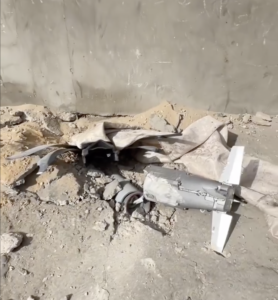
Although this munition started out life as a mortar projectile of the M492-pattern, it has been modified to be dropped from an unmanned aerial vehicle (UAV) and, in its present state, could not be fired from a conventional mortar. As such, it is correctly classified here as an air-delivered bomb. (ARES)