



101–200 of 239
Current Filter
Iraq
A large country in the Middle East affected by conflict since a 2003 US-led invasion to overthrow dictatorial President Saddam Hussein. Since 2013 the Iraqi military, with the military support of a US-led Coalition, has fought the so-called Islamic State, while conflict between often sectarian militias continues. Turkey also conducts regular strikes against Kurdish militants in northern Iraq.

Current Filter
Palestinian Territories
The areas internationally recognised as the basis of a future independent Palestinian state, primarily the West Bank, east Jerusalem and the Gaza Strip. Israel has fought multiple wars with the Hamas militant group, which controlled Gaza.

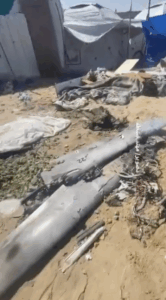
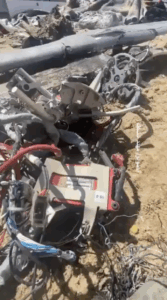
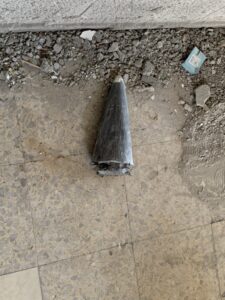
Analyst Note:
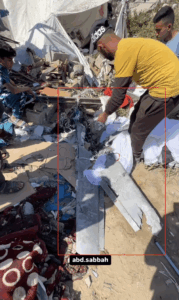
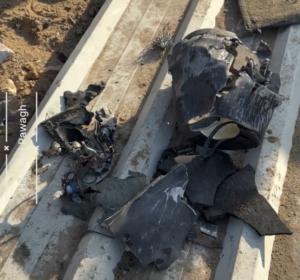
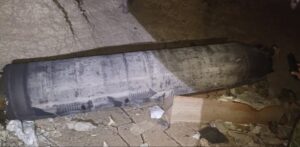
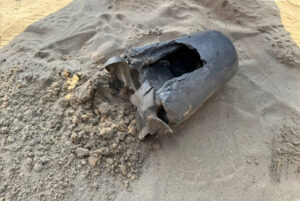
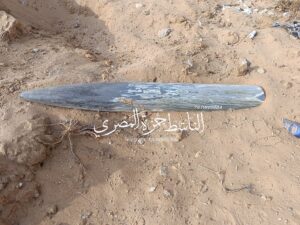
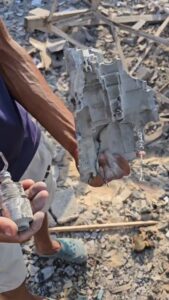
This image shows the nosecone from an Israeli SPICE 250 air-delivered bomb. Whilst generally similar in appearance to the nosecone of the GBU-39, the SPICE 250 nosecone is longer and narrower. (ARES)
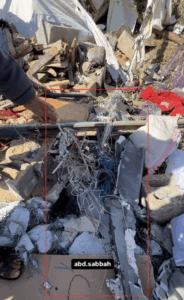

Analyst Note:
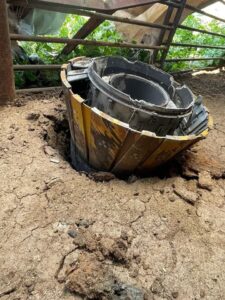
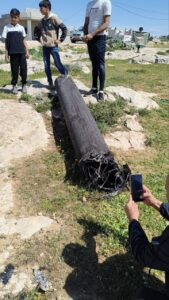
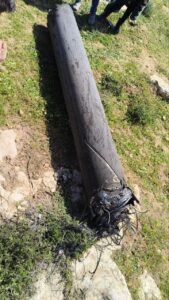
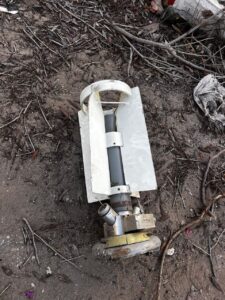
This image shows the flare from a Terminal High Altitude Area Defense (THAAD) system's ‘Talon’ kinetic interceptor missile. The flare is located at the aft end of the missile's booster engine. The ‘petals’ of the flare are initially flush, and are actuated into the deployed position, seen here, as part of the missile‘s functioning. (ARES)
Analyst Note:
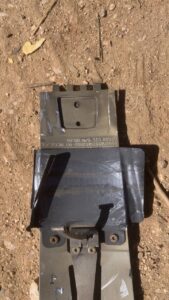
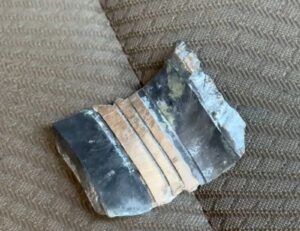
This image shows a fragment of the “inner petal assembly” of a Terminal High Altitude Area Defense (THAAD) system’s ‘Talon’ interceptor missile. The part number for the assembly (“23917ASSY1A62803-101 REV.E / E”), Commercial and Government Entity (CAGE) code (“07554”), manufacturer abbreviation (“CTL”), and serial number (“S/N DDLKD”) are visible. This CAGE code and manufacturer abbreviation are associated with CTL Aerospace Inc, a subcontractor for Lockheed Martin, the manufacturer of the THAAD system. It is not uncommon for complex munitions to be made by several different manufacturers, and thus multiple CAGE codes may be present as a result of the various subcontractors. (ARES)



Analyst Note:
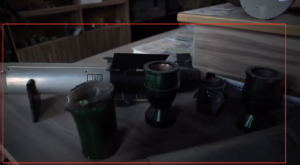
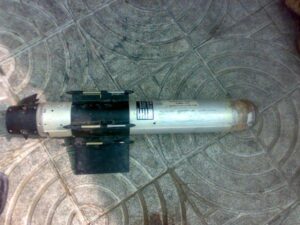
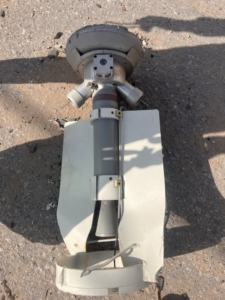
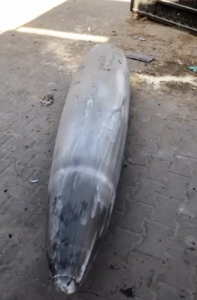
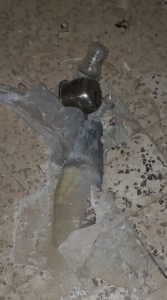
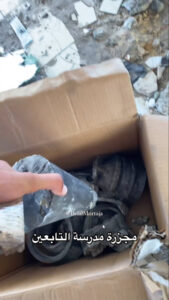
This image shows a Mikholit glide bomb, with its warhead removed (green cylinder on the left side of the box). The fins that spring outward when deploye have been taped down. This Mikholit was reportedly recovered by the Israeli Defense Forces (IDF) from Hamas, who had captured the bomb after it failed to function when originally deployed by the IDF. (ARES)

Analyst Note:
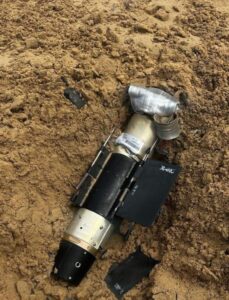
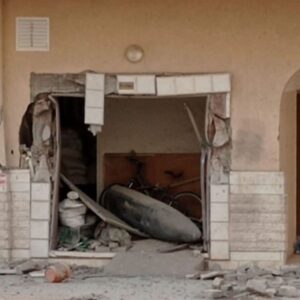
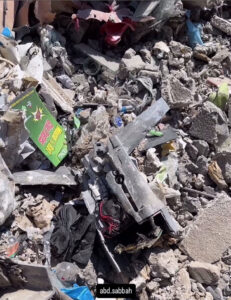
This image shows two Mikholit air-delivered bombs (‘glide bombs’), and four Mikholit warheads. There are at least two different variants of warheads available for the Mikholit glide bomb. The green cylinder on the left is a blast (high explosive) warhead, whilst the other three warheads are shaped charge warheads which incorporate additional fragmentation. Blast warheads of this type have also been seen with red markings, while the shaped charge warheads have been seen with yellow markings. (ARES)

Analyst Note:
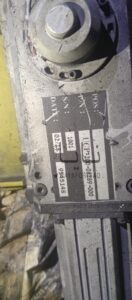
This image shows a fragment of an Israeli 120 mm tank gun projectile, with its distinctive obturating band configuration. The additional remnants shown in the related OSMP entry permit distinguishing this projectile from other potential Israeli models, identifying it as the M339 tank gun projectile. (ARES)

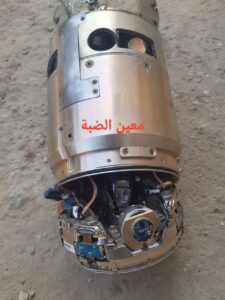
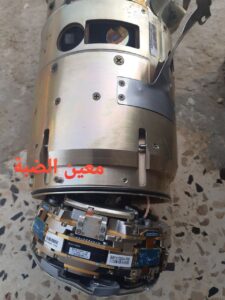
Analyst Note:
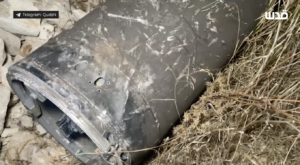
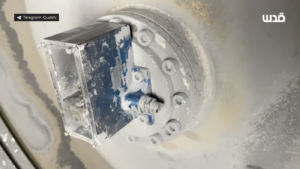
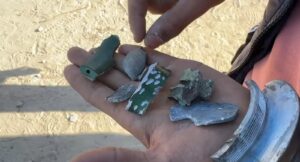
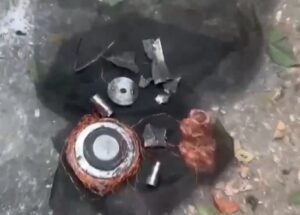
This image shows the section just forward of the Tamir missile’s forward fins and appears to incorporate the base of the active radar seeker (open end) and the laser proximity sensor part of the warhead fuzing system (mirrors/glass & opening in the casing). While the Tamir has been reported to physically impact some targets, the proximity fuze is designed to closely pass by the target, then detonate the high explosive fragmentation warhead thereby destroying the target. ‘Tamir’ is a Hebrew acronym for Til Meyaret, or ‘interceptor missile’. (ARES)
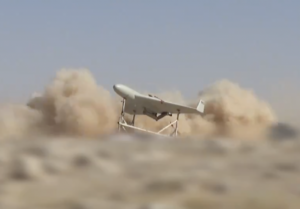


Analyst Note:
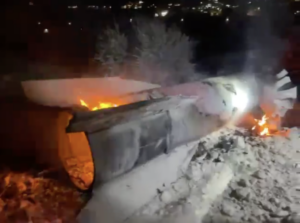
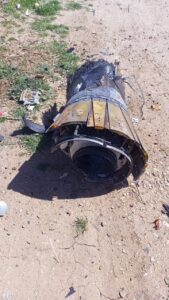
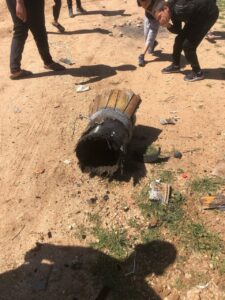
This image shows the functioned rocket motor of an Israeli Carpet rocket. The Carpet uses a fuel-air explosive (FAE) warhead which is designed to function mines and improvised explosive devices (IEDs), clearing a target area for the advance of friendly forces. These rockets are fired from the Carpet rocket launcher, which is loaded with up to 20 rockets and can be fitted to a variety of vehicles. (ARES)

Analyst Note:
This image shows a MK 84 2,000-pound bomb that has had its fuze and baseplate removed in order to access the explosive filler. The fuze, fuze retaining ring, and baseplate can be seen on the white sheet.
The explosive material used to fill the bomb has been removed, possibly to be repurposed in improvised explosive devices or craft-produced munitions. Unexploded ordnance is often ‘harvested’ for these purposes. (ARES)
Analyst Note:
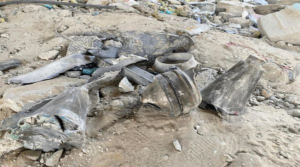
This image shows various munitions remnants, including a fuzewell and two nosecone fragments from GBU-39 Small Diameter Bombs. The presence of two different nosecones indicates that these remnants are from at least two distinct munitions. (ARES)
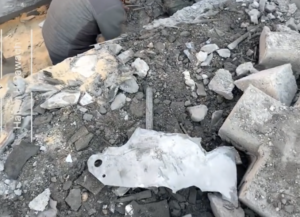
Analyst Note:
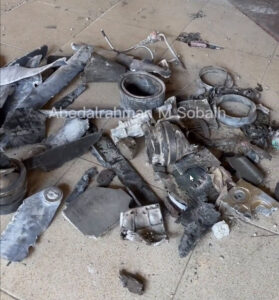
This image shows a wing fragment from a SPICE-1000 bomb guidance kit. While there are no remnants of the bomb body visible, it can be determined that a MK 83-series 1,000-pound bomb or similar was used, as MK-83 series bombs are paired with the SPICE-1000 bomb guidance kit to form a complete munition. (ARES)

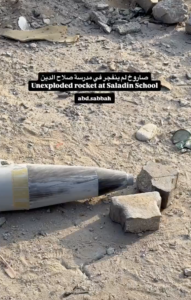
Analyst Note:
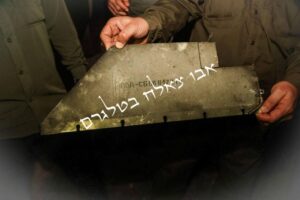
As with several other images in the OSMP database, the text on this image was added by a social media user prior to its inclusion herein. Rather than a “rocket” as described in the annotation, this image actually shows an air-delivered bomb. (ARES)
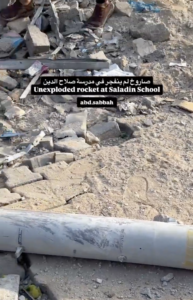



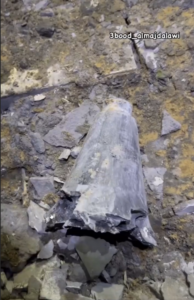
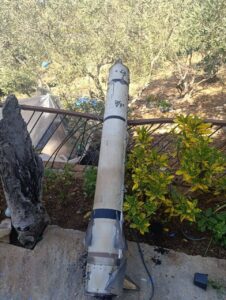
Analyst Note:
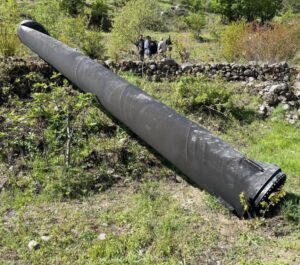
The Stunner surface-to-air missile fired by the David’s Sling air defence system is a two-stage interceptor, meaning that the munition contains two separate rocket motors for launch and propulsion. The first stage, or launch motor, detaches from the munition after a short time, before the second stage, or flight motor, ignites. The second stage motor, visible here, was found relatively intact. (ARES)
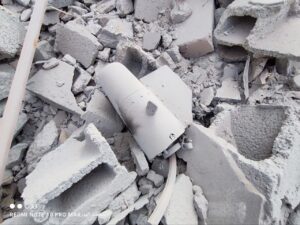
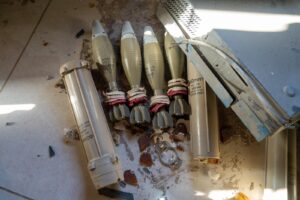
Analyst Note:
This Iranian 60 mm mortar projectile is of the ‘Long Range’ type described without a specific model name in various Iranian export catalogues and other sources. The designation as marked on projectiles and packaging is variable, with observed formulations including “60mm H.E. L.R.”, “60mm H.E L.R”, and “60mm HE L.R”. Sometimes, as here, “60mm L.R” is followed by “HE / TNT”. (ARES)
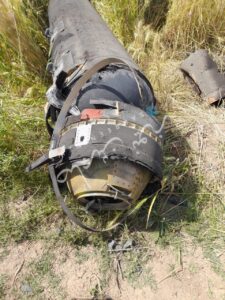

Analyst Note:
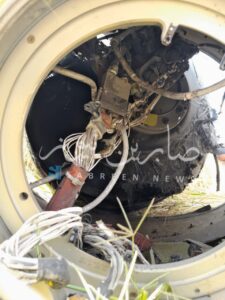
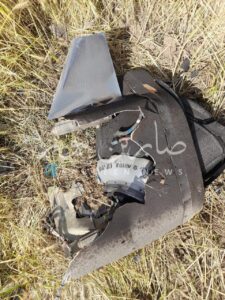
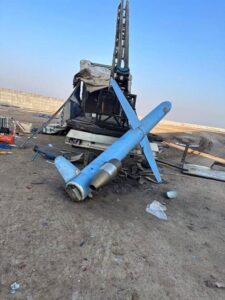
The Blue Sparrow is one of a series of three of air-launched missiles originally designed by Rafael as targets to test ballistic missile defence systems. Blue Sparrow missiles can be fitted with either inert or high explosive (HE) warheads. The recovery of Sparrow-series boosters following a reported Israeli strike on an Iranian air-defence system could suggest that a derivative variant of the Blue Sparrow missile was further developed for engaging surface targets. (ARES)
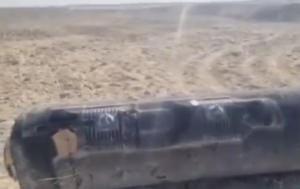

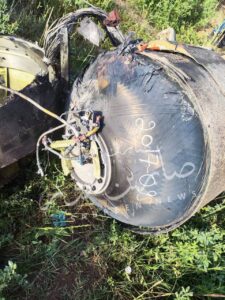
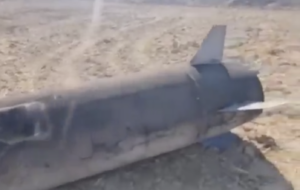

Analyst Note:
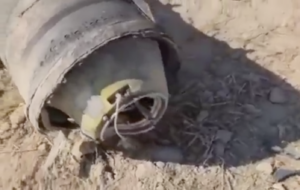
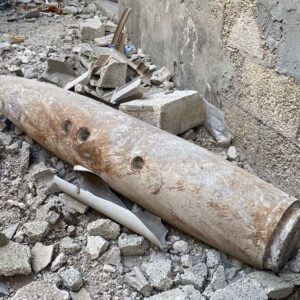
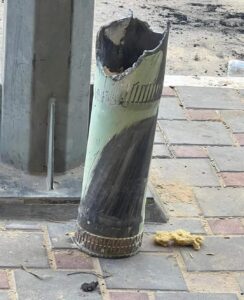
This image shows what is probably just the body of an Israeli 155 mm smoke artillery projectile. Israel predominantly uses two varieties of 155 mm smoke munition: the M825 white phosphorous (WP) series of munitions, and the M150 hexachloroethane/zinc mixture (HC) munition. These munitions are externally near-identical, save for their markings. In this case, the markings are insufficient to determine whether the image shows an M825-series WP munition or an M150 HC munition. (ARES)
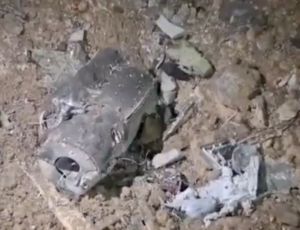

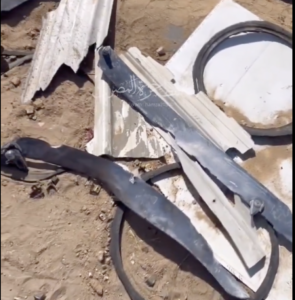
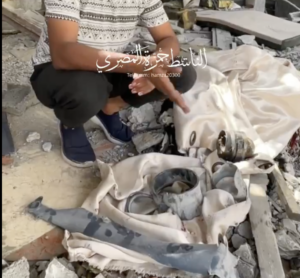
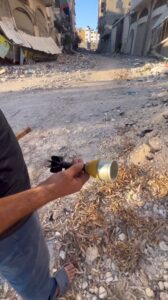
Analyst Note:
The M824 60 mm mortar projectile dispenses a parachute-retarded illumination flare which burns for 35 seconds. The tail portion of the munition (seen here) separates from the forward (body) portion and is sometimes found along the line of fire. (ARES)
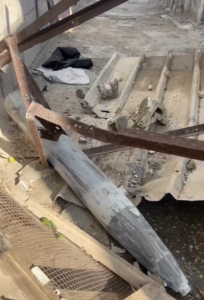
Analyst Note:
Contextual information, including an assessment of the crater which appears to be linked to this munition remnant, suggests that a 2,000-pound-class bomb fitted with a SPICE 2000 guidance kit was used in this airstrike. (ARES)
Analyst Note:
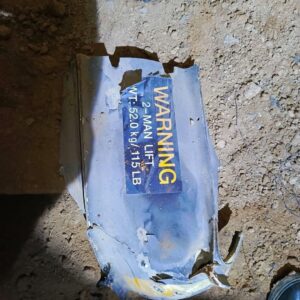
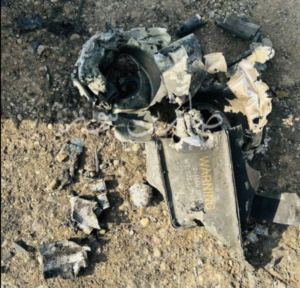
The AGM-179 Joint Air-to-Ground Missile (JAGM) is derived from the AGM-114 Hellfire series of air-to-surface missiles—and thus shares physical characteristics in terms of general construction, including rear fin placement. The marked weight of 52.0 kg (115 lbs) is generally believed to be an indicator that the rocket motor is from a JAGM; however, remnants marked with this weight have been observed from several years before the JAGM was initially fielded. (ARES)






Analyst Note:
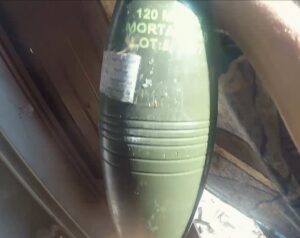
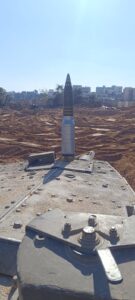
The M329 is a multi-purpose tank gun projectile designed to engage a range of targets other than tanks. It is one of the few cluster munitions that takes the form of a tank gun projectile, dispensing six explosive submunitions over a relatively small area. It has also been referred to as the ‘APAM 120’, describing its functional role (‘anti-personnel/anti-materiel’) and calibre (120 mm). (ARES)

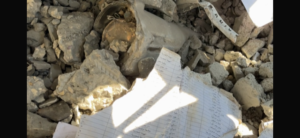

Analyst Note:
This image shows a distinctively shaped component of MBDA’s ‘Diamond Back’ joined tandem wing assembly as fitted to the GBU-39 Small Diameter Bomb (SDB). (ARES)