Where the munition is launched from and what it targets
Domain (7)
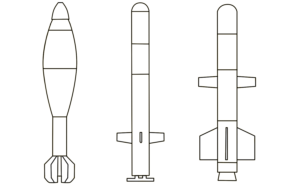
The type of fins visible on the munition
Fins Characteristic (6)
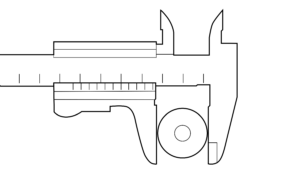
The nominal diameter of a projectile. For most modern munitions, this is expressed in millimetres (e.g. 82 mm mortar projectile), but older artillery gun projectiles may be described in inches.
Portions of the munition that make up hydraulic or electrical control sections. In general, more sophisticated munitions, such as guided missiles, will have a greater percentage of these components.
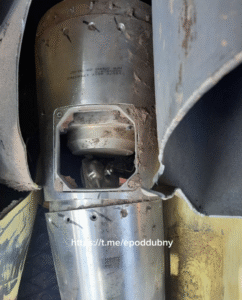
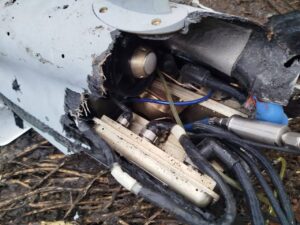
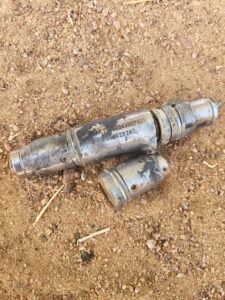
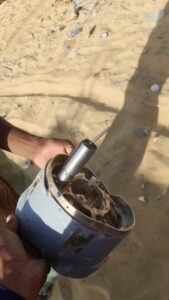
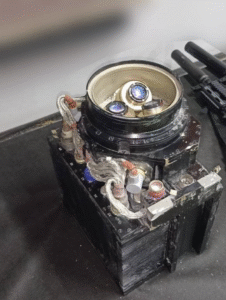
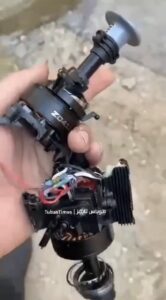
Moog Inc.—headquartered in East Aurora, New York, as marked on this munitions remnant—describes itself as a “worldwide designer, manufacturer, and integrator of precision control components and systems”. Moog supplies actuator and control components to the prime contractor on the Miniature Air-Launched Decoy (MALD) programme, Raytheon. (ARES)
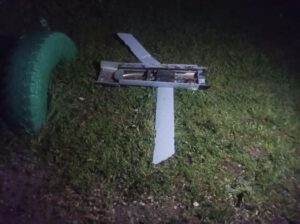
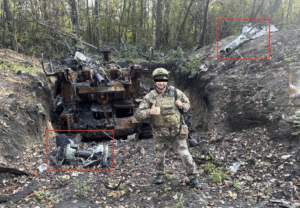
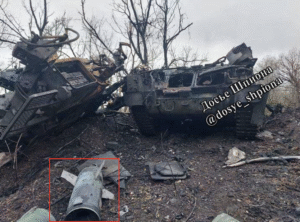
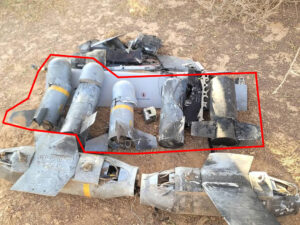
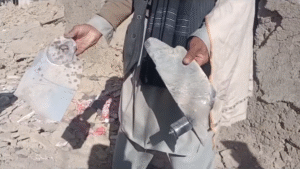
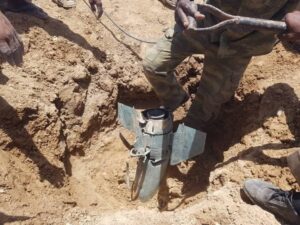
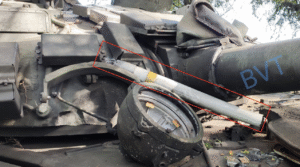
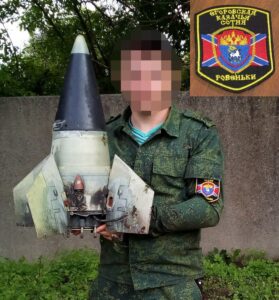
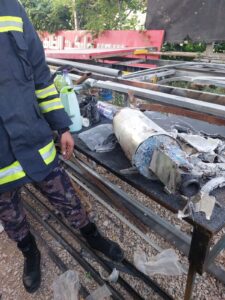
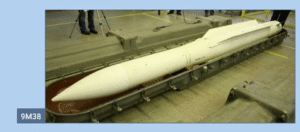
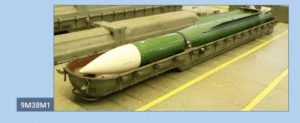
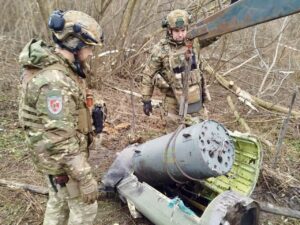
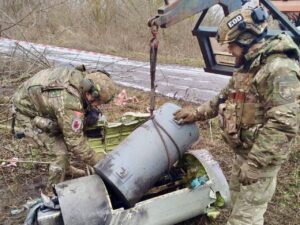
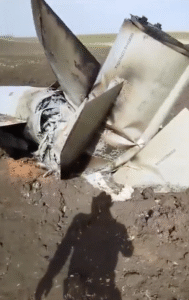
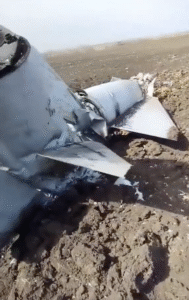
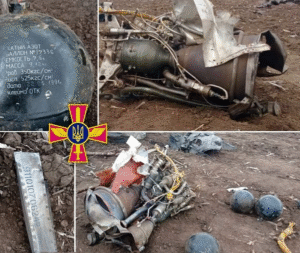
Positive identification of this surface-to-air missile cannot be made based on the imagery in the source. The items highlighted in this image are most likely the remains of either a 9M38- or 9M317-series missile, based on fin construction and their size relative to the individual posing in the foreground. These two missiles are close in design and function, and are predominantly fired from the Buk series of SAM systems. (ARES)
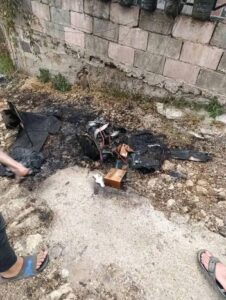
Although the source claims that this image shows a Buk-M3 surface-to-air missile system, this imagery is not sufficient to determine whether the remnants highlighted are from a 9M38-or 9M317-series guided missile. (ARES)
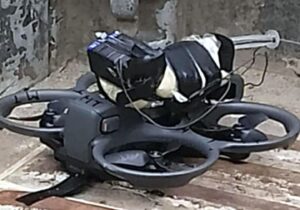
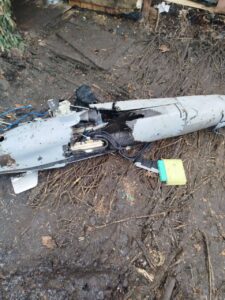
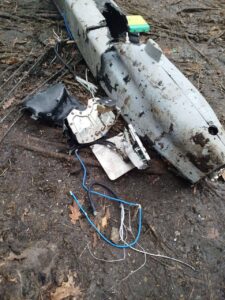
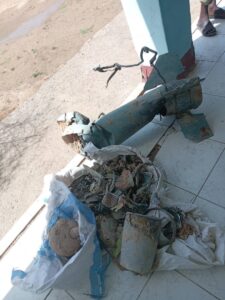
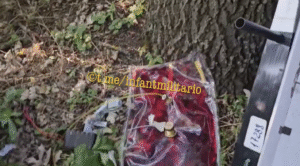
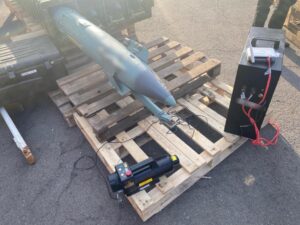
This guided munition is built around a sacrificial DJI Avata-series UAV that has been fitted with an improvised explosive device (IED). From front to back, it consists of an impact switch made from a syringe, the main charge (yellow/white material in a plastic bag), and a battery that acts as the power source. While crudely made, it is probably still functional. (ARES)
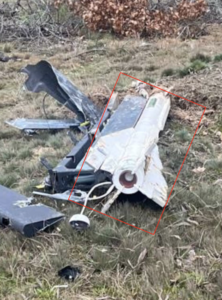
This image represents the first documented instance of a Shahed-series UAV carrying an R-60 air-to-air missile. This appears to add a new capability to the Shahed, enabling it to target enemy aircraft. Arming UAVs to counter interception and engage alternative targets is an emergent trend. Previously, unmanned surface vessels (USVs) employed by the Ukrainian Armed Forces have been observed carrying R-73 air-to-air missiles, for example. (ARES)
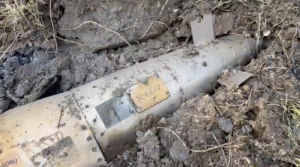
This munition remnant is marked with a manufacturer’s CAGE Code (“MFR-05DN8”) which indicates it was produced by Klune Industries. Klune Industries is a sub-contractor on the GMLRS contract. (ARES)
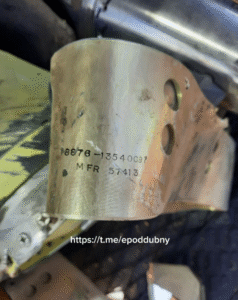
This munition remnant is marked with a manufacturer’s CAGE Code (“MFR-57413”) which indicates it was produced by the Maine Machine Products Company, a sub-contractor on the GMLRS contract. (ARES)
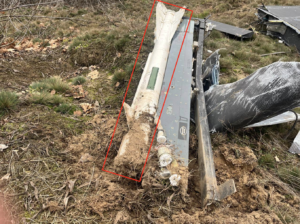
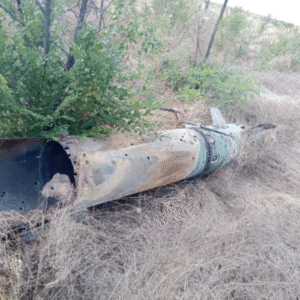
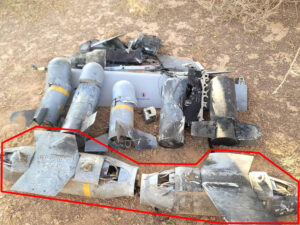
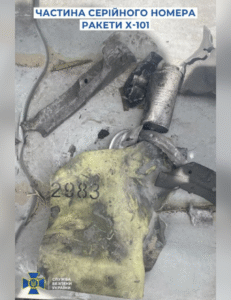
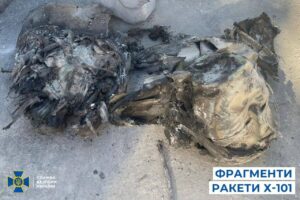
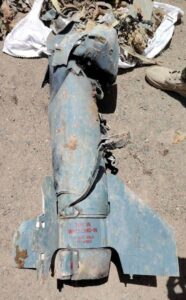
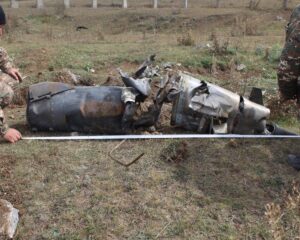
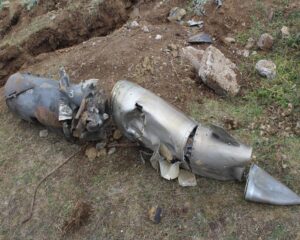
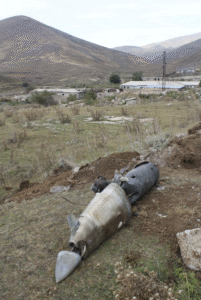
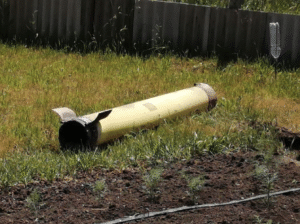
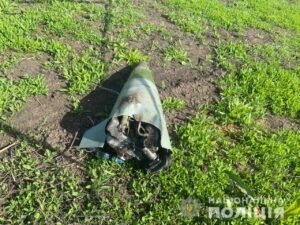
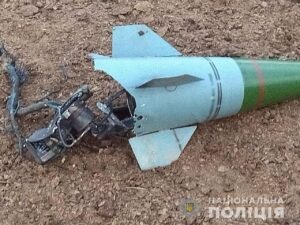
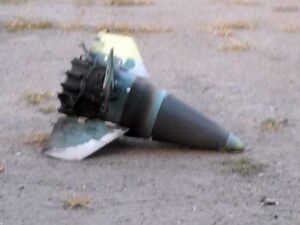
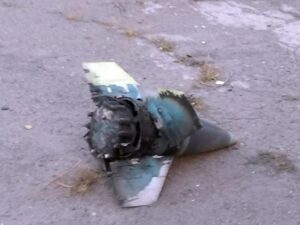
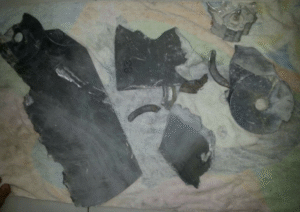
This image shows remnants of a Russian Kh-101 air-launched cruise missile. The remnant on the right is the rearmost tail section of the missile. (ARES)
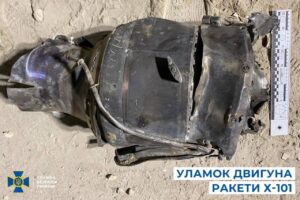
This image shows a remnant of the TRDD-50A(M) (ТРДД-50А(M)) turbojet engine, which powers Kh-101 and Kh-59M missiles. Other models of Russian cruise missiles are known to use other variants of the TRDD-50. (ARES)
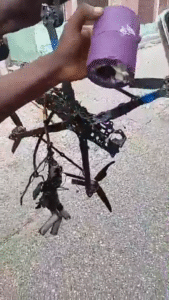
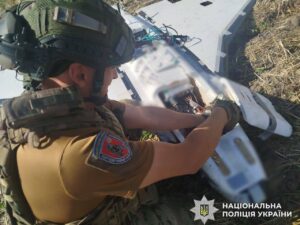
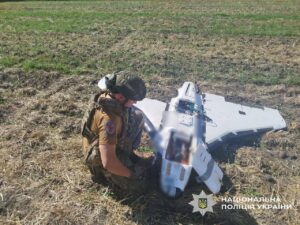
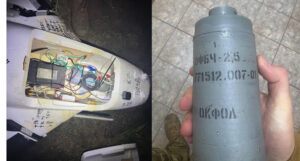
The image shows a one-way-attack (OWA) UAV that appears to have crashed, but failed to function. It consists of an FPV chassis, as well as some of the essential components required for flight and the explosive charge (purple container). The initiator and other parts relevant to both flight and the munition’s function are not visible. This appears to be craft-produced ‘sacrificial’ UAV. (ARES)
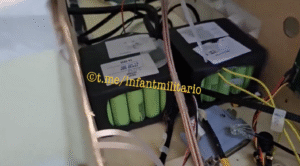
This photo shows some of the lithium-ion power banks found within a Gerbera UAV. These are used to power the onboard avionics, control surfaces, communications hardware, camera, and other components. The quantity and type of batteries fitted to the Gerbera will often vary based on the role for which the UAV has been configured—one-way attack (OWA; i.e., a ‘sacrificial’ munition), reconnaissance, signal relay, or decoy—and which specific hardware has been installed to effect this mission. (ARES)
This photo shows the fuel bladder of a Gerbera UAV, which still contains some fuel. It is likely that a bladder is used—rather than a rigid tank—to save on both weight and cost. Some variants of the Gerbera have been observed to be fitted with a second bladder in the forward section of the fuselage, serving to extend the UAV’s range. (ARES)
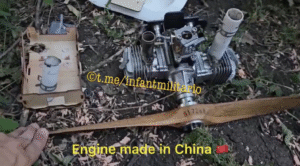
The DLE60 two-stroke petrol (gasoline) engine pictured here is the standard engine found on Gerbera UAVs. It is produced by the Chinese company Mile Haoxiang Technology Co., Ltd. and marketed specifically for use in UAVs. Although the Gerbera is manufactured in Russia, the engine and many other key components continue to be supplied from Chinese sources. (ARES)
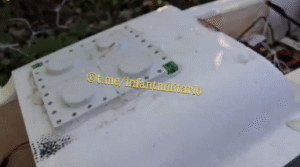
This image shows a Controlled Reception Pattern Antennas (CRPA) unit installed on a Gerbera-series UAV. CRPAs are specialised antenna arrays that help protect GPS receivers from interference, spoofing, and jamming. This particular model, featuring four antennas, was first observed on the Shahed-136 UAV and has since been routinely seen fitted to Gerbera-series UAVs. An alternative array, with six antenna elements, has also been observed, reflecting the varied and ever-evolving state of electronic warfare in Ukraine. (ARES)
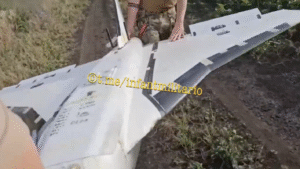
A Gerbera-series UAV is pictured here being carried by just two Ukrainian soldiers. This highlights the Gerbera’s lightweight design—the airframe is mostly constructed from Styrofoam and wood, which saves on both weight and cost. This particular example does not bear signs of significant damage, suggesting that it either malfunctioned or was brought down by EW and crashed. (ARES)
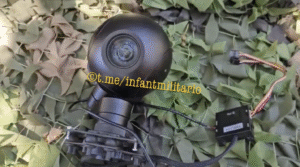
This image shows an A40 Pro camera, manufactured by the Chinese company Viewpro UAV and design specifically for use in UAVs. The black box to the right of the camera is the control box which manages video output, camera control, and power. The manufacturer claims this model has a 40× optical zoom, AI detection and tracking, and 3-axis gyro-stabilisation. The company further claims that it can customise the onboard AI recognition based on “target characteristics” provided by the client. Numerous Gerberas fitted with this model of camera are known to have been recovered by Ukrainian forces, although it is by no means the only camera model in use. (ARES)
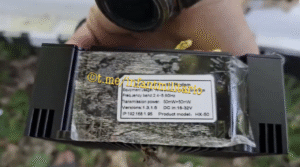
This image shows the back surface of a wireless communications module contained within a downed Gerbera UAV. Although labeled as an HX-50 model designed for fixed locations, Ukrainian military analysis indicates this is an XK-F358 mesh-network module more suitable for use in UAVs. See OSMP1646 for further details. (ARES)
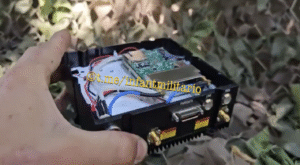
This image shows the front and interior surfaces of a wireless communications module recovered from a downed Gerbera UAV. Although labelled as an HX-50 industrial wireless modem (compatible with WiFi and 5G/4G networks and designed for fixed locations), analysis by Ukrainian military sources indicates that this component is, in fact, an XK-F358 mesh-network module which offers significantly more capabilities. Manufactured and sold by Shenzhen Xingkai Technology Co., Ltd., these modules are designed for, amongst other things, use in robots and unmanned vehicles. Gerbera UAVs have been found operating on a wide variety of frequencies and networks, and this type of module is well-suited to this use. (ARES)
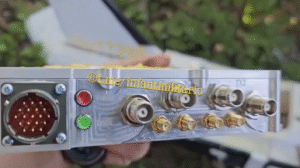
Pictured is a navigation/GPS module recovered from a downed Gerbera UAV. This particular model is used with the 4-antenna CRPA module seen in OSMP1648. The four RX ports on the bottom are normally directly connected to the CRPA (antenna) module, with other connections made to the UAV’s flight controller and power sources. Some Gerberas have been recovered with CRPA modules bearing a different number of antennas; different navigation modules have been observed on these. (ARES)
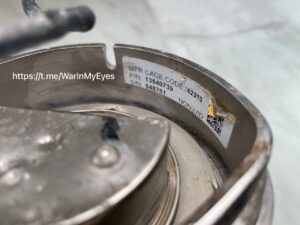
This munition remnant is marked with a manufacturer’s CAGE Code (“MFR CAGE CODE: 62313”) which indicates it was produced by Lockheed Martin. Lockheed Martin is the primary contractor that makes GMLRS missiles. (ARES)
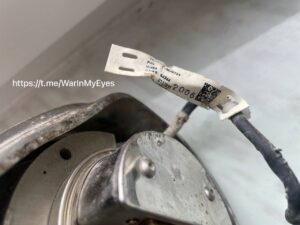
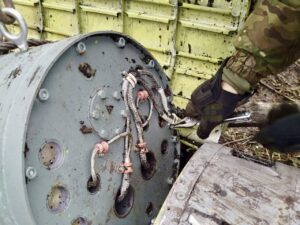
This remnant shows a munition component marked with the CAGE Code for a sub-contractor who produced part of a larger munition. “64344” is the code for Unique Electronics Inc., a known sub-contractor working on Lockheed Martin’s GMLRS contract. One of the parts they make is the “CABLE ASSEMBLY W459“, as seen in this image. (ARES)
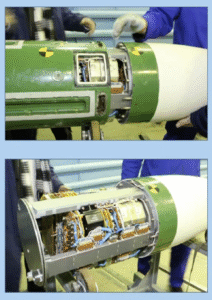
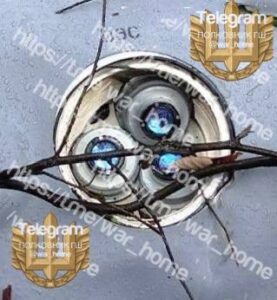
This image shows the three lenses that form the new version of the Kh-101 Digital Scene Matching Area Correlator (DSMAC) system. (The older version only had a single lens.) DSMAC systems take digital images of the ground as the missile passes overhead, and then compare those images to pre-captured images stored in the onboard memory. The DSMAC corrects the flight path as needed based on differences between the two sets of images. (ARES)
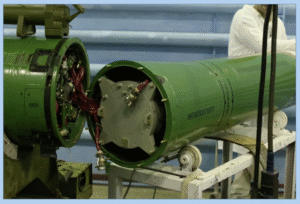
This image shows the second warhead present in some variants of the Kh-101 cruise missile. The inclusion of this additional warhead requires a smaller fuel tank in the missile, offering increased explosive weight in exchange for a reduced maximum range. (ARES)
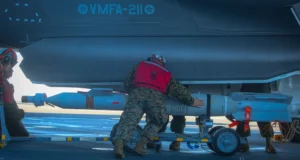
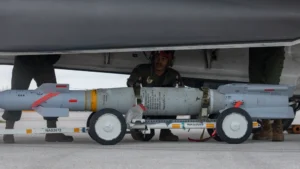
This image shows a GBU-12 series guided bomb being loaded onto a F-35B belonging to Marine Fighter Attack Squadron 211. Two of the control fins have not yet been installed in the Paveway’s guidance control section. (ARES)
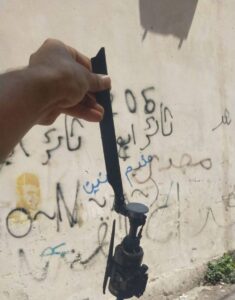
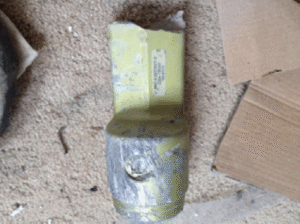
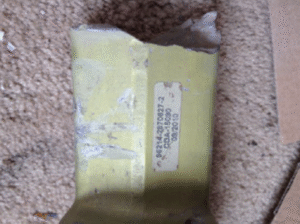
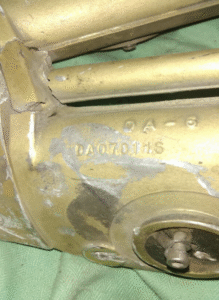
This image shows a remnant of a control actuator shaft from a Paveway guidance kit control section, found after a strike in Yemen in 2015. Markings giving the CAGE code for Raytheon (“96214”) and the part number (“2870627-2”) are both visible. The complete remnant can be seen in related entry 1559. (ARES)
This image shows a BLU-111 500-pound-class bomb paired with a Paveway II guidance kit, and an MXU-650 series airfoil group, or tail kit. This combination is designated the GBU-12 series in U.S. service. (ARES)
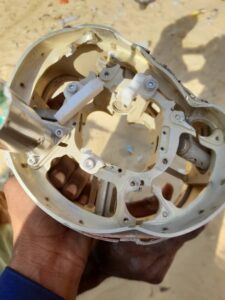
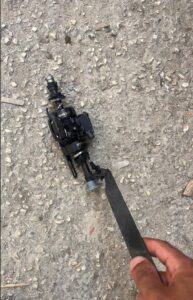
This image shows a close up view of an actuator assembly from an AGM-114 ‘Hellfire’ series missile. This assembly is what actuates the control fins, and the attachment point for one of the control fins is visible at the bottom right of the image. This assembly belongs to the control section, which is the rearmost section of the missile. (ARES)


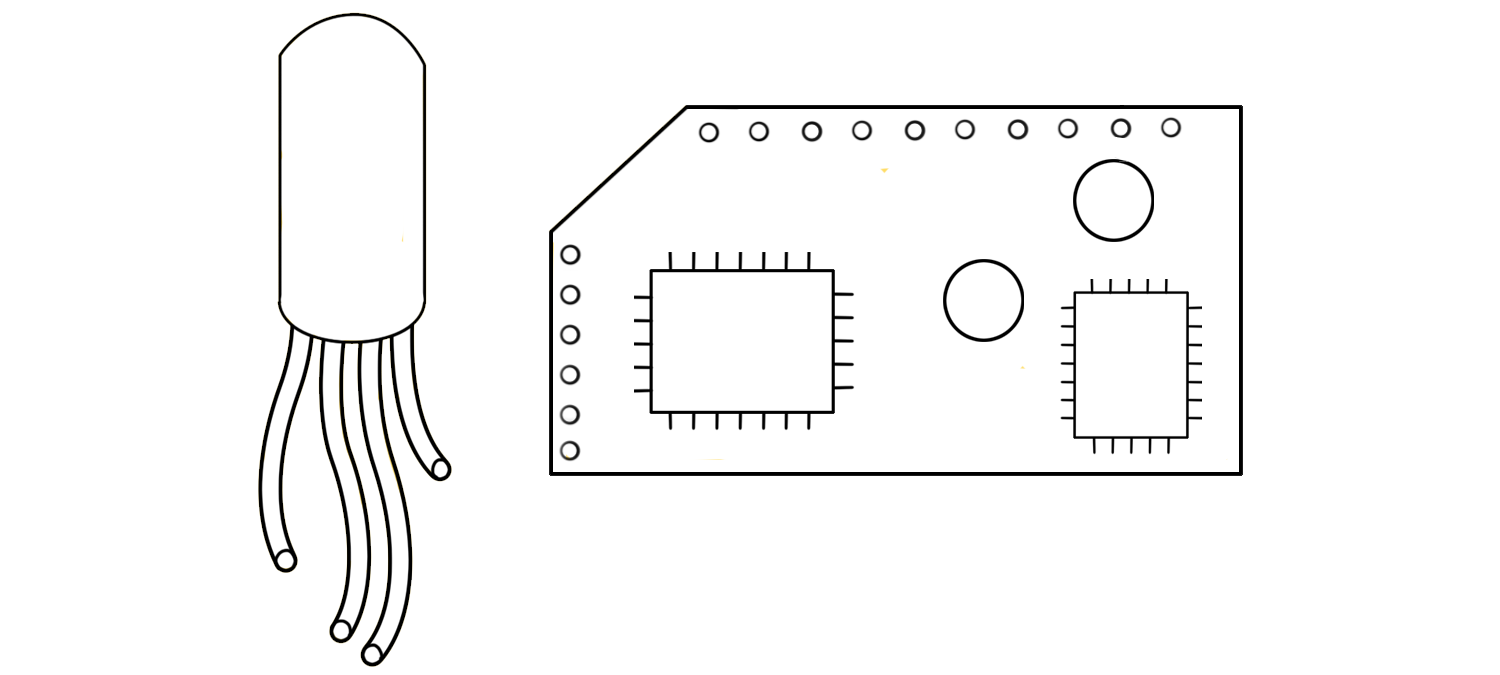 Parts defining the operation mechanisms of a projectile that are visible in the image