Key features defining the operation mechanisms of a projectile
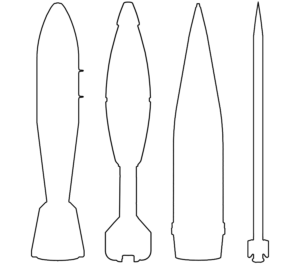
Mechanical Feature (10)
Whether a munition is guided or unguided
Guidance (2)
Where the munition is launched from and what it targets
Domain (7)
The type of fins visible on the munition
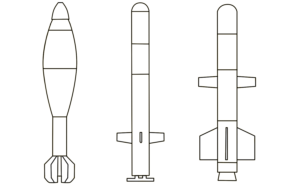
Fins Characteristic (6)
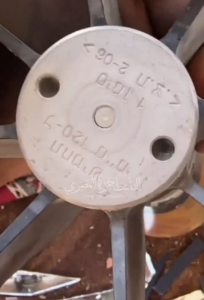
The nominal diameter of a projectile. For most modern munitions, this is expressed in millimetres (e.g. 82 mm mortar projectile), but older artillery gun projectiles may be described in inches.
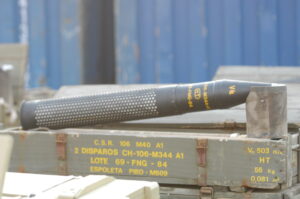
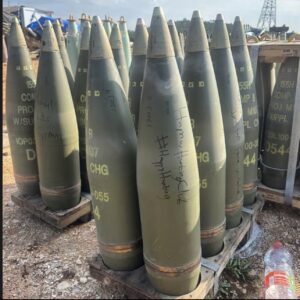
Markings on this 106 mm recoilless gun projectile indicate it is a M344A1 high explosive anti-tank (HEAT) round (“CH-106-M344-A1”) produced by Fábrica Nacional de Granada (“FNG”), Spain, in 1984 (“84”). The packing crate identifies the intended weapon as an M40A1 Cañón sin retroceso, or ‘recoilless rifle’ (“C.S.R. 106 M40 A1”). Other markings show that the round is fitted with an M509-type point-impact, base initiating (PIBD) fuze (“Espoleta PIBD M509”), and give additional details such as the expected muzzle velocity (“V₀”) of 503 m/s. (ARES)
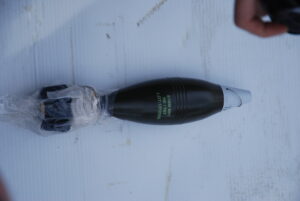
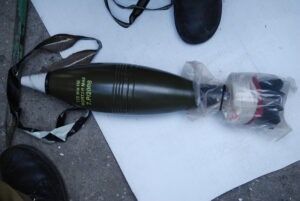
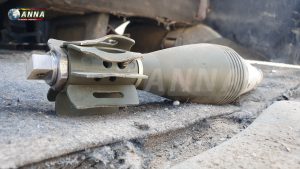
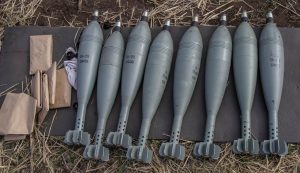
This Iranian M91 81 mm mortar projectile is marked to indicate it was produced in 2009. The AZ111A2 fuze fitted to the projectile is also marked with the same year of manufacture. (ARES)
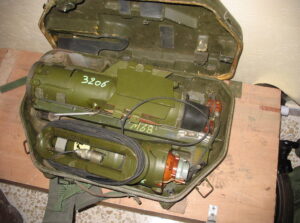
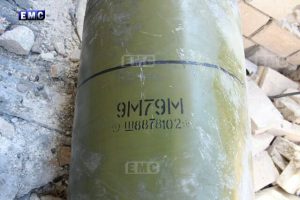
The 9M14 Malyutka anti-tank guided missile was designed and fielded by the Soviet Union in the 1960s. It uses an outdated guidance principle known as manual command to line-of-sight (MCLOS), in which the operator must manually adjust the course of the missile in flight. Nonetheless, this munition has been seen in several 21st-century conflicts. (ARES)
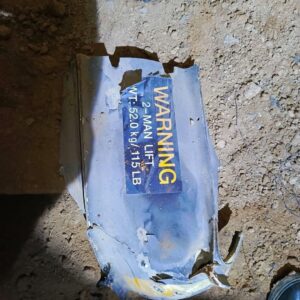
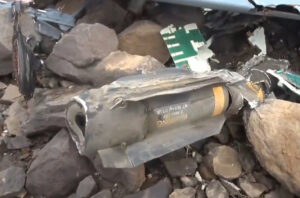
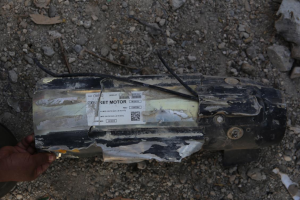
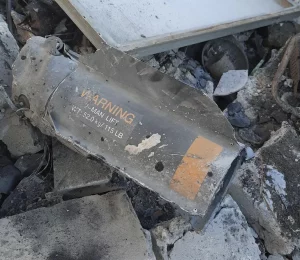
The AGM-179 Joint Air-to-Ground Missile (JAGM) is derived from the AGM-114 Hellfire series of air-to-surface missiles—and thus shares physical characteristics in terms of general construction, including rear fin placement. The marked weight of 52.0 kg (115 lbs) is generally believed to be an indicator that the rocket motor is from a JAGM; however, remnants marked with this weight have been observed from several years before the JAGM was initially fielded. (ARES)
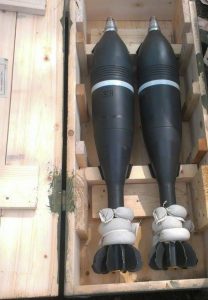
This Iranian M48 120 mm mortar projectile is marked to indicate it was manufactured in 2008. A plastic bag cable-tied to the tail of the munition protects the auxiliary, or supplemental, propellant charges fitted to the round. (ARES)
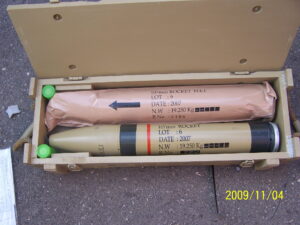
This Iranian copy of the Chinese Type 63 107 mm rocket is marked with a red stripe and text to indicate it is of the high explosive incendiary (“H.E.I”) type. Markings also show that it was produced in 2007. (ARES)
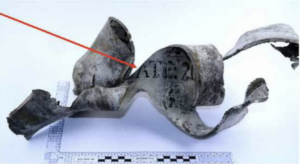
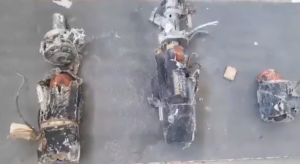
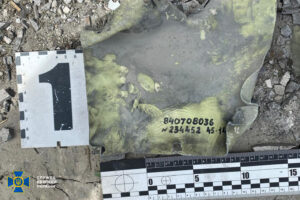
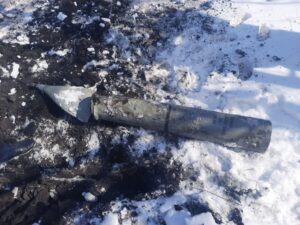
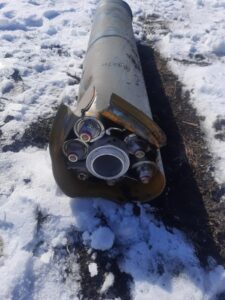
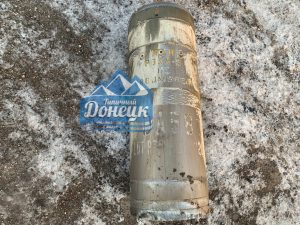
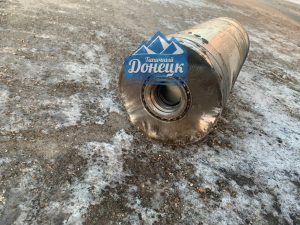
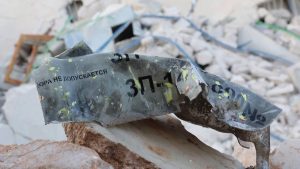
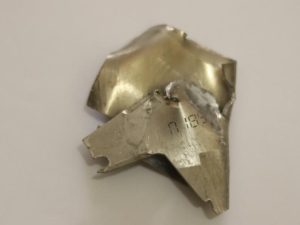
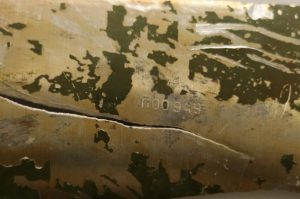
The remnants shown in these linked images have been falsely identified in Russian sources as chemical munitions. This image clearly exhibits the marking “NBK DM 1216”—the ‘NBK’ standing for the German Nebelkörper (‘smoke element’)—identifying this as one of four DM 1216 hexachloroethane/zinc (HC) smoke elements dispensed by the German DM 105 155 mm artillery gun projectile. Video of the incident shows all four elements being ejected from the base of the projectile in flight. (ARES)
The SPICE family of munitions, manufactured by Israeli aerospace and defence company Rafael, includes two models which use ‘bolt-on’ guidance kits. The SPICE 1000 and SPICE 2000 models convert 1,000- and 2,000-pound unguided aerial bombs, respectively, to precision guided munitions. (ARES)
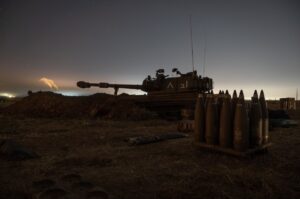
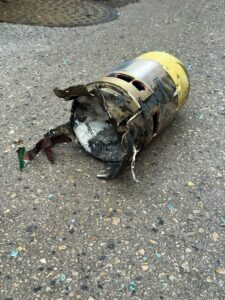
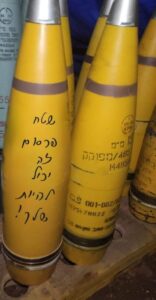
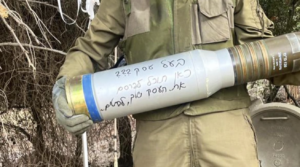
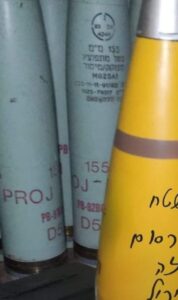
Israeli illumination munitions—often finished in a distinctive yellow—are sometimes mistaken for high explosive munitions by observers more familiar with the NATO or U.S. marking systems. This image shows an M485-pattern illumination projectile, a base-eject type that uses a parachute-retarded canister containing a powerful candle to illuminate the battlefield.
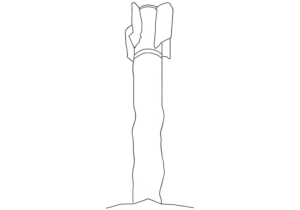
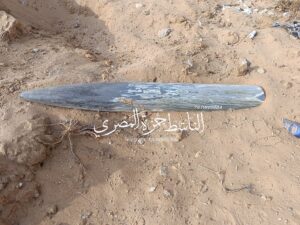
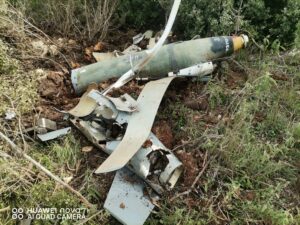
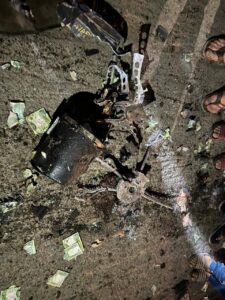
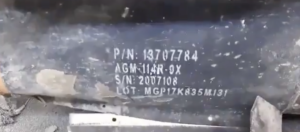
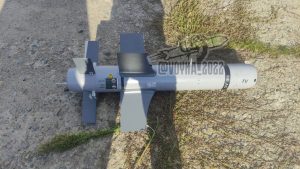
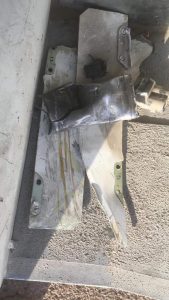
This image shows a component believed to be part of the folding-blade assembly used in the AGM-114R-9X variant of the Hellfire missile. Blades are used in place of an explosive payload to create a kinetic weapon that achieves a practical level of lethality whilst minimising collateral harm. (ARES)
Little is known with certainty about the AGM-114-R9X variant of the Hellfire missile, although it has been associated with high-profile targeted killings including those of senior al-Qaeda figures. The weapon functions as a kinetic-impact munition, using pop-out blades—rather than an explosive warhead—to reduce the prospects of collateral harm. (ARES)
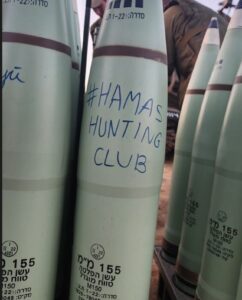
The M825A1 155 mm smoke projectile makes use of white phosphorus (WP) to generate a brilliant white smoke. Whilst WP does have incendiary effects, the method of dispersal in the case of the M825A1 is optimised for screening and marking purposes. (ARES)
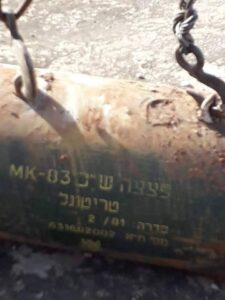
This image depicts an M117-series unguided aerial bomb. Belonging to a class of weapons referred to as ‘demolition bombs’—which use Tritonal or similar explosive compounds to generate a more powerful blast effect than TNT or Composition B—the M117 is an American design which dates to the Korean War era and is rarely seen in service with modern armed forces. (ARES)
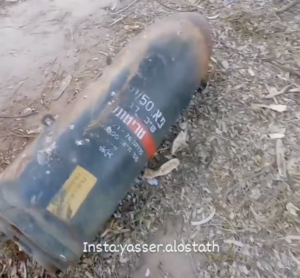
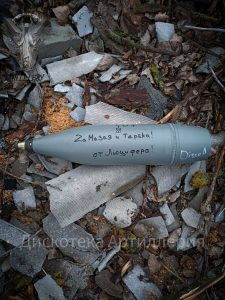
Some artillery projectiles, such as this M150 type, use a hexachloroethane-based composition (HC) to generate smoke for screening or marking purposes. In many armed forces, HC smoke munitions have partially replaced those relying on white phosphorus for similar effects. (ARES)
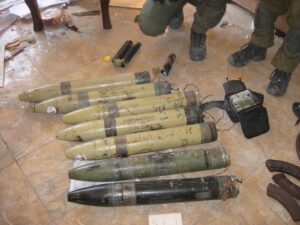
107mm spin-stabilized rockets of this design are often utilized by non-state actors in an indirect fire role. Like the original Chinese models that they are copied from, they do not require more than a simple electric power source and a rudimentary launch platform to achieve an acceptable level of accuracy. (ARES)
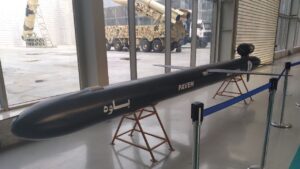
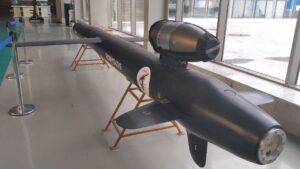
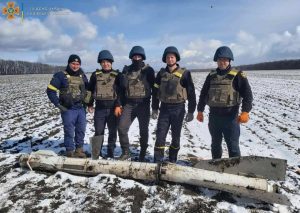
The various Iranian Qaem-series guided air-delivered bombs can be difficult to differentiate from one another. In this case, the wing (forward fin) assembly distinguishes this Qaem-5 from the visually similar Qaem-1. Note also that the name 'Qaem' has applied by Iran to other, unrelated munitions. (ARES)
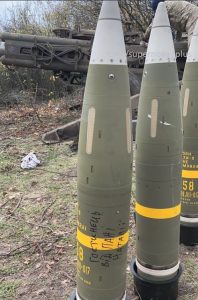
Once fired, four canards will deploy from the forward (ogival) section of these M982 Excalibur guided artillery projectiles. The narrow-shaped ports through which the canards deploy are a good indicator of a guided or extended-range artillery projectile. (ARES)
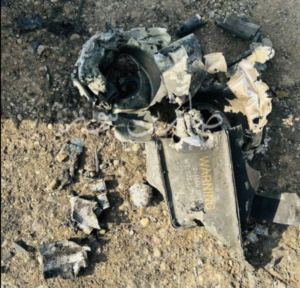
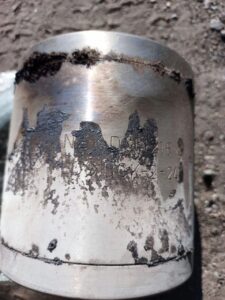
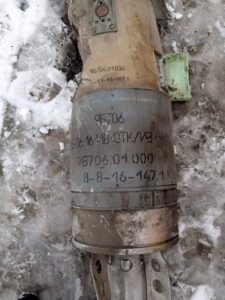
Many guided (or otherwise complex) munitions like this one are marked with additional information on individual assemblies or components. This can include information on sub-contractors that produced or integrated specific parts of a munition. (ARES)
In this image, a Ukrainian soldier is using an M1155 Enhanced Portable Inductive Artillery Fuze Setter (EPIAFS) to input the target coordinates and set functioning parameters for an M982 Excalibur guided artillery projectile. (ARES)
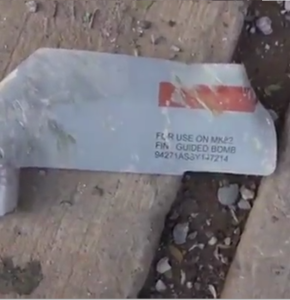
The MK 84 series of unguided air-delivered bombs can be converted to precision guided munitions by being fitted with guidance kits such as the Joint Direct Attack Munition (JDAM), SPICE 2000, or Paveway series. This MK 84 is also marked with a variant designation “MOD 4”. (ARES)
Russian air-delivered cluster bombs, such as this one, are often named using a designation that is a compound of the names of the cargo (carrier) bomb and the submunition it carries. For example, this RBK-500 unguided, air-delivered cluster bomb carries 268 PTAB-1M HEAT submunitions, and is thus designated the 'RBK-500 PTAB-1M'. (ARES)
This component is one of four pneumatically controlled canards from the guidance section of a Paveway II precision guided munition (PGM) conversion kit. When a Paveway II conversion kit is fitted to a MK 82 series unguided air-delivered bomb (note markings), the munition receives a GBU-12 series designation. (ARES)
Although this munition started out life as a mortar projectile of the M492-pattern, it has been modified to be dropped from an unmanned aerial vehicle (UAV) and, in its present state, could not be fired from a conventional mortar. As such, it is correctly classified here as an air-delivered bomb. (ARES)
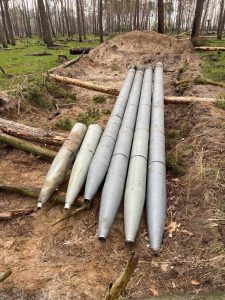
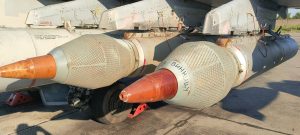
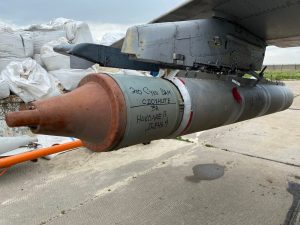
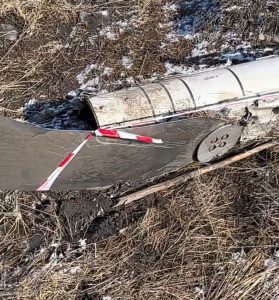
These S-25-O air-to-surface rockets are each loaded into a single-barrelled O-25 rocket launcher (sometimes called a 'launch tube' or 'rocket pod') that is affixed to an aircraft hardpoint. The over-calibre high explosive fragmentation warhead (of 420 mm in diameter) protrudes from the front of the tube. (ARES)
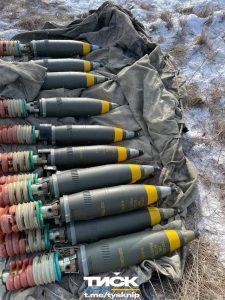
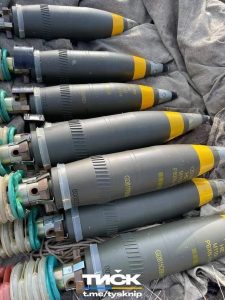
Whilst most mortars are smoothbore guns, some have a rifled bore. These M1101 120 mm mortar projectiles feature a 'pre-rifled' driving band—that is, a driving band with grooves cut at the factory to fit the mortar's rifling. (ARES)