The nominal diameter of a projectile. For most modern munitions, this is expressed in millimetres (e.g. 82 mm mortar projectile), but older artillery gun projectiles may be described in inches.
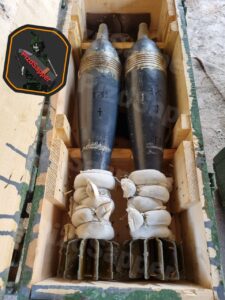
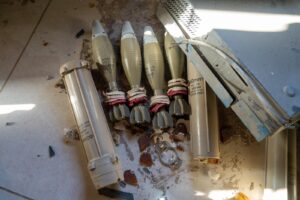
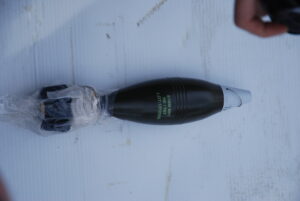
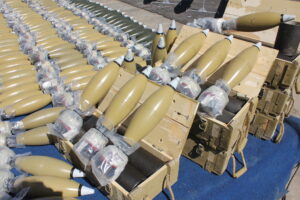
The two North Korean 120 mm high explosive (HE) mortar projectiles in this image are each fitted with five cloth bags affixed above the tailfins. These are incremental propellant charges (sometimes known as augmenting, auxiliary, or supplemental charges), the number of which can be varied along with a mortar’s elevation to adjust the trajectory and range of the munition when fired. (ARES)
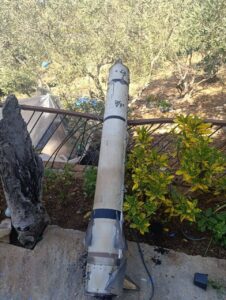
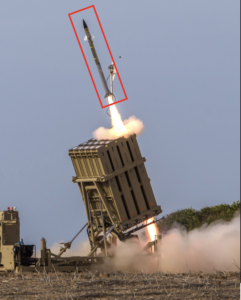
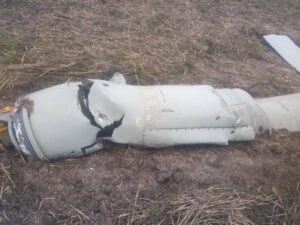
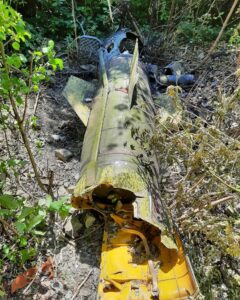
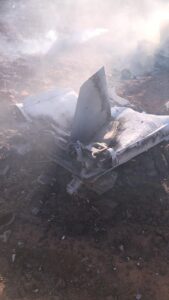
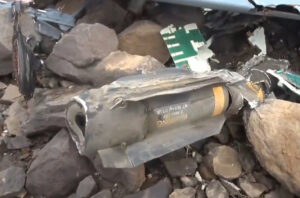
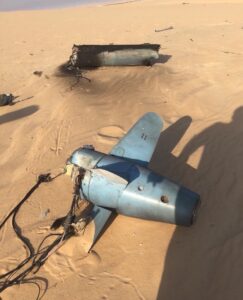
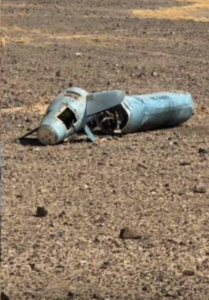
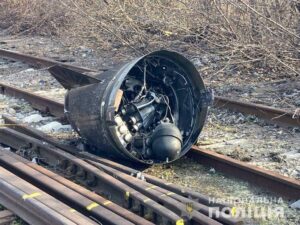
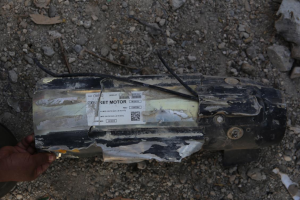
The Stunner surface-to-air missile fired by the David’s Sling air defence system is a two-stage interceptor, meaning that the munition contains two separate rocket motors for launch and propulsion. The first stage, or launch motor, detaches from the munition after a short time, before the second stage, or flight motor, ignites. The second stage motor, visible here, was found relatively intact. (ARES)
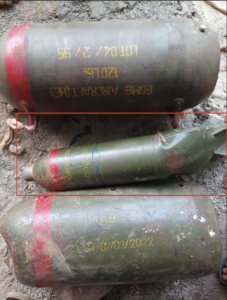
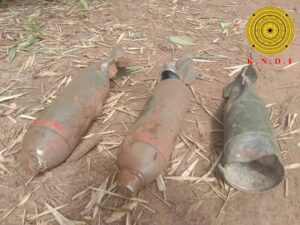
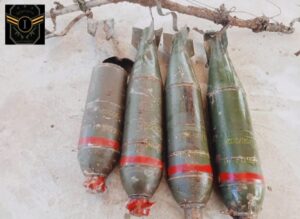
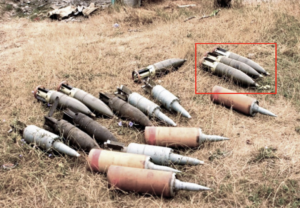
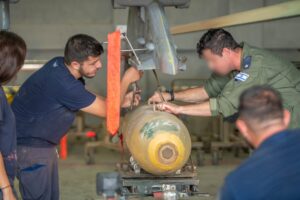
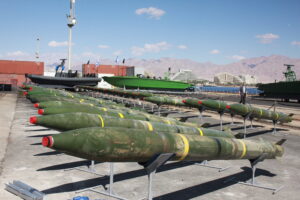
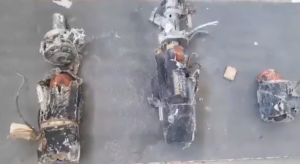
The arming vane for a nose fuze (painted red) is visible on each of the two leftmost MAB-10B6 air-delivered bombs in this image. As the bomb falls, air passing over the arming vane causes it to spin, arming the fuze. (ARES)
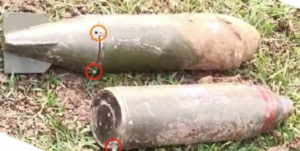
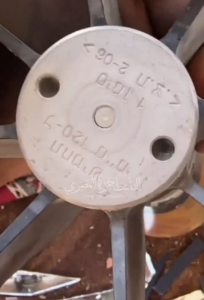
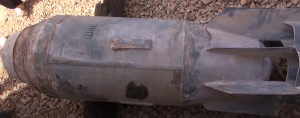
The circles in this image indicate where the fixed fin assembly is connected to the bomb body. Fin assemblies such as this help stabilise the bomb as it falls, improving the predictability of the trajectory and thus precision. Fins also orient the bomb as it falls so that munition travels nose-down. Orientation of the bomb on impact can play a role in fuze functioning, as well as the distribution of explosive or other effects. (ARES)
This Iranian 60 mm mortar projectile is of the ‘Long Range’ type described without a specific model name in various Iranian export catalogues and other sources. The designation as marked on projectiles and packaging is variable, with observed formulations including “60mm H.E. L.R.”, “60mm H.E L.R”, and “60mm HE L.R”. Sometimes, as here, “60mm L.R” is followed by “HE / TNT”. (ARES)
The RAFAEL Advanced Defense Systems SPICE 1000 guidance kit is fitted to MK 83-series 1,000-pound unguided air-delivered bombs to convert them to precision guided munitions. Like the JDAM-ER, it has a deployable wings to provide a ‘gliding’ attack trajectory. (ARES)
The M117 series of air-delivered bombs were historically referred to as ‘demolition bombs’, due to the more substantial blast effect they offer in comparison with so-called ‘general-purpose bombs’. This is achieved through the use of more energetic explosive compositions, such as Tritonal or Minol, which incorporate an oxidiser (typically aluminium powder). Today, munitions using such compositions are sometimes considered in the loose category of ‘enhanced blast munitions’, but the distinction between demolition and general-purpose bombs has largely disappeared. (ARES)
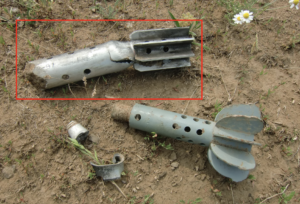
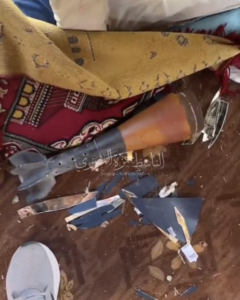
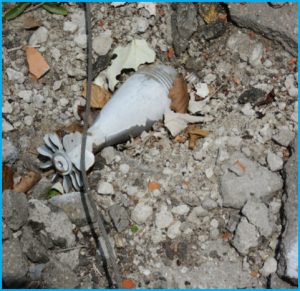
The M824 60 mm mortar projectile dispenses a parachute-retarded illumination flare which burns for 35 seconds. The tail portion of the munition (seen here) separates from the forward (body) portion and is sometimes found along the line of fire. (ARES)
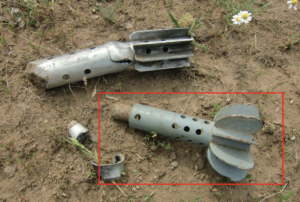
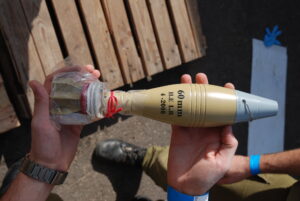
This is an Iranian 60 mm mortar projectile, marked to indicate it is of the ‘high explosive, long-range’ type (“H.E L.R”). Both the munition body and fuze are marked to with the year of production (“2008”). Whilst the tan colouring is often indicative of Iranian-made munitions (especially where the fins are also painted), this is not diagnostic, and a combination of physical features and markings should be assessed to reach a positive identification. (ARES)
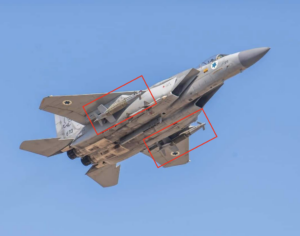
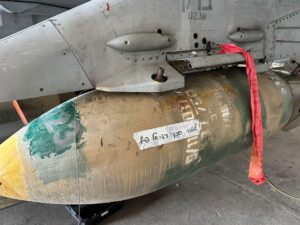
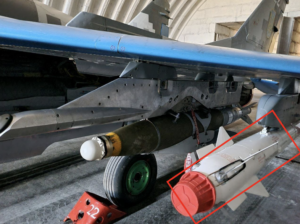
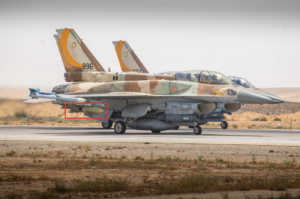
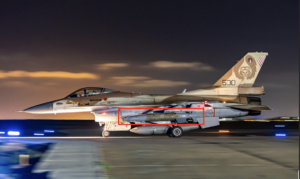
This image shows an Israeli Air Force F-16C fighter aircraft from 101 Squadron carrying a MK 84-series 2,000-pound-class air-delivered bomb fitted with a SPICE 2000 ‘bolt-on’ guidance kit. (ARES)
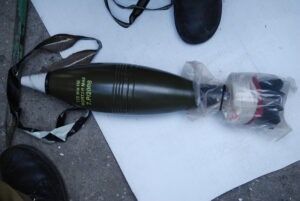
This Iranian M91 81 mm mortar projectile is marked to indicate it was produced in 2009. The AZ111A2 fuze fitted to the projectile is also marked with the same year of manufacture. (ARES)
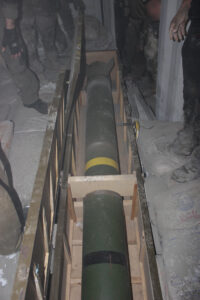
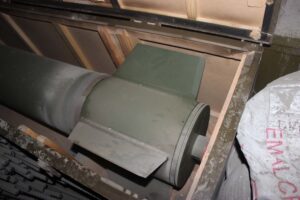
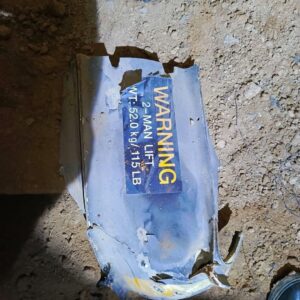
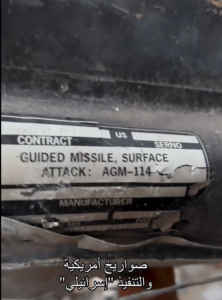
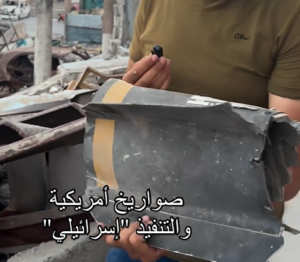
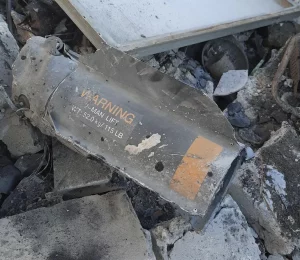
The AGM-179 Joint Air-to-Ground Missile (JAGM) is derived from the AGM-114 Hellfire series of air-to-surface missiles—and thus shares physical characteristics in terms of general construction, including rear fin placement. The marked weight of 52.0 kg (115 lbs) is generally believed to be an indicator that the rocket motor is from a JAGM; however, remnants marked with this weight have been observed from several years before the JAGM was initially fielded. (ARES)
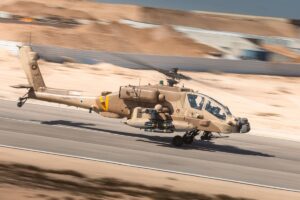
In this image, four AGM-114 Hellfire-series missiles can be seen fitted to an M299-series missile launcher, itself attached to the stub wings of this Israeli AH-64 Apache helicopter. In theory, the Apache could be armed with up to sixteen Hellfire missiles, but fewer are carried in practice to allow for other weapons and sensor payloads (ARES).
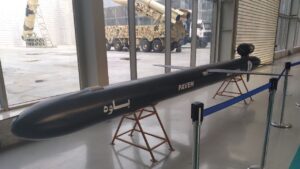
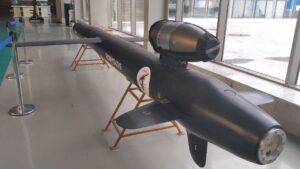
‘Khaibar-1’ is a designation given to a series of 302 mm rockets produced in Syria, possibly derived from the Chinese WS-1/WS-1B. The Khaibar-1 is also referred to as the M-302 or M302. (ARES)
This Iranian M48 120 mm mortar projectile is marked to indicate it was manufactured in 2008. A plastic bag cable-tied to the tail of the munition protects the auxiliary, or supplemental, propellant charges fitted to the round. (ARES)
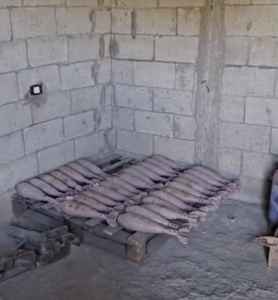
The physical features, colour scheme, and packaging of these 120 mm mortar projectiles are all consistent with Iranian manufacture, but the markings are mostly obscured in this image. (ARES)
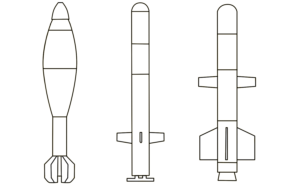
Some tank gun projectiles may have fins affixed to an extended ‘tail boom’, in a similar manner to a mortar projectile. Note, however, that the cylindrical tail assembly is not perforated as it would be for most mortar projectiles. Tank gun projectiles are also more likely to be generally cylindrical, rather than lachrymiform (teardrop-shaped). (ARES)
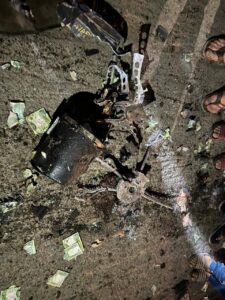
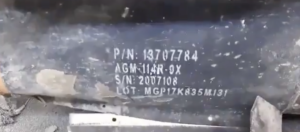
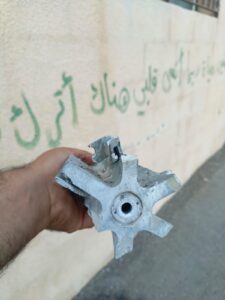
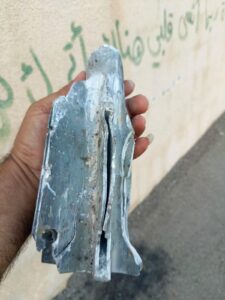
This image shows a component believed to be part of the folding-blade assembly used in the AGM-114R-9X variant of the Hellfire missile. Blades are used in place of an explosive payload to create a kinetic weapon that achieves a practical level of lethality whilst minimising collateral harm. (ARES)
Little is known with certainty about the AGM-114-R9X variant of the Hellfire missile, although it has been associated with high-profile targeted killings including those of senior al-Qaeda figures. The weapon functions as a kinetic-impact munition, using pop-out blades—rather than an explosive warhead—to reduce the prospects of collateral harm. (ARES)
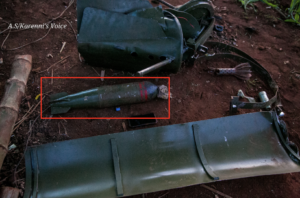
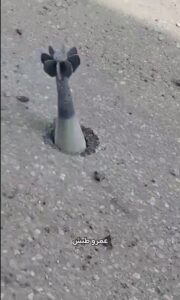
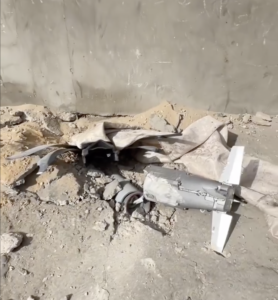
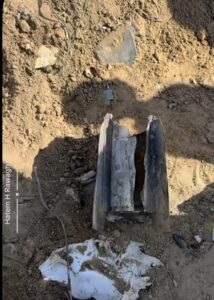
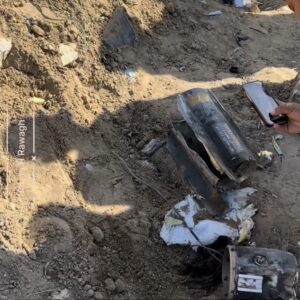
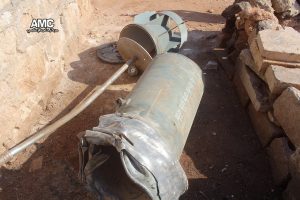
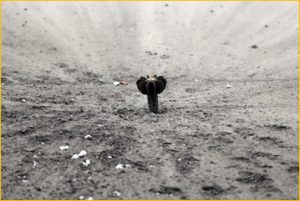
The image is of "a high-velocity shell fired from the main armament of a battle tank," Desmond Travers, former director of the Institute for International Criminal Investigations, told Airwars and AFP. "The calibre appears to be 120 mm, and the shell is fin-stabilised. The maximum effective range is five kilometers, but a skilled tank crew member should be able to hit a target the size of a car." (Airwars)
The M-54 ‘high-drag’ series of Soviet/Russian air-delivered bombs can be distinguished by two key identification features: 1.) the ballistic ring located in the forward portion of the bomb (missing in this example); and 2.) the presence of two or four rectangular, longitudinal ‘levelling bars’ (two can be seen in this example). (ARES)
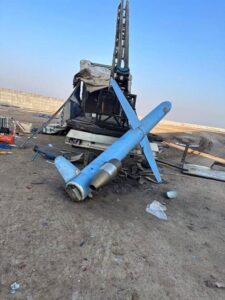
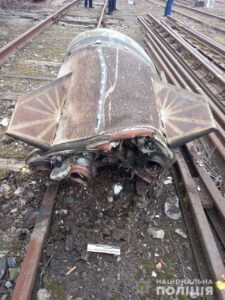
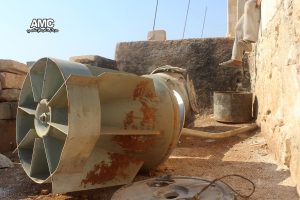
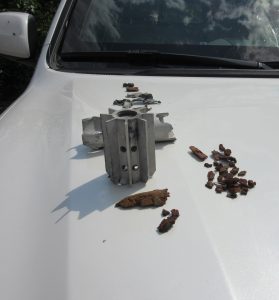
The 57E6 series of missiles fired from the 96K6 Pantsir system use a two-stage design that is unusual for surface-to-air missiles of this type. The remnant seen in this image is part of the missile’s booster section, which accelerates the second stage to a high velocity before separating. The booster section uses a distinctive toffee-brown, filament-wound composite body. (ARES)
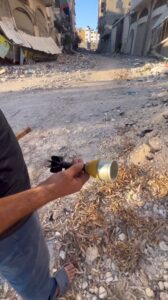
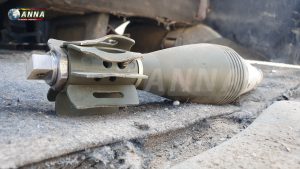
Although this munition started out life as a mortar projectile of the M492-pattern, it has been modified to be dropped from an unmanned aerial vehicle (UAV) and, in its present state, could not be fired from a conventional mortar. As such, it is correctly classified here as an air-delivered bomb. (ARES)
The fin assembly in the image bears a strong resemblance to those of other munitions employed in the same incident that have been identified as M49A2 mortar projectiles modified to be delivered by UAV. (ARES)
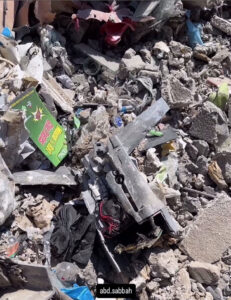
The munition remnants pictured here are likely to be from either a Russian OG-9 or a Bulgarian RHEF-9MA/GHEF-9MA recoilless gun projectile. However, based on the available information, positive identification cannot be not be made. (ARES)




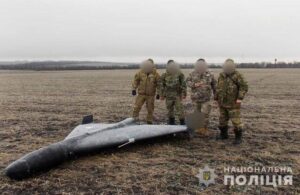
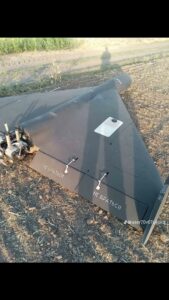
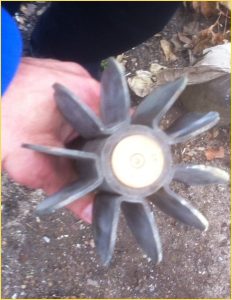
 Fins that do not move during the munition's flight