




201–300 of 933
Current Filter
Surface-to-Surface
Munitions launched from a ground-based weapons platform, whether on land or at sea, and designed to strike other surface targets.

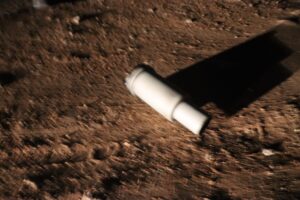
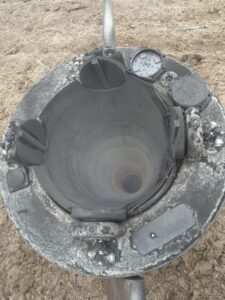

Analyst Note
28 November 2025
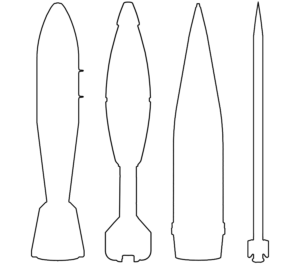
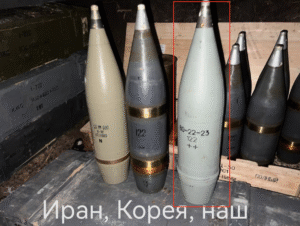
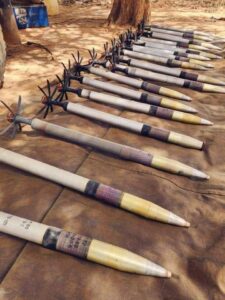
This image shows 122 mm high explosive (HE) artillery gun projectiles manufactured in three different states, L–R: Iran, North Korea, and Russia. Whilst these examples are distinct from one another—particularly in coloration, as well as the presence or absence of paint over the driving band and bourrelet—this is not always the case, and a combination of physical features and markings should be assessed before identification is made. (ARES)



Analyst Note
5 February 2026
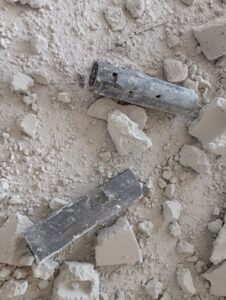
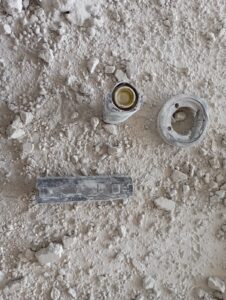
Pictured here are a pair of 106 mm M344A1 High Explosive Anti-Tank (HEAT) projectiles fitted with M509A1 point-initiating, base-detonating (PIBD) fuzes. These are designed to be fired from M40-series 106 mm recoilless rifles. Note that, despite the nominal 106 mm designations, the M40 has a bore diameter of 105 mm. (ARES)

Analyst Note
31 December 2025
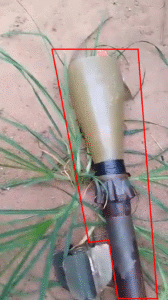
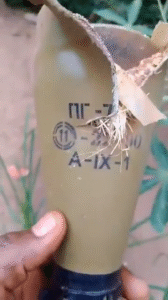
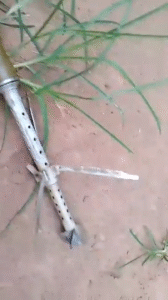
This PG-7VR recoilless gun projectile is painted in a tan colour often associated with Iranian production, but also used by other manufacturers. Iranian munitions have been seen and reported in Sudan with regularity. (ARES)

Analyst Note
31 December 2025
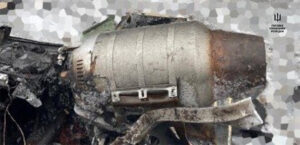
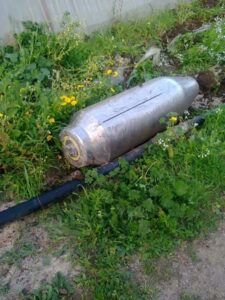
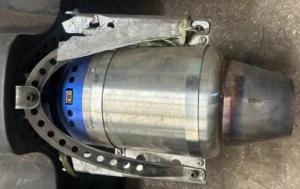
This image shows a Telefly JT80 jet engine, as used on Shahed-238 (Geran-3) UAVs. These jet engines are manufactured in China by Telefly Telecommunications Company. According to the manufacturer, each engine produces approximately 80kg of thrust. (ARES)
Analyst Note
31 December 2025
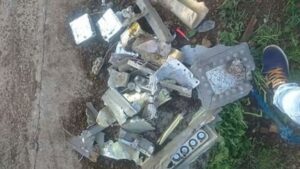
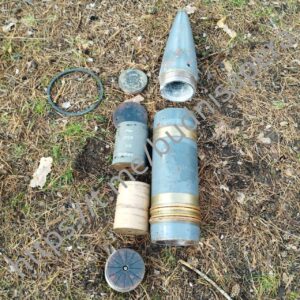
This image shows a North Korean 170 mm artillery projectile, as fired by the M-1978 Koksan self-propelled artillery gun. Very little is known of the M-1978 Koksan due to the secretive nature of North Korean arms development, but both high explosive and rocket-assisted high explosive projectiles are believed to be available. The designations ‘M-1978’ and ‘Koksan’ were applied by American military analysts identified the system in Koksan, North Korea, in 1978. (ARES)

Analyst Note
9 January 2026
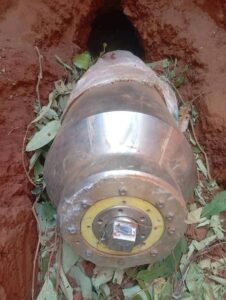
This image shows a WDU-36 series warhead as used in the RGM-/UGM-109 Tomahawk series of cruise missiles. The warhead design suggests this is likely a WDU-36/B from an RGM-/UGM-109E missile. The RGM-/UGM-109E Tomahawk Land Attack Missile (also known as TLAM Block IV) is an improved version of the BGM-109C TLAM-C. In cases where the missile strikes a building but does not function as intended, the dense, comparatively heavy warhead is often projected forwards of the point of impact. (ARES)

Analyst Note
9 January 2026
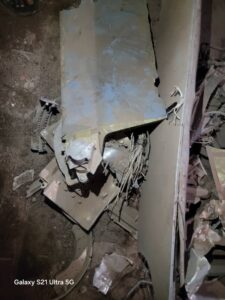
This image shows a WDU-36/B warhead as used in the RGM-/UGM-109 Tomahawk series of missiles. The WDU-36/B is the improved, lighter version of the previous WDU-25/B warhead. It is reported that the titanium-cased WDU-36/B weighs around 310 kg and carries a main charge of approximately 120 kg of PBXN-107 high explosives. (ARES)


Analyst Note
31 December 2025
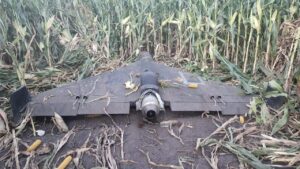
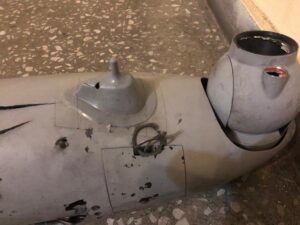
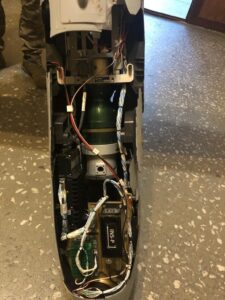
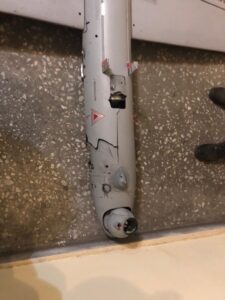
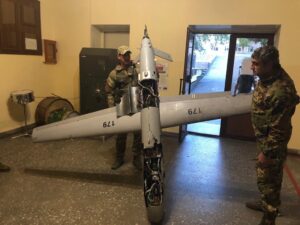
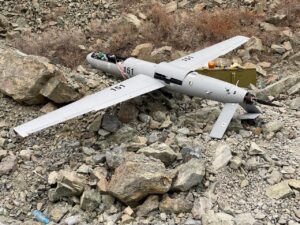
This image shows a one-way-attack (‘sacrificial’) UAV with the apparent warhead broken off. It is believed to have been attached to the grey mechanism located at the rear of the UAV, likely separating when the UAV was downed. (ARES)
Analyst Note
31 December 2025
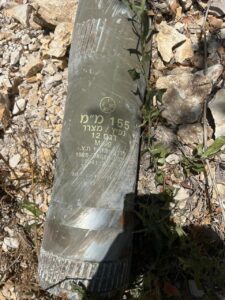
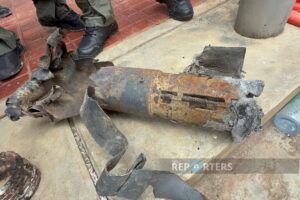
This image depicts remnants from a M999 (‘Barak Eitan’) 155 mm cluster munition. Reports indicate that the M999 artillery projectile carries nine M99 Dual-Purpose Improved Conventional Munition (DPICM) submunitions. (ARES)
Analyst Note
9 January 2026
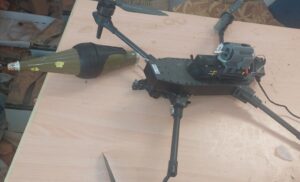
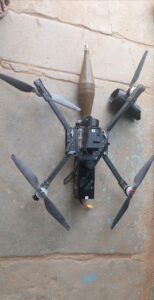
This image shows a one-way attack (OWA) UAV fitted with a high explosive anti-tank (HEAT) warhead adapted from a PG-7 series recoilless gun projectile. (ARES)


Analyst Note
28 November 2025
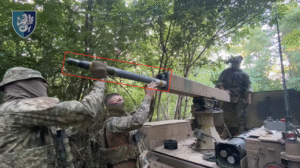
This image shows a Hydra-70 rocket fitted with an Advanced Precision Kill Weapon System (APKWS) guidance kit, converting it into a guided missile. In this case, the missile features an M151 high explosive (HE) warhead fitted with either an M427 or M423 point-detonating (PD) fuze. The rocket motor model cannot be determined from this source alone, but it is most likely to be a MK 66-series motor. The launcher appears to be a LAND-LGR4 model produced by Arnold Defense. (ARES)
Analyst Note
28 November 2025
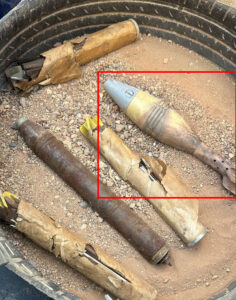
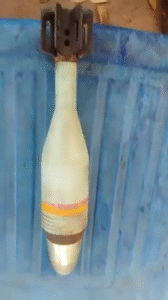
The physical features of this munition indicate that it is most likely an Iranian 60 mm ‘high explosive, long-range’ (“H.E. L.R.”) mortar projectile fitted with an AZ111A2 impact fuze. However, positive identification cannot be made based on the source imagery. (ARES)
Analyst Note
28 November 2025
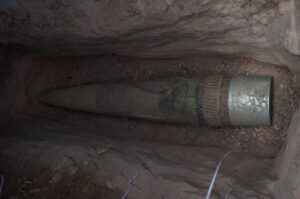
The munition depicted in this image is a type of aerodynamically optimised artillery projectile, in this case 155 mm in calibre, known as an ‘Extended Range Full-Bore (ERFB)’ design. This example is a cargo projectile fitted with a base-bleed (BB) base unit to further extend its range. This configuration is designated NR269, and reportedly contains 56 M46 dual-purpose (anti-personnel/anti-armour) submunitions. (ARES)
Analyst Note
28 November 2025
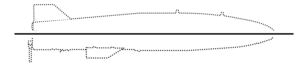
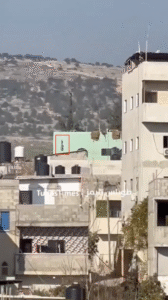
In this case, the tentative identification of this munition is possible based on an analysis of its silhouette, particularly the distinctive detachable warhead compartment that can be seen hanging from the base of the munition's body. In many cases, such an identification technique would not be possible to apply with confidence. (ARES)

Analyst Note
28 November 2025
This image shows the base of a 155 mm Extended Range Full-Bore (ERFB) projectile, fitted with either a base-bleed (BB) or a base-bleed, rocket-assisted (BB/RA) base unit. Although munitions of this type are capable of carrying submunitions and this image is associated with an incident about which claims of cluster munitions use have been made, there is not enough of the projectile visible in the source images to determine what type of payload was carried by this particular round. (ARES)
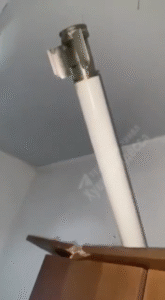
Analyst Note
28 November 2025
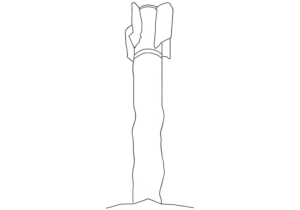
This image shows the rear section of a Hydra-70 rocket. The Hydra-70 uses the MK 66 series of rocket motors, visible here, but can be fitted with at least 11 different warheads. They can also be fitted with the Advanced Precision Kill Weapon System (APKWS) ‘bolt-on’ guidance kit, converting an unguided rocket into a guided missile. From the available imagery, it is not clear with which warhead or guidance section this munition may have been fitted. (ARES)
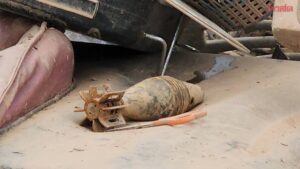
Analyst Note
28 November 2025
This image shows an M49-series 60 mm high explosive (HE) mortar projectile, or a copy thereof. Due to the state of the round the available imagery, the specific model or variant cannot be determined. The fuze is also not clearly visible. Most M49 mortar projectiles use an M525, M717, M935, or similar point-detonating (PD) fuze. (ARES)
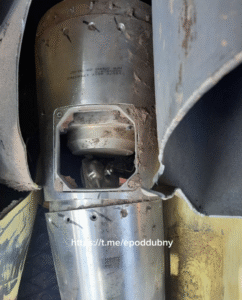
Analyst Note
28 November 2025
This munition remnant is marked with a manufacturer’s CAGE Code (“MFR-05DN8”) which indicates it was produced by Klune Industries. Klune Industries is a sub-contractor on the GMLRS contract. (ARES)
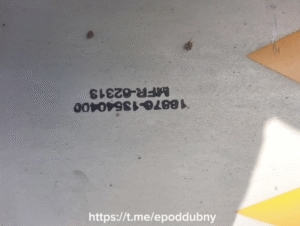
Analyst Note
21 November 2025
This munition remnant is marked with a manufacturer’s CAGE Code (“MFR-62313”) which indicates it was produced by Lockheed Martin. Lockheed Martin is the primary contractor that makes GMLRS missiles. (ARES)
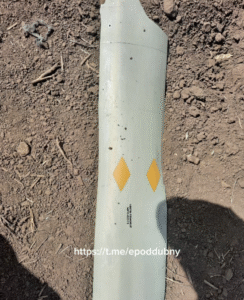
Analyst Note
28 November 2025
This image shows a remnant from an American M30 Guided Multiple Launch Rocket System(GMLRS) missile, which carries M77/M101 submunitions. The yellow diamond markings indicate a payload of explosive submunitions. (ARES)
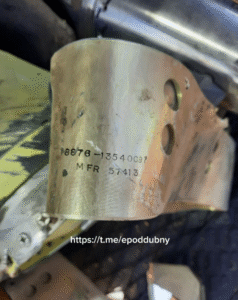
Analyst Note
28 November 2025
This munition remnant is marked with a manufacturer’s CAGE Code (“MFR-57413”) which indicates it was produced by the Maine Machine Products Company, a sub-contractor on the GMLRS contract. (ARES)
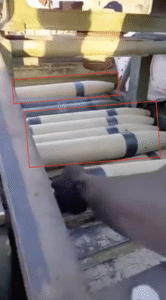
Analyst Note
28 November 2025
This image shows several 107 mm rockets of the Type 63 pattern. Whilst developed by China, munitions of this design are now produced by several countries around the world, including Iran, North Korea, and Sudan. The state-owned Military Industry Corporation (MIC) of Sudan produces a copy of the Type 63 known as the TAKA-01, TAKA-1, or TAKA-107. (ARES)

Analyst Note
28 November 2025
Based on the tail-fin assembly design and relative size, the item pictured appears to be a 122 mm rocket. However, it is unclear if this image shows a Russian 9M22-series (‘Grad’) rocket, a Chinese Type 81 rocket, or a similar variant from a different country of origin. (ARES)
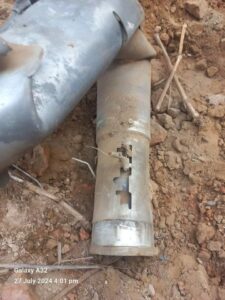
Analyst Note
28 November 2025
This images appears to show the remnants of a 122 mm rocket. It is unclear what the country of origin is, but it is most likely a 9M22-series or Type 81-series rocket. (ARES)
2 Analyst Notes
28 November 2025
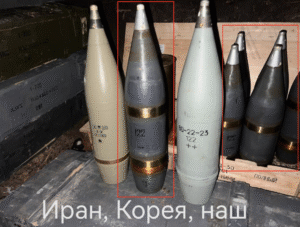
This image shows 122 mm high explosive (HE) artillery gun projectiles manufactured in three different states, L–R: Iran, North Korea, and Russia. Whilst these examples are distinct from one another—particularly in coloration, as well as the presence or absence of paint over the driving band and bourrelet—this is not always the case, and a combination of physical features and markings should be assessed before identification is made. (ARES)
2 Analyst Notes
25 November 2025
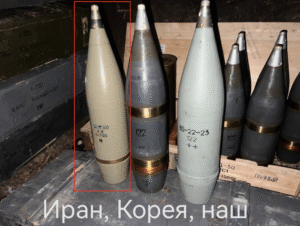
This image shows 122 mm high explosive (HE) artillery gun projectiles manufactured in three different states, L–R: Iran, North Korea, and Russia. Whilst these examples are distinct from one another—particularly in coloration, as well as the presence or absence of paint over the driving band and bourrelet—this is not always the case, and a combination of physical features and markings should be assessed before identification is made. (ARES)




Analyst Note
15 September 2025
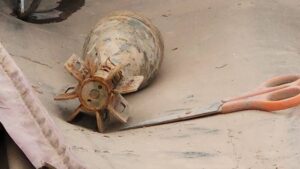
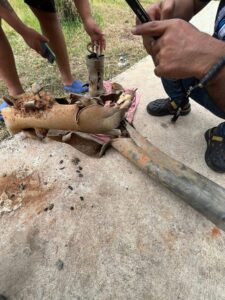
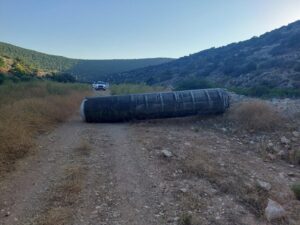
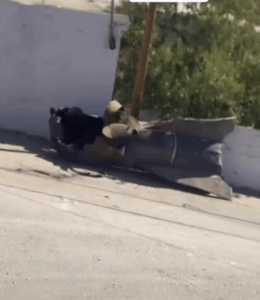
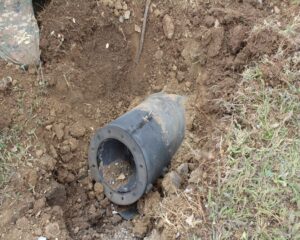
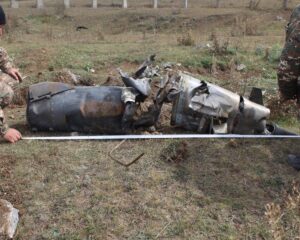
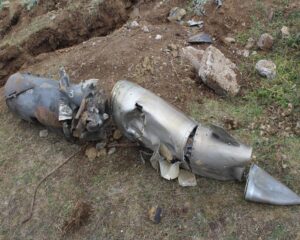
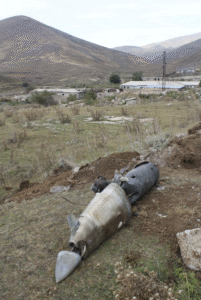
This image shows the damaged rocket motor section of a ballistic missile that was fired by the Houthis in Yemen towards Israel and likely intercepted. The Houthis employ ballistic missiles that are supplied by Iran, and given different names. In Houthi service, the Iranian Kheibar Shekan missile is known as the Hatem-2. (ARES)

Analyst Note
5 October 2025
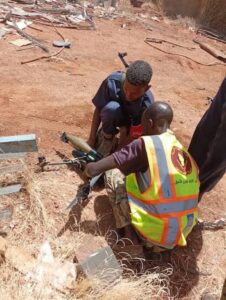
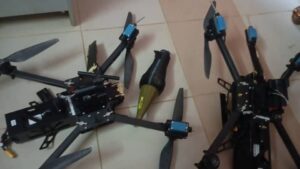
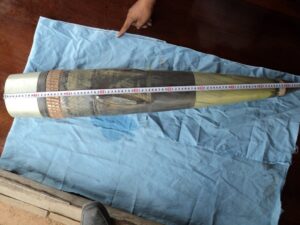
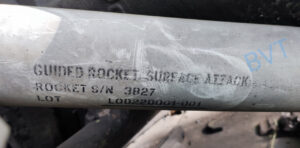
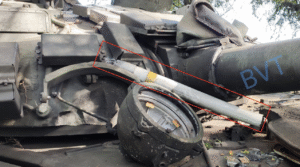
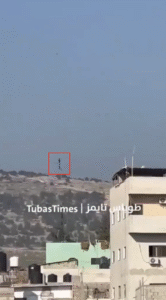
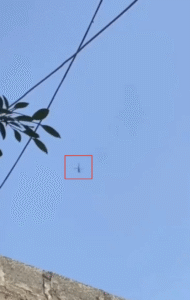
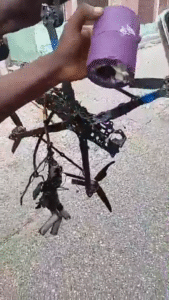
The image shows a one-way-attack (OWA) UAV that appears to have crashed, but failed to function. It consists of an FPV chassis, as well as some of the essential components required for flight and the explosive charge (purple container). The initiator and other parts relevant to both flight and the munition’s function are not visible. This appears to be craft-produced ‘sacrificial’ UAV. (ARES)

Analyst Note
29 September 2025
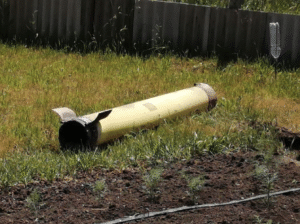
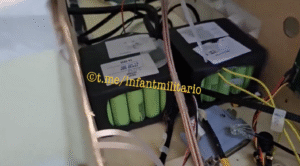
This photo shows some of the lithium-ion power banks found within a Gerbera UAV. These are used to power the onboard avionics, control surfaces, communications hardware, camera, and other components. The quantity and type of batteries fitted to the Gerbera will often vary based on the role for which the UAV has been configured—one-way attack (OWA; i.e., a ‘sacrificial’ munition), reconnaissance, signal relay, or decoy—and which specific hardware has been installed to effect this mission. (ARES)

Analyst Note
29 September 2025
This photo shows the fuel bladder of a Gerbera UAV, which still contains some fuel. It is likely that a bladder is used—rather than a rigid tank—to save on both weight and cost. Some variants of the Gerbera have been observed to be fitted with a second bladder in the forward section of the fuselage, serving to extend the UAV’s range. (ARES)
Analyst Note
29 September 2025
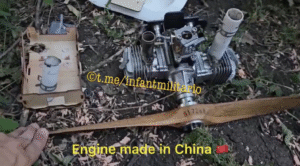
The DLE60 two-stroke petrol (gasoline) engine pictured here is the standard engine found on Gerbera UAVs. It is produced by the Chinese company Mile Haoxiang Technology Co., Ltd. and marketed specifically for use in UAVs. Although the Gerbera is manufactured in Russia, the engine and many other key components continue to be supplied from Chinese sources. (ARES)

Analyst Note
29 September 2025
This image shows a Controlled Reception Pattern Antennas (CRPA) unit installed on a Gerbera-series UAV. CRPAs are specialised antenna arrays that help protect GPS receivers from interference, spoofing, and jamming. This particular model, featuring four antennas, was first observed on the Shahed-136 UAV and has since been routinely seen fitted to Gerbera-series UAVs. An alternative array, with six antenna elements, has also been observed, reflecting the varied and ever-evolving state of electronic warfare in Ukraine. (ARES)
Analyst Note
29 September 2025
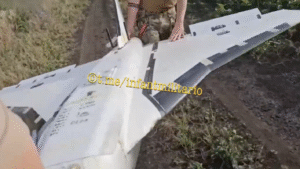
A Gerbera-series UAV is pictured here being carried by just two Ukrainian soldiers. This highlights the Gerbera’s lightweight design—the airframe is mostly constructed from Styrofoam and wood, which saves on both weight and cost. This particular example does not bear signs of significant damage, suggesting that it either malfunctioned or was brought down by EW and crashed. (ARES)
Analyst Note
29 September 2025
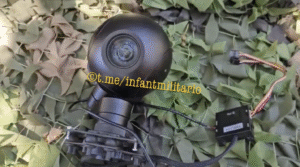
This image shows an A40 Pro camera, manufactured by the Chinese company Viewpro UAV and design specifically for use in UAVs. The black box to the right of the camera is the control box which manages video output, camera control, and power. The manufacturer claims this model has a 40× optical zoom, AI detection and tracking, and 3-axis gyro-stabilisation. The company further claims that it can customise the onboard AI recognition based on “target characteristics” provided by the client. Numerous Gerberas fitted with this model of camera are known to have been recovered by Ukrainian forces, although it is by no means the only camera model in use. (ARES)
Analyst Note
29 September 2025
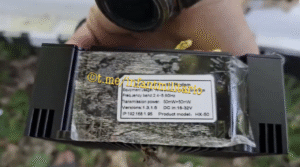
This image shows the back surface of a wireless communications module contained within a downed Gerbera UAV. Although labeled as an HX-50 model designed for fixed locations, Ukrainian military analysis indicates this is an XK-F358 mesh-network module more suitable for use in UAVs. See OSMP1646 for further details. (ARES)