Colour of all, or some, of the markings on the munition
Marking Colour (11)
Language or script of the marking on a munition
Marking Script (10)
Condition of the munition pictured
Condition (6)
Key features defining the operation mechanisms of a projectile
Mechanical Feature (10)
Whether a munition is guided or unguided
Guidance (2)
Where the munition is launched from and what it targets
Domain (7)
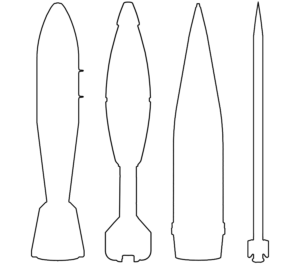
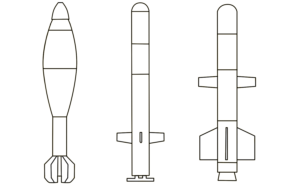
The type of fins visible on the munition
Fins Characteristic (6)
The nominal diameter of a projectile. For most modern munitions, this is expressed in millimetres (e.g. 82 mm mortar projectile), but older artillery gun projectiles may be described in inches.
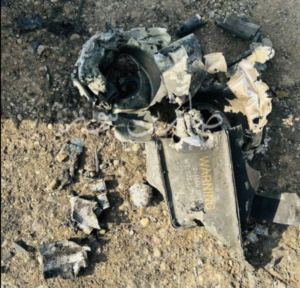
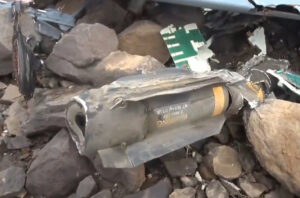
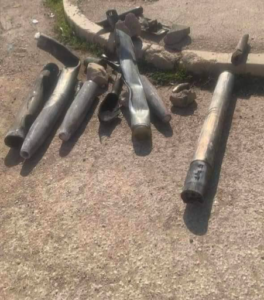
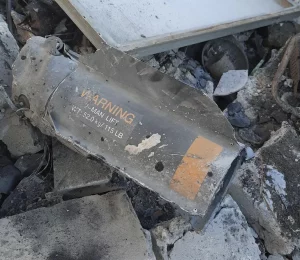
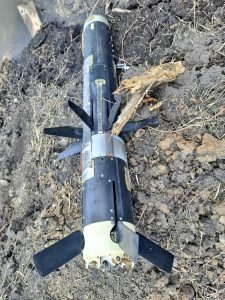
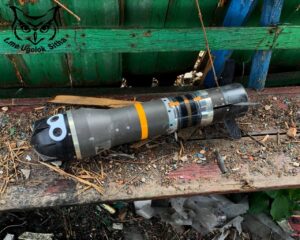
The AGM-179 Joint Air-to-Ground Missile (JAGM) is derived from the AGM-114 Hellfire series of air-to-surface missiles—and thus shares physical characteristics in terms of general construction, including rear fin placement. The marked weight of 52.0 kg (115 lbs) is generally believed to be an indicator that the rocket motor is from a JAGM; however, remnants marked with this weight have been observed from several years before the JAGM was initially fielded. (ARES)
In this image, four AGM-114 Hellfire-series missiles can be seen fitted to an M299-series missile launcher, itself attached to the stub wings of this Israeli AH-64 Apache helicopter. In theory, the Apache could be armed with up to sixteen Hellfire missiles, but fewer are carried in practice to allow for other weapons and sensor payloads (ARES).
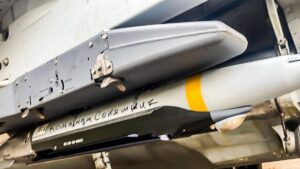
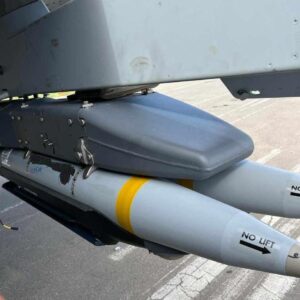
In this image, two GBU-39 Small Diameter Bombs are attached to a BRU-61/A bomb rack. The Ukrainian Air Force adapted this American-designed bomb rack to fit their Soviet-designed Mikoyan MiG-29 fighter aircraft. The BRU-61/A can carry up to four GBU-39 air-delivered bombs. (ARES)
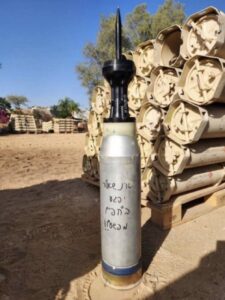
This is an Israeli 120 mm tank gun round, of the ‘armour-piercing, fin-stabilised discarding sabot – tracer’ (APFSDS-T) type. The physical features identify it as either the M322 or M338.
The projectile (penetrator) of this round has no explosive content and relies on kinetic energy to penetrate armoured targets. When a projectile is of a smaller calibre than the gun’s bore, a sabot is sometimes used to ensure the projectile is centred in the bore and to trap the gas from the propellant of the cartridge and propel the projectile. In flight, the sabot separates into two or more pieces, sometimes called ‘petals’, often found along the line of fire before the impact point. (ARES)
Some tank gun projectiles may have fins affixed to an extended ‘tail boom’, in a similar manner to a mortar projectile. Note, however, that the cylindrical tail assembly is not perforated as it would be for most mortar projectiles. Tank gun projectiles are also more likely to be generally cylindrical, rather than lachrymiform (teardrop-shaped). (ARES)
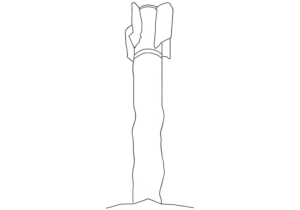
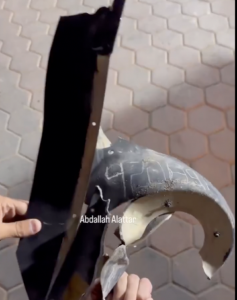
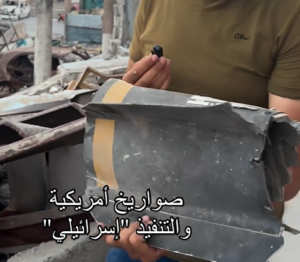
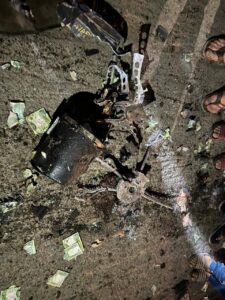
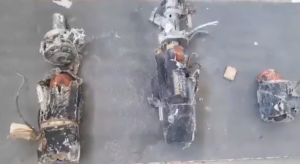
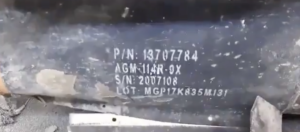
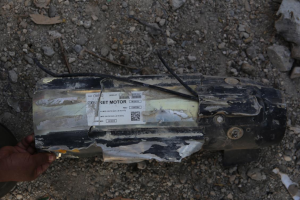
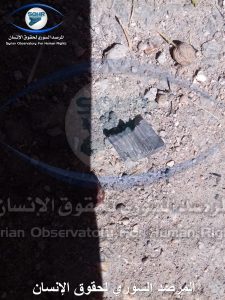
This image shows a component believed to be part of the folding-blade assembly used in the AGM-114R-9X variant of the Hellfire missile. Blades are used in place of an explosive payload to create a kinetic weapon that achieves a practical level of lethality whilst minimising collateral harm. (ARES)
Little is known with certainty about the AGM-114-R9X variant of the Hellfire missile, although it has been associated with high-profile targeted killings including those of senior al-Qaeda figures. The weapon functions as a kinetic-impact munition, using pop-out blades—rather than an explosive warhead—to reduce the prospects of collateral harm. (ARES)
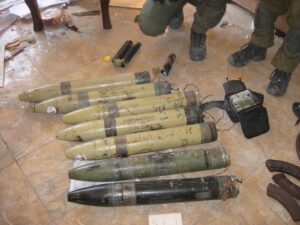
107mm spin-stabilized rockets of this design are often utilized by non-state actors in an indirect fire role. Like the original Chinese models that they are copied from, they do not require more than a simple electric power source and a rudimentary launch platform to achieve an acceptable level of accuracy. (ARES)
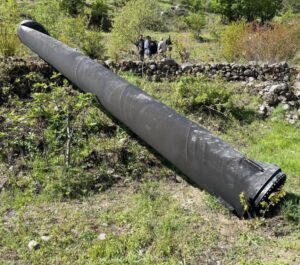
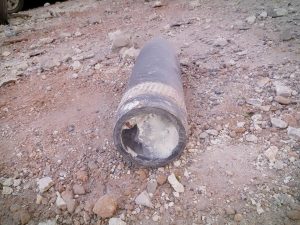
The 57E6 series of missiles fired from the 96K6 Pantsir system use a two-stage design that is unusual for surface-to-air missiles of this type. The remnant seen in this image is part of the missile’s booster section, which accelerates the second stage to a high velocity before separating. The booster section uses a distinctive toffee-brown, filament-wound composite body. (ARES)
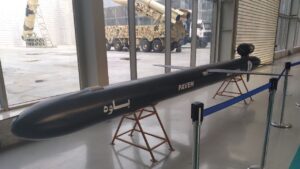
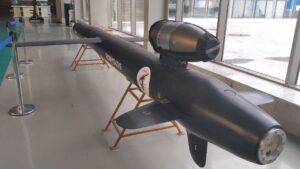
As a result of the rapid introduction of new models and variants during ongoing conflicts, sometimes a munition is issued with a provisional designation, or with no designation at all. In other cases, the designation is not yet known to researchers. (ARES)
The Next-generation Light Anti-tank Weapon (NLAW) uses an uncommon form of guidance known as predicted line-of-sight (PLOS). PLOS guidance calculates the anticipated position of a moving target prior to launch, with the munition using inertial guidance to fly to the projected impact point. This fire-and-forget technique allows the operator to move positions immediately after firing, and is generally cheaper than other fire-and-forget guidance types. (ARES)