Colour of all, or some, of the markings on the munition
Marking Colour (11)
Language or script of the marking on a munition
Marking Script (10)
Condition of the munition pictured
Condition (6)
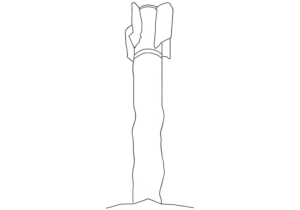
Key features defining the operation mechanisms of a projectile
Mechanical Feature (10)
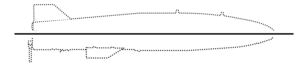
Whether a munition is guided or unguided
Guidance (2)
Where the munition is launched from and what it targets
Domain (7)
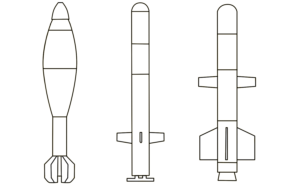
The type of fins visible on the munition
Fins Characteristic (6)
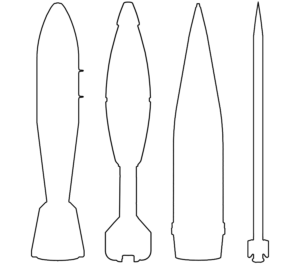
The nominal diameter of a projectile. For most modern munitions, this is expressed in millimetres (e.g. 82 mm mortar projectile), but older artillery gun projectiles may be described in inches.
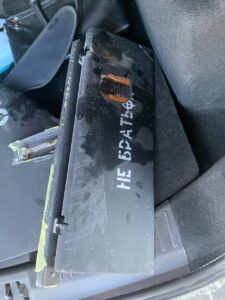
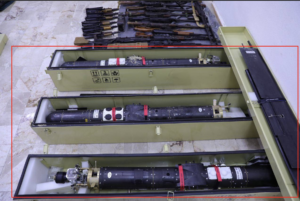
This image shows a Mikholit glide bomb, with its warhead removed (green cylinder on the left side of the box). The fins that spring outward when deploye have been taped down. This Mikholit was reportedly recovered by the Israeli Defense Forces (IDF) from Hamas, who had captured the bomb after it failed to function when originally deployed by the IDF. (ARES)
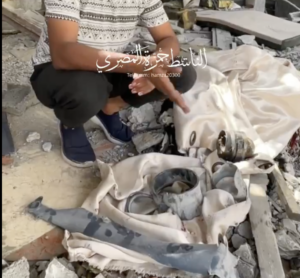
This image shows two Mikholit air-delivered bombs (‘glide bombs’), and four Mikholit warheads. There are at least two different variants of warheads available for the Mikholit glide bomb. The green cylinder on the left is a blast (high explosive) warhead, whilst the other three warheads are shaped charge warheads which incorporate additional fragmentation. Blast warheads of this type have also been seen with red markings, while the shaped charge warheads have been seen with yellow markings. (ARES)
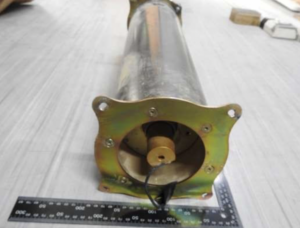
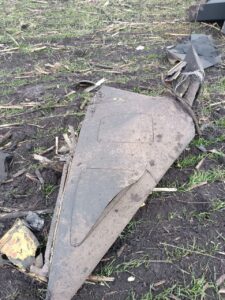
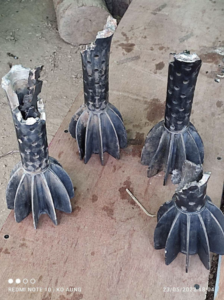
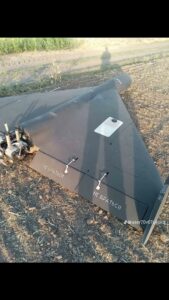
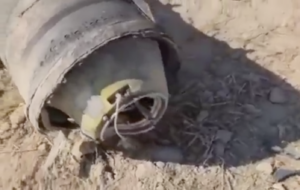
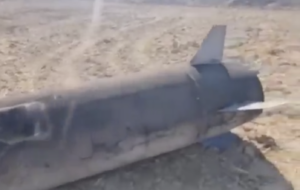
This image shows the rear fin section that is attached to a M-302/Khaibar-1/Fadi series rockets to add guidance capabilities. This rear fin section is installed, along with a forward control section between the warhead and the rocket motor. The guided munition, now classified as a missile, is referred to as a Nasr-1/Nasr-2. A similar, but larger, rear fin section is fitted to Zelzal rockets to convert them to guided munitions. (ARES).
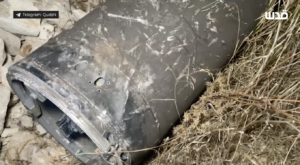
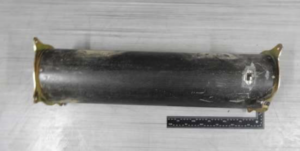
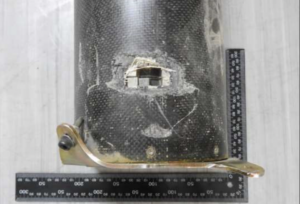
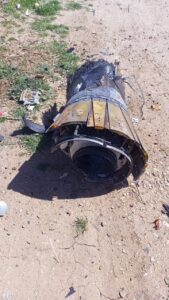
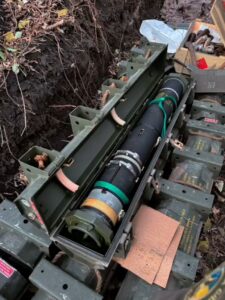
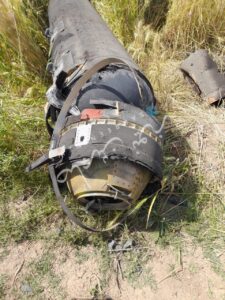
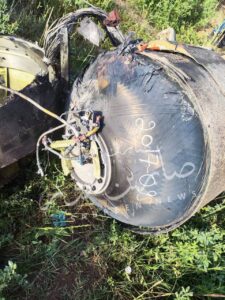
This image shows the rocket motor of a Kheibar Shekan or Fattah-1 medium-range ballistic missile (MRBM). The Fattah-1 was publicly unveiled by Iran in June 2023, with very few images surfacing since that time. Due to the lack of available reference material, differentially identifying the Kheibar Shekan and Fattah-1 is difficult. The missile components displayed at unveilings and public displays are also often different from those used in production models. (ARES).
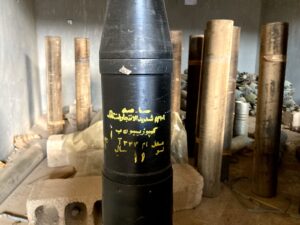
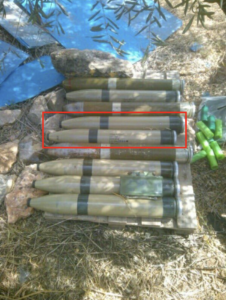
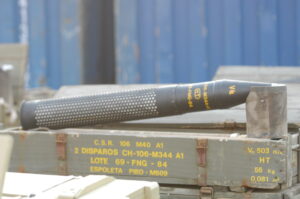
This image shows an Iranian M344 106 mm recoilless gun projectile. The M344 is a high explosive anti-tank (HEAT) munition, containing a shaped charge that is designed to penetrate armour. (ARES)
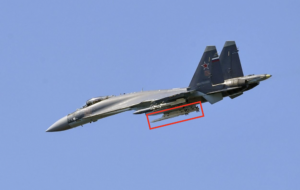
Two R-77 air-to-air missiles (NATO reporting name: AA-12 Adder) are carried in this photograph by a Russian Aerospace Forces Sukhoi Su-35 fighter aircraft. Key markings, including the aircraft’s bort number (a coloured numeral that acts as a unit or base identifier), have been digitally obscured. (ARES)
The Armement Air-Sol Modulaire (AASM; ‘Modular Air-to-Ground Armament’) family of French bolt-on guidance kits are fitted to air-delivered bombs of various sizes in a similar fashion to American JDAM kits. In some marketing materials, the acronym HAMMER is used, standing for ‘Highly Agile Modular Munition Extended Range’. This refers, in part, to the rocket boosters fitted to munitions in the family to extend their effective range. (ARES)
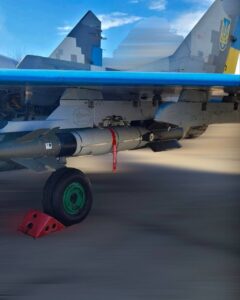
In this photo, a Ukrainian Sukhoi Su-25 ground-attack aircraft from the 299th Tactical Aviation Brigade, with the bort number ‘Blue 28’, is seen carrying an AASM-250 guided air-delivered bomb under its left wing. Available imagery shows that the AASM-250 has also been fitted to Mikoyan MiG-29 fighter aircraft, and can likely be carried by the Sukhoi Su-27 as well. (ARES)
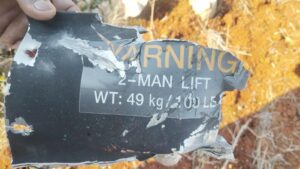
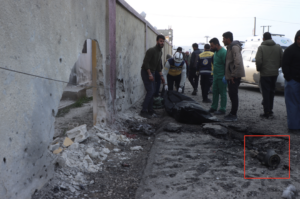
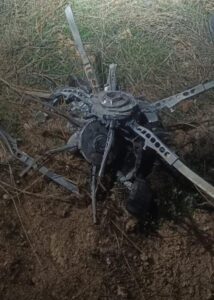
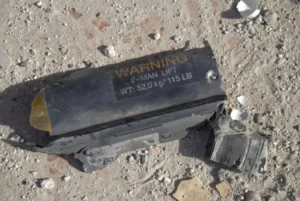
Contextual images of the damage caused by this munition indicate the remnant pictured is from the AGM-114R9X variant of the Hellfire missile, a kinetic munition which does not carry an explosive warhead. This remnant cannot be differentiated from either other AGM-114 or the AGM-179 JAGM variants based off this image alone. (ARES)
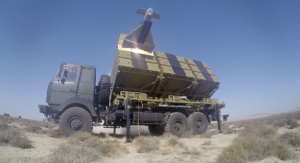
The M712 ‘Copperhead’ is a laser-guided 155 mm artillery gun projectile carrying a high explosive anti-tank (HEAT) warhead designed to engage armoured vehicles. The Copperhead was developed in the United States in the 1970s, and saw limited use during Operation Desert Storm. The M712 is is pictured here inside its shipping container, and the slots for the enclosed, deployable (‘pop-out’) wings and fins are visible. The M712 has two operational modes: a ballistic mode that follows a gun’s ballistic trajectory like a traditional artillery projectile, and a glide mode, which follows a longer and flatter trajectory. The preferred mode is set by the artillery crew before firing. (ARES)
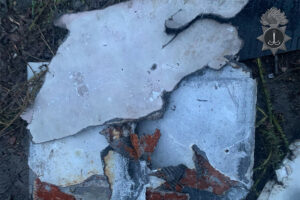
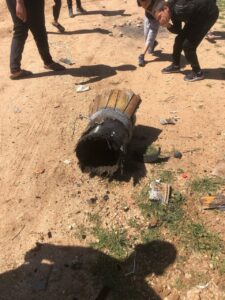
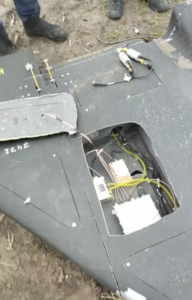
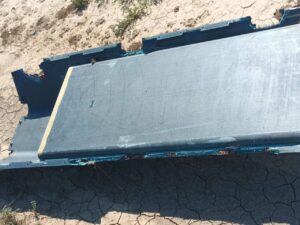
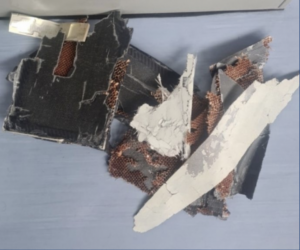
Honeycomb-like internal structures are often used in aerospace applications to provide rigidity with reduced weight, and are sometimes constructed using materials which reduce radar cross-section by absorbing or scattering electromagnetic waves. (ARES)
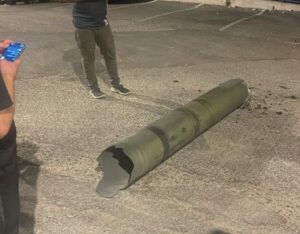
The Blue Sparrow is one of a series of three of air-launched missiles originally designed by Rafael as targets to test ballistic missile defence systems. Blue Sparrow missiles can be fitted with either inert or high explosive (HE) warheads. The recovery of Sparrow-series boosters following a reported Israeli strike on an Iranian air-defence system could suggest that a derivative variant of the Blue Sparrow missile was further developed for engaging surface targets. (ARES)
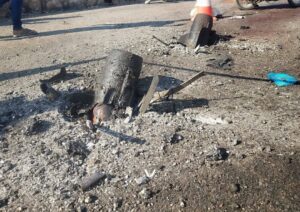
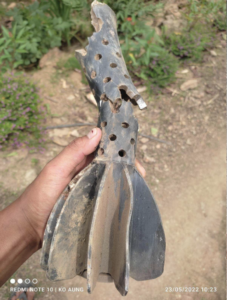
The M824 60 mm mortar projectile dispenses a parachute-retarded illumination flare which burns for 35 seconds. The tail portion of the munition (seen here) separates from the forward (body) portion and is sometimes found along the line of fire. (ARES)
Markings on this 106 mm recoilless gun projectile indicate it is a M344A1 high explosive anti-tank (HEAT) round (“CH-106-M344-A1”) produced by Fábrica Nacional de Granada (“FNG”), Spain, in 1984 (“84”). The packing crate identifies the intended weapon as an M40A1 Cañón sin retroceso, or ‘recoilless rifle’ (“C.S.R. 106 M40 A1”). Other markings show that the round is fitted with an M509-type point-impact, base initiating (PIBD) fuze (“Espoleta PIBD M509”), and give additional details such as the expected muzzle velocity (“V₀”) of 503 m/s. (ARES)
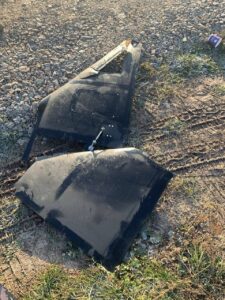
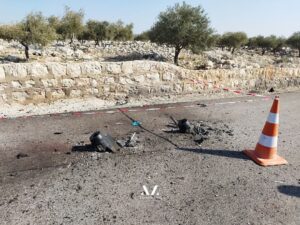
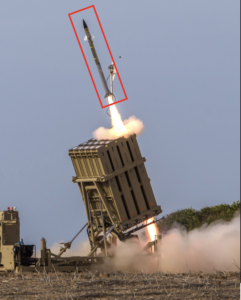
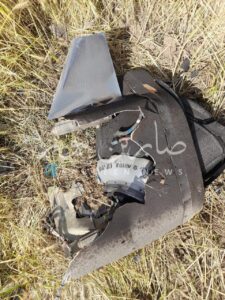
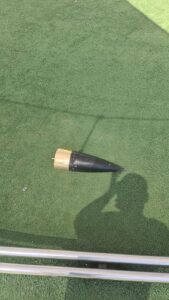
This image shows the nosecone from an Israeli Tamir surface-to-air missile. This component is often found as a remnant after the functioning of the missile. (ARES)