
Do not approach munitions
under any circumstances
Country or territory where the image was reported

Reported Location (49)

Year the image is reported to have been taken

Year (21)

2021
Classification groups of key explosive munitions used in conflicts

Munition Category (8)

The impact or effect the munition is intended to have

Functional use (10)

The specific model of munition pictured

Tentative Model (381)

Search

The external organisation that documented the munition

Research Organisation (6)

Colour of the munition pictured

Base Colour (12)

Colour of all, or some, of the markings on the munition

Marking Colour (11)

Language or script of the marking on a munition

Marking Script (9)

Condition of the munition pictured

Condition (6)

Key features defining the operation mechanisms of a projectile

Mechanical Feature (10)

Whether a munition is guided or unguided

Guidance (2)

Where the munition is launched from and what it targets

Domain (7)

The type of fins visible on the munition

Fins Characteristic (5)

The nominal diameter of a projectile. For most modern munitions, this is expressed in millimetres (e.g. 82 mm mortar projectile), but older artillery gun projectiles may be described in inches.

Calibre (72)

Weight class of the aerial bomb pictured

Weight Class (14)

1–30 of 30
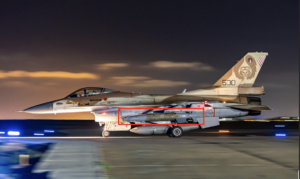
OSMP2211
Analyst Note:
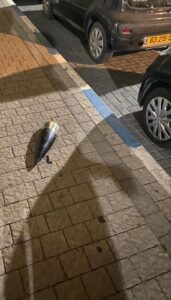
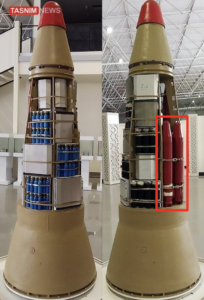
This image shows the ‘manoeuvrable re-entry vehicle’ (MaRV; a detachable, steerable payload section) of an Iranian ballistic missile loaded with submunitions. It appears there are three different models of submunition loaded into the MaRV (black, blue, and red). The black and blue submunitions are most likely anti-personnel designs, whilst the red submunitions (indicated by a red box) are likely designed with penetrating or shaped-charge warheads to target vehicles or structures. Some submunitions may utilise time-delay fuzing, allowing for random detonations over several hours or days to hamper clearance efforts, denying use of the afflicted area. Reports have shown Iran has used ballistic missiles with mixed submunition loads, and suggest that this type of warhead can scatter its payload up to a radius of 8 km. (ARES)
OSMP1410
Analyst Note:
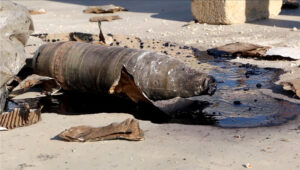
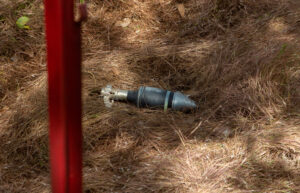
This image shows a conventional 122 mm high explosive artillery projectile that has been modified to carry a chemical payload. It is one of several used in an attack by the so-called ‘Islamic State’ on the town of Marea, Syria. The black substance on the ground is suggestive of low-purity sulphur mustard, a chemical warfare agent. (ARES)
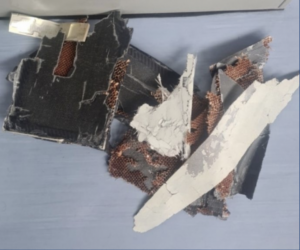
OSMP795
Analyst Note:
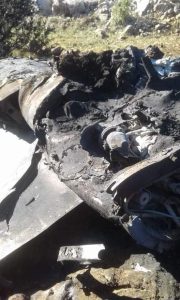
Honeycomb-like internal structures are often used in aerospace applications to provide rigidity with reduced weight, and are sometimes constructed using materials which reduce radar cross-section by absorbing or scattering electromagnetic waves. (ARES)