Classification groups of key explosive munitions used in conflicts
Munition Category (8)
The impact or effect the munition is intended to have
Functional use (10)
The specific model of munition pictured
Tentative Model (346)
Search
The external organisation that documented the munition
Research Organisation (6)
Colour of the munition pictured
Base Colour (12)
Colour of all, or some, of the markings on the munition
Marking Colour (11)
Language or script of the marking on a munition
Marking Script (10)
Condition of the munition pictured
Condition (6)
Key features defining the operation mechanisms of a projectile
Mechanical Feature (10)
Whether a munition is guided or unguided
Guidance (2)
Where the munition is launched from and what it targets
Domain (7)
The type of fins visible on the munition
Fins Characteristic (6)
The nominal diameter of a projectile. For most modern munitions, this is expressed in millimetres (e.g. 82 mm mortar projectile), but older artillery gun projectiles may be described in inches.
A large Farsi-speaking country in the Middle East which has seen a number of conflicts in recent decades. Following the 1979 revolution, Iran became an Islamic republic. Since then Iran has militarily supported various allies and proxies across the region, including Hezbollah in Lebanon. In 2025 the country fought a twelve-day war with Israel, with Iran's nuclear and ballistic missile programs heavily damaged - as well as the first large-scale American strikes inside Iran.
Current Filter
Iraq
A large country in the Middle East affected by conflict since a 2003 US-led invasion to overthrow dictatorial President Saddam Hussein. Since 2013 the Iraqi military, with the military support of a US-led Coalition, has fought the so-called Islamic State, while conflict between often sectarian militias continues. Turkey also conducts regular strikes against Kurdish militants in northern Iraq.
Current Filter
Palestinian Territories
The areas internationally recognised as the basis of a future independent Palestinian state, primarily the West Bank, east Jerusalem and the Gaza Strip. Israel has fought multiple wars with the Hamas militant group, which controlled Gaza.
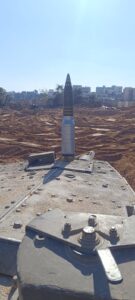
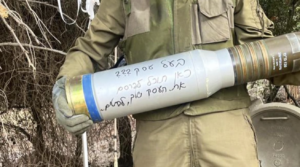
The M329 is a multi-purpose tank gun projectile designed to engage a range of targets other than tanks. It is one of the few cluster munitions that takes the form of a tank gun projectile, dispensing six explosive submunitions over a relatively small area. It has also been referred to as the ‘APAM 120’, describing its functional role (‘anti-personnel/anti-materiel’) and calibre (120 mm). (ARES)
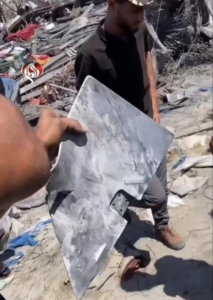
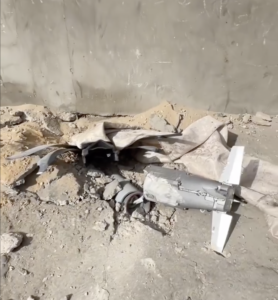
This image shows a distinctively shaped component of MBDA’s ‘Diamond Back’ joined tandem wing assembly as fitted to the GBU-39 Small Diameter Bomb (SDB). (ARES)
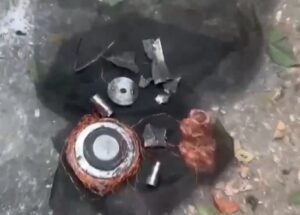
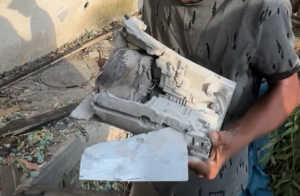
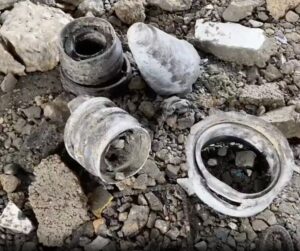
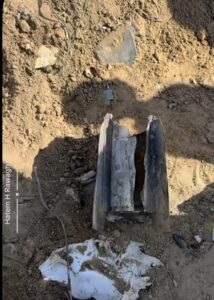
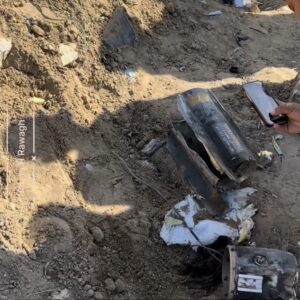
This image shows a component believed to be part of the folding-blade assembly used in the AGM-114R-9X variant of the Hellfire missile. Blades are used in place of an explosive payload to create a kinetic weapon that achieves a practical level of lethality whilst minimising collateral harm. (ARES)
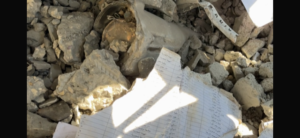
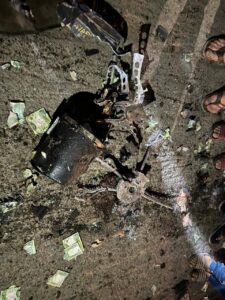
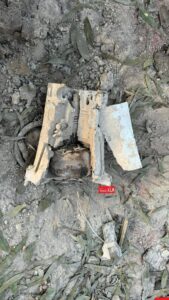
The remnant pictured here is part of a Small Diameter Bomb actuator assembly (‘Tail Actuation Section’), which moves the four tail-fin control surfaces which alter the course of the munition in flight. (ARES)
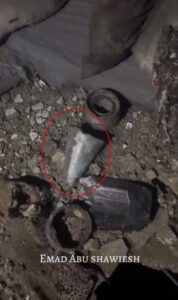
The circled remnant is the hardened steel nosecone of the GBU-39, which renders the munition capable of penetrating more than 3 feet (approx. 1 metre) of steel-reinforced concrete. It is one of several components that often survives the detonation of the munition. (ARES)
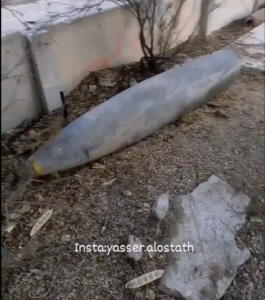
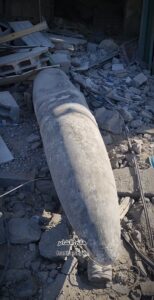
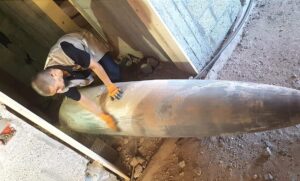
This image depicts an M117-series unguided aerial bomb. Belonging to a class of weapons referred to as ‘demolition bombs’—which use Tritonal or similar explosive compounds to generate a more powerful blast effect than TNT or Composition B—the M117 is an American design which dates to the Korean War era and is rarely seen in service with modern armed forces. (ARES)
This munition is assessed to be one of the Small Diameter Bomb (SDB) I variants (GBU-39 series), rather than one of the SDB II 'StormBreaker' (GBU-53 series) munitions, on the basis of contextual information. 'Small Diameter Bomb' is the manufacturer's terminology, whilst 'GBU-39' is the U.S. Air Force designation (also used by many other operators). (ARES)
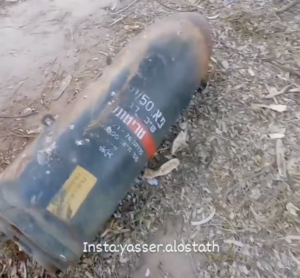
Some artillery projectiles, such as this M150 type, use a hexachloroethane-based composition (HC) to generate smoke for screening or marking purposes. In many armed forces, HC smoke munitions have partially replaced those relying on white phosphorus for similar effects. (ARES)
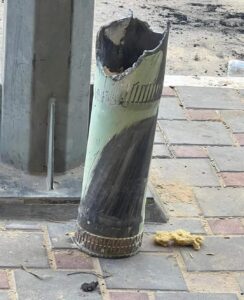
107mm spin-stabilized rockets of this design are often utilized by non-state actors in an indirect fire role. Like the original Chinese models that they are copied from, they do not require more than a simple electric power source and a rudimentary launch platform to achieve an acceptable level of accuracy. (ARES)
The MK 84 series of unguided air-delivered bombs can be converted to precision guided munitions by being fitted with guidance kits such as the Joint Direct Attack Munition (JDAM), SPICE 2000, or Paveway series. This MK 84 is also marked with a variant designation “MOD 4”. (ARES)
This component is one of four pneumatically controlled canards from the guidance section of a Paveway II precision guided munition (PGM) conversion kit. When a Paveway II conversion kit is fitted to a MK 82 series unguided air-delivered bomb (note markings), the munition receives a GBU-12 series designation. (ARES)