Key features defining the operation mechanisms of a projectile
Mechanical Feature (10)
Whether a munition is guided or unguided
Guidance (2)
Where the munition is launched from and what it targets
Domain (7)
The type of fins visible on the munition
Fins Characteristic (6)
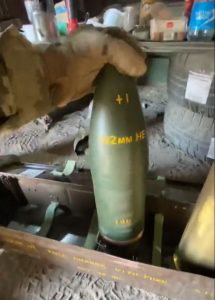
The nominal diameter of a projectile. For most modern munitions, this is expressed in millimetres (e.g. 82 mm mortar projectile), but older artillery gun projectiles may be described in inches.
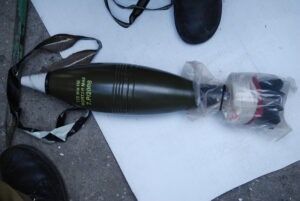
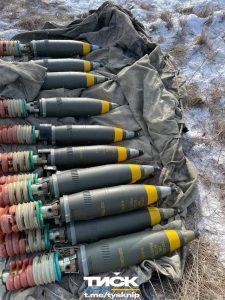
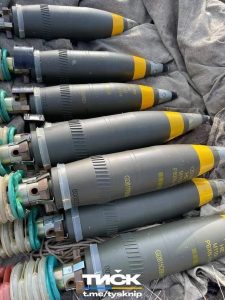
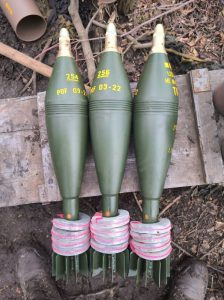
This Iranian M48 120 mm mortar projectile is marked to indicate it was manufactured in 2008. A plastic bag cable-tied to the tail of the munition protects the auxiliary, or supplemental, propellant charges fitted to the round. (ARES)
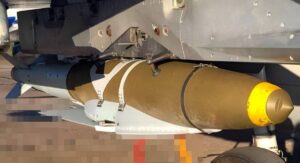
The Joint Direct Attack Munition – Extended Range (JDAM-ER) marries the JDAM guidance kit to a ‘glide bomb’ wing kit developed by the Australian Defence Force, offering a munition with at least three times the range of a standard GBU-38 500-pound-class guided aerial bomb. (ARES)
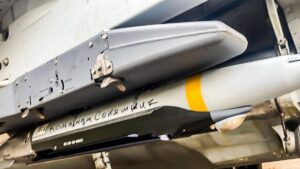
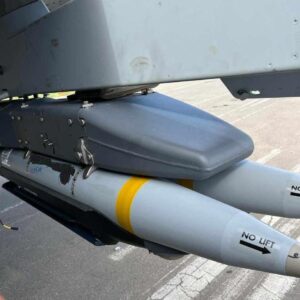
In this image, two GBU-39 Small Diameter Bombs are attached to a BRU-61/A bomb rack. The Ukrainian Air Force adapted this American-designed bomb rack to fit their Soviet-designed Mikoyan MiG-29 fighter aircraft. The BRU-61/A can carry up to four GBU-39 air-delivered bombs. (ARES)
The M329 is a multi-purpose tank gun projectile designed to engage a range of targets other than tanks. It is one of the few cluster munitions that takes the form of a tank gun projectile, dispensing six explosive submunitions over a relatively small area. It has also been referred to as the ‘APAM 120’, describing its functional role (‘anti-personnel/anti-materiel’) and calibre (120 mm). (ARES)
The SPICE family of munitions, manufactured by Israeli aerospace and defence company Rafael, includes two models which use ‘bolt-on’ guidance kits. The SPICE 1000 and SPICE 2000 models convert 1,000- and 2,000-pound unguided aerial bombs, respectively, to precision guided munitions. (ARES)
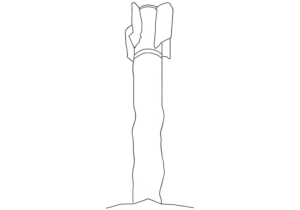
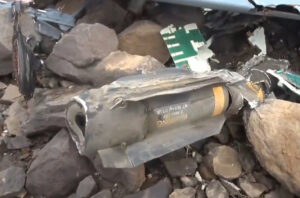
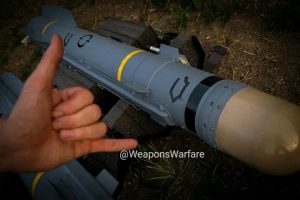
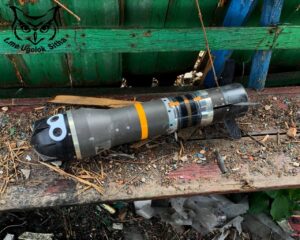
This image shows a component believed to be part of the folding-blade assembly used in the AGM-114R-9X variant of the Hellfire missile. Blades are used in place of an explosive payload to create a kinetic weapon that achieves a practical level of lethality whilst minimising collateral harm. (ARES)
This image depicts an M117-series unguided aerial bomb. Belonging to a class of weapons referred to as ‘demolition bombs’—which use Tritonal or similar explosive compounds to generate a more powerful blast effect than TNT or Composition B—the M117 is an American design which dates to the Korean War era and is rarely seen in service with modern armed forces. (ARES)
The various Iranian Qaem-series guided air-delivered bombs can be difficult to differentiate from one another. In this case, the wing (forward fin) assembly distinguishes this Qaem-5 from the visually similar Qaem-1. Note also that the name 'Qaem' has applied by Iran to other, unrelated munitions. (ARES)
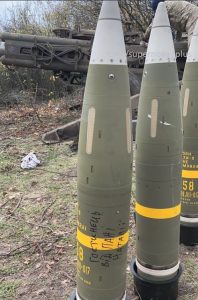
Once fired, four canards will deploy from the forward (ogival) section of these M982 Excalibur guided artillery projectiles. The narrow-shaped ports through which the canards deploy are a good indicator of a guided or extended-range artillery projectile. (ARES)
In this image, a Ukrainian soldier is using an M1155 Enhanced Portable Inductive Artillery Fuze Setter (EPIAFS) to input the target coordinates and set functioning parameters for an M982 Excalibur guided artillery projectile. (ARES)
The Brimstone is a series of British-designed guided missiles that can be launched from air, land, or sea platforms. The United Kingdom first provided Ukraine with the Brimstone I missile in 2022 and exports have continued since, more recently believed to include the Brimstone II model. In Ukraine, Brimstone-series missiles have been exclusively launched from ground-based and sea-based platforms as of May 2024. (ARES)
Whilst most mortars are smoothbore guns, some have a rifled bore. These M1101 120 mm mortar projectiles feature a 'pre-rifled' driving band—that is, a driving band with grooves cut at the factory to fit the mortar's rifling. (ARES)
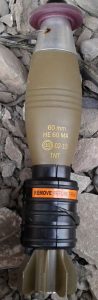
The plum-coloured plastic ring at the nose of this mortar projectile (placed over its fuze) and the black plastic propellant cover (placed over its tail) are both fitted for transport and storage, before the projectile is loaded into a cardboard tube, and then packed into an outer crate. The propellant cover obscures the perforated cylindrical tail assembly in this image. (ARES)
The Next-generation Light Anti-tank Weapon (NLAW) uses an uncommon form of guidance known as predicted line-of-sight (PLOS). PLOS guidance calculates the anticipated position of a moving target prior to launch, with the munition using inertial guidance to fly to the projected impact point. This fire-and-forget technique allows the operator to move positions immediately after firing, and is generally cheaper than other fire-and-forget guidance types. (ARES)