Colour of all, or some, of the markings on the munition
Marking Colour (11)
Language or script of the marking on a munition
Marking Script (10)
Condition of the munition pictured
Condition (6)
Key features defining the operation mechanisms of a projectile
Mechanical Feature (10)
Whether a munition is guided or unguided
Guidance (2)
Where the munition is launched from and what it targets
Domain (7)
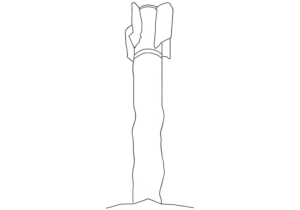
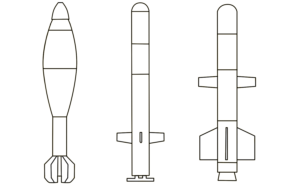
The type of fins visible on the munition
Fins Characteristic (6)
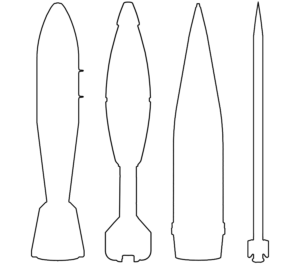
The nominal diameter of a projectile. For most modern munitions, this is expressed in millimetres (e.g. 82 mm mortar projectile), but older artillery gun projectiles may be described in inches.
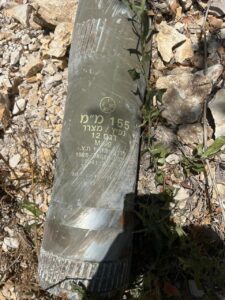
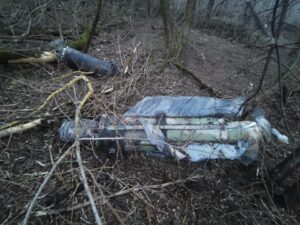
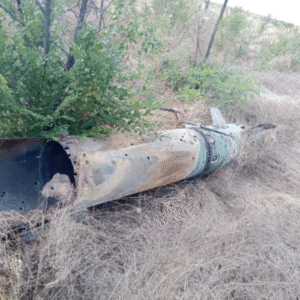
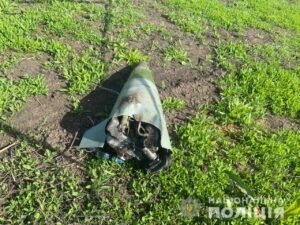
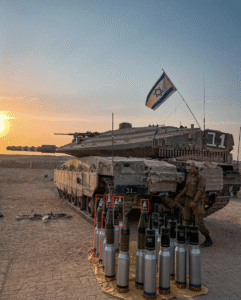
This image depicts remnants from a M999 (‘Barak Eitan’) 155 mm cluster munition. Reports indicate that the M999 artillery projectile carries nine M99 Dual-Purpose Improved Conventional Munition (DPICM) submunitions. (ARES)
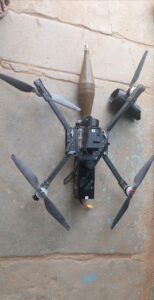
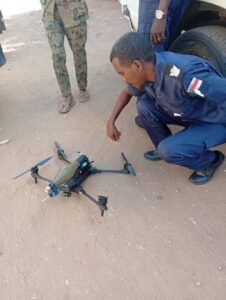
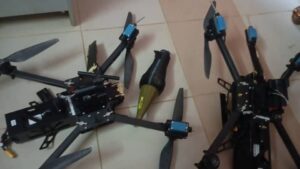
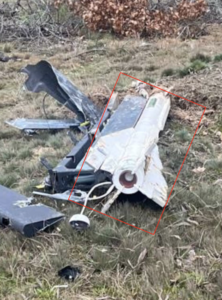
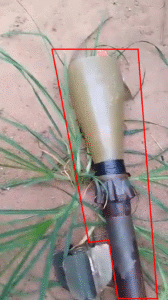
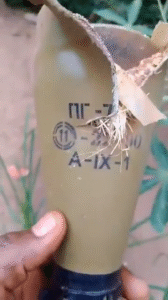
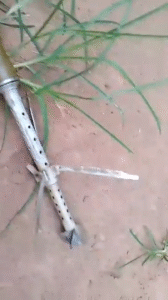
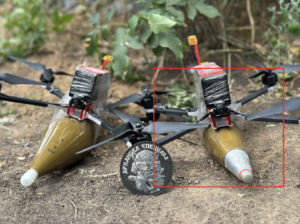
This image shows a one-way attack (OWA) UAV fitted with a high explosive anti-tank (HEAT) warhead adapted from a PG-7 series recoilless gun projectile. (ARES)
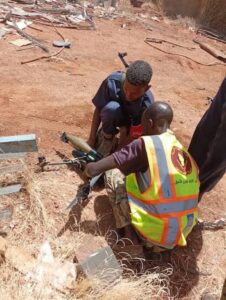
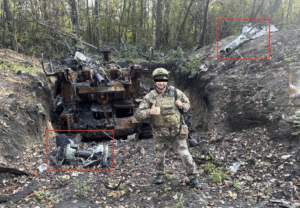
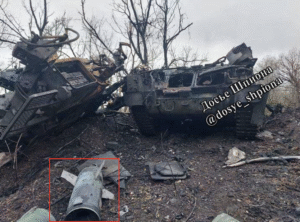
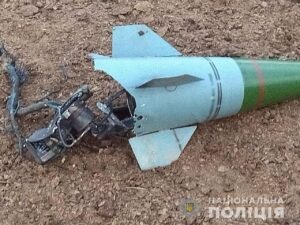
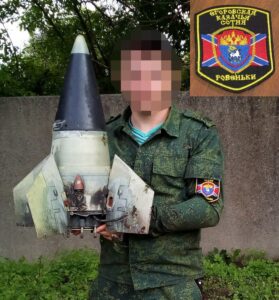
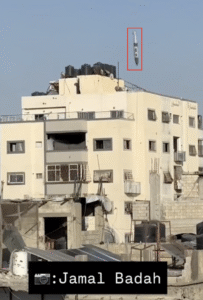
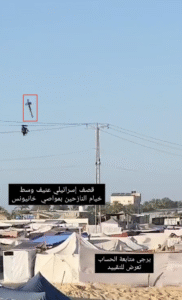
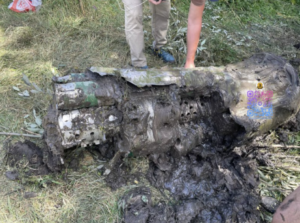
Positive identification of this surface-to-air missile cannot be made based on the imagery in the source. The items highlighted in this image are most likely the remains of either a 9M38- or 9M317-series missile, based on fin construction and their size relative to the individual posing in the foreground. These two missiles are close in design and function, and are predominantly fired from the Buk series of SAM systems. (ARES)
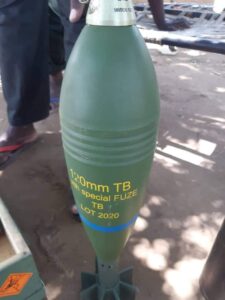
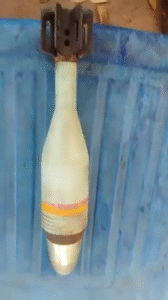
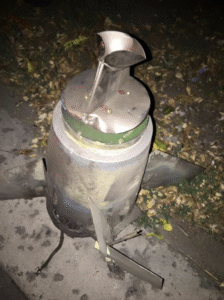
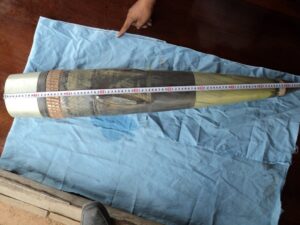
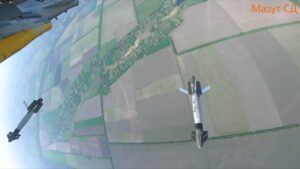
This image shows a ‘120mm TB’ air-delivered bomb that has been adapted from a 120 mm mortar projectile. It is claimed by the manufacturer that this thermobaric munition offers improved fragmentation and blast effects when compared with standard (high explosive) 120 mm mortar projectiles. The “with special FUZE” marking refers to the use of the UT M18 impact fuze. Note that this munition cannot be fired from a mortar, despite the munition body showing features consistent with this use (e.g., gas-check bands). Instead of a standard mortar projectile tailboom which would contain an ignition cartridge and be perforated by flash holes, this munition is fitted with a simplified, plastic tailfin assembly that is designed to stabilise the munition as it falls after being released by a UAV. (ARES)
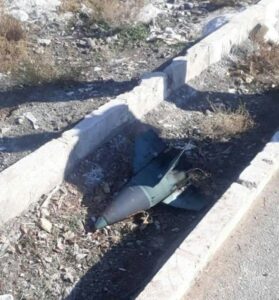
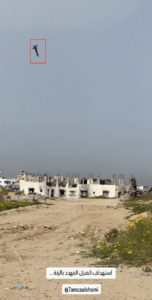
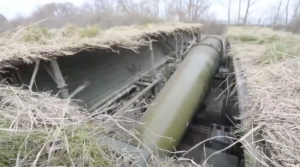
Although the source claims that this image shows a Buk-M3 surface-to-air missile system, this imagery is not sufficient to determine whether the remnants highlighted are from a 9M38-or 9M317-series guided missile. (ARES)
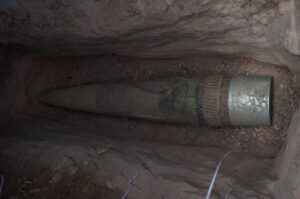
The munition depicted in this image is a type of aerodynamically optimised artillery projectile, in this case 155 mm in calibre, known as an ‘Extended Range Full-Bore (ERFB)’ design. This example is a cargo projectile fitted with a base-bleed (BB) base unit to further extend its range. This configuration is designated NR269, and reportedly contains 56 M46 dual-purpose (anti-personnel/anti-armour) submunitions. (ARES)
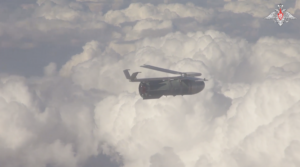
This image represents the first documented instance of a Shahed-series UAV carrying an R-60 air-to-air missile. This appears to add a new capability to the Shahed, enabling it to target enemy aircraft. Arming UAVs to counter interception and engage alternative targets is an emergent trend. Previously, unmanned surface vessels (USVs) employed by the Ukrainian Armed Forces have been observed carrying R-73 air-to-air missiles, for example. (ARES)
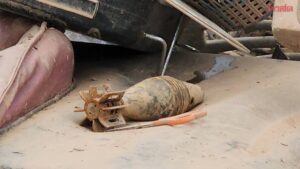
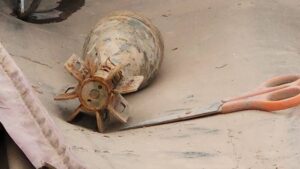
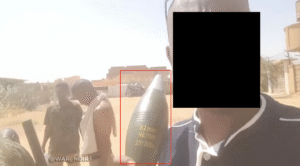
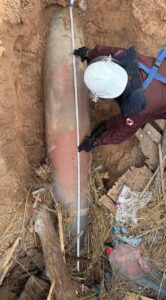
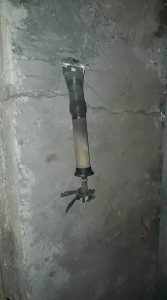
This image shows an M49-series 60 mm high explosive (HE) mortar projectile, or a copy thereof. Due to the state of the round the available imagery, the specific model or variant cannot be determined. The fuze is also not clearly visible. Most M49 mortar projectiles use an M525, M717, M935, or similar point-detonating (PD) fuze. (ARES)
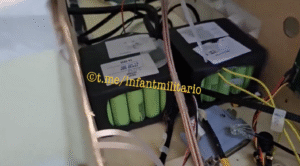
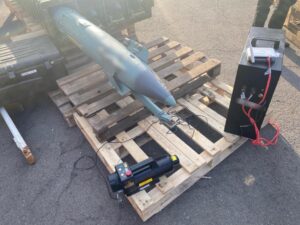
This photo shows some of the lithium-ion power banks found within a Gerbera UAV. These are used to power the onboard avionics, control surfaces, communications hardware, camera, and other components. The quantity and type of batteries fitted to the Gerbera will often vary based on the role for which the UAV has been configured—one-way attack (OWA; i.e., a ‘sacrificial’ munition), reconnaissance, signal relay, or decoy—and which specific hardware has been installed to effect this mission. (ARES)
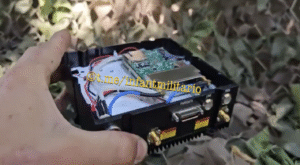
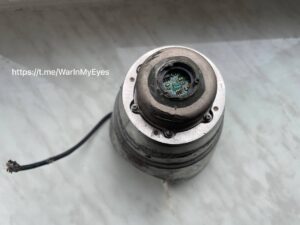
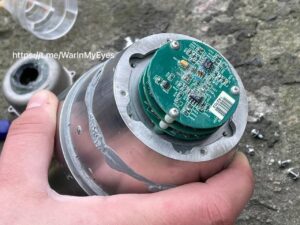
This image shows the front and interior surfaces of a wireless communications module recovered from a downed Gerbera UAV. Although labelled as an HX-50 industrial wireless modem (compatible with WiFi and 5G/4G networks and designed for fixed locations), analysis by Ukrainian military sources indicates that this component is, in fact, an XK-F358 mesh-network module which offers significantly more capabilities. Manufactured and sold by Shenzhen Xingkai Technology Co., Ltd., these modules are designed for, amongst other things, use in robots and unmanned vehicles. Gerbera UAVs have been found operating on a wide variety of frequencies and networks, and this type of module is well-suited to this use. (ARES)
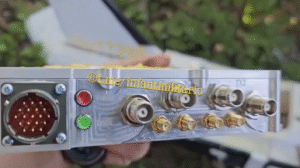
Pictured is a navigation/GPS module recovered from a downed Gerbera UAV. This particular model is used with the 4-antenna CRPA module seen in OSMP1648. The four RX ports on the bottom are normally directly connected to the CRPA (antenna) module, with other connections made to the UAV’s flight controller and power sources. Some Gerberas have been recovered with CRPA modules bearing a different number of antennas; different navigation modules have been observed on these. (ARES)
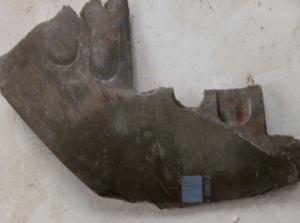
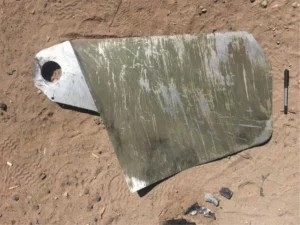
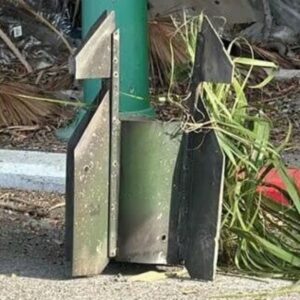
This image shows a remnant of a control fin from a Paveway III bomb guidance kit that is compatible with 2,000-pound-class air-delivered bombs. In U.S. service, this combination receives designations in the GBU-24 series. Based off this remnant alone, it cannot be determined which model of air-delivered bomb was paired with this particular guidance kit. (ARES)
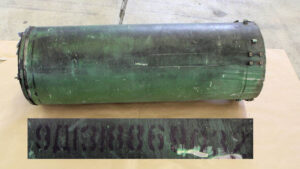
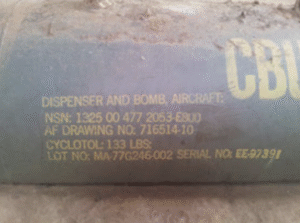
This image shows markings on an SUU-30H/B dispenser which comprises part of a CBU-52B/B Cluster Bomb Unit, including a National Stock Number (“NSN 1325 00 477 2053-E800”), design reference (“AF DRAWING NO: 716514-10”), total explosive weight of the submunitions (“CYCLOTOL: 133 LBS:”), lot number (“LOT NO: MA-77G246-002”), and serial number (“SERIAL NO: EE-97391”). This lot number indicates that this CBU-52B/B was manufactured at the Milan Army Ammunition Plant in the U.S. in July 1977. (ARES)
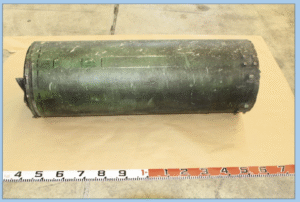
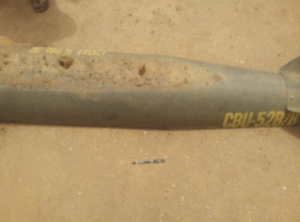
This image shows part of an SUU-30H/B dispenser (cargo munition) that comprises part of the CBU-52B/B ‘Cluster Bomb Unit’. A CBU-52B/B comprises a SUU-30H/B dispenser that is loaded with 217 BLU-61A/B anti-personnel submunitions. (ARES)
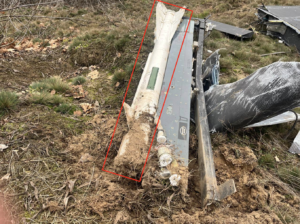
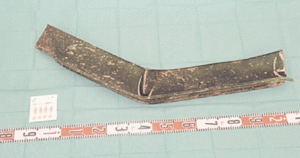
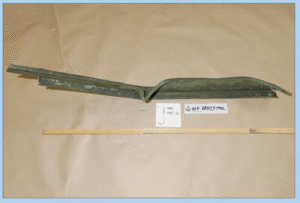
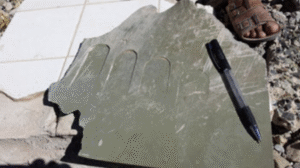
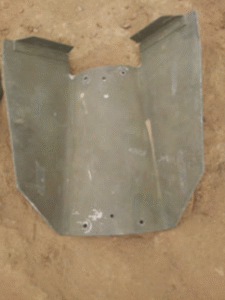
This image shows one of two tail fin sections that are attached to an SUU-30H/B air-delivered dispenser (cargo munition). Similar tail fins are used in other variants of the SUU-30 series dispensers. The SUU-30H/B can be used in various ‘Cluster Bomb Units’ including variants of the CBU-52, CBU-58, and CBU-71 munitions. (ARES)
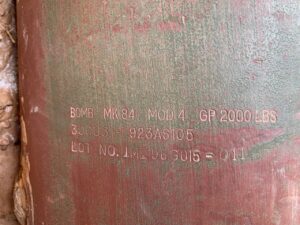
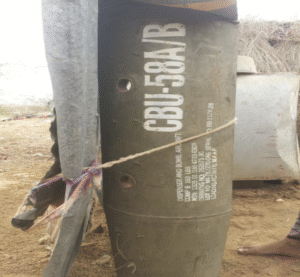
This image shows a remnant of an SUU-30H/B air-delivered dispenser (cargo munition), that comprised a CBU-58A/B ‘Cluster Bomb Unit’ (CBU). The CBU-58A/B carries 650 BLU-63A/B anti-personnel submunitions, that have a total explosive weight of 163 lbs (~74 kg) of COMP B explosive; this is reflected in the visible markings. (ARES)
This image shows a remnant of the control fin of a GBU-24 (as seen partially marked), the designation for the combination of a Paveway III guidance kit paired with a 2,000-pound-class air-delivered bomb. This remnant is not enough to determine which model of bomb the kit was originally paired with. (ARES)
Although Human Rights Watch reported that they found manufacturing markings on a guidance fin assembly indicating that this MXU-series aerofoil group was paired with a Paveway III guidance kit, this cannot be determined by this wing remnant from the aerofoil group alone. (ARES)
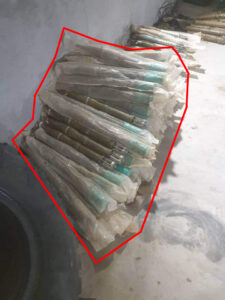
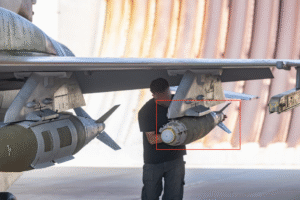
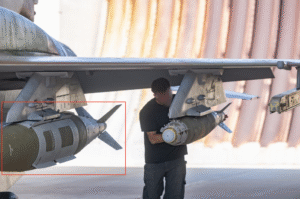
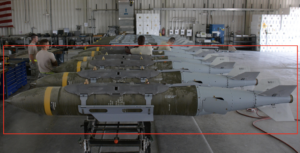
This image shows a variety of small air-delivered munitions that have been developed specifically for deployment via UAV. Some of these appear to be original designs, whilst others have been made by modifying existing munitions. This entry reflects those munitions outlined with the red box, but all of the munitions are generally of similar in size and format, and all have tailfin assemblies intended to orient the munition as it falls, just like more traditional air-delivered bombs. (ARES)
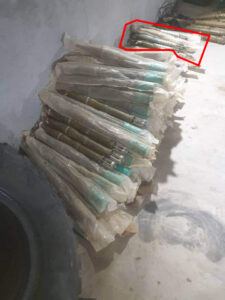
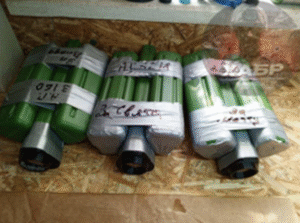
This image shows three sets of three PTM-1 series scatterable anti-vehicle mines taped together. While these mines have likely been repurposed from their original delivery munition to be delivered via UAV, this cannot be confirmed based off this image alone. (ARES)
The warhead of the OWA UAV indicated in this image cannot be positively identified from this photograph alone. It appears to be the warhead section of either an OG-9 series or OG-15 series high explosive fragmentation (HE-FRAG) projectile, with a GO-2 or similar impact fuze fitted in the nose. (ARES)
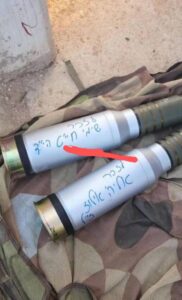
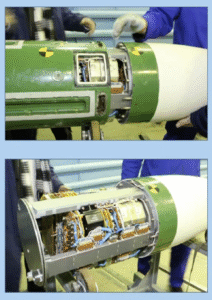
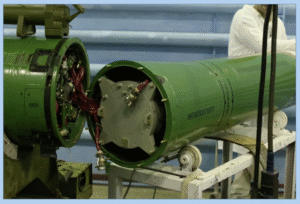
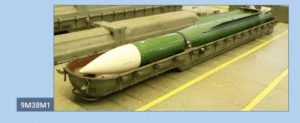
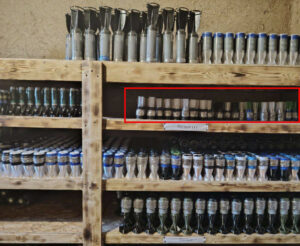
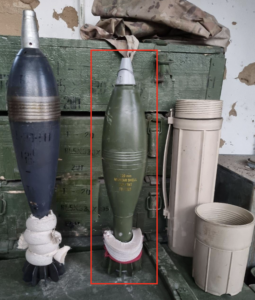
This image shows a Mikholit glide bomb, with its warhead removed (green cylinder on the left side of the box). The fins that spring outward when deploye have been taped down. This Mikholit was reportedly recovered by the Israeli Defense Forces (IDF) from Hamas, who had captured the bomb after it failed to function when originally deployed by the IDF. (ARES)
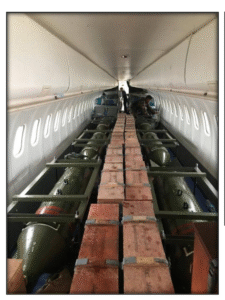
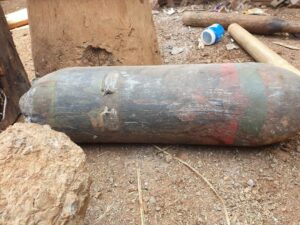
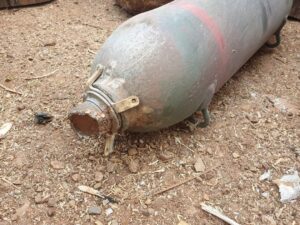
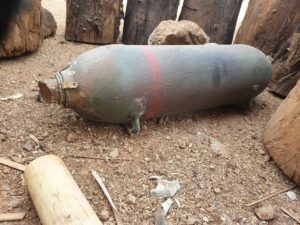
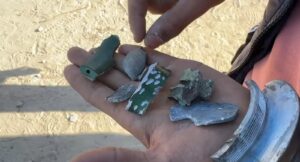
This image shows two Mikholit air-delivered bombs (‘glide bombs’), and four Mikholit warheads. There are at least two different variants of warheads available for the Mikholit glide bomb. The green cylinder on the left is a blast (high explosive) warhead, whilst the other three warheads are shaped charge warheads which incorporate additional fragmentation. Blast warheads of this type have also been seen with red markings, while the shaped charge warheads have been seen with yellow markings. (ARES)
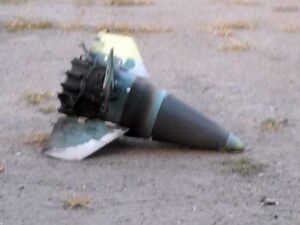
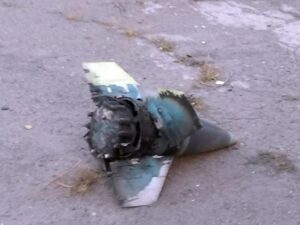
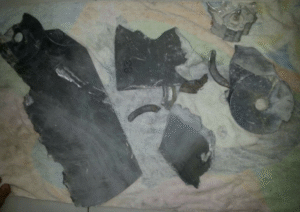
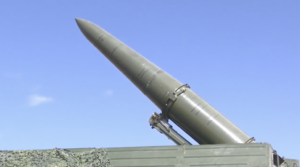
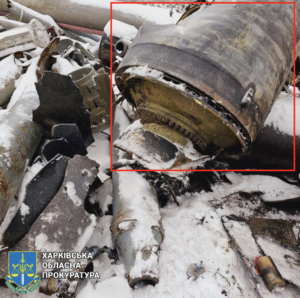
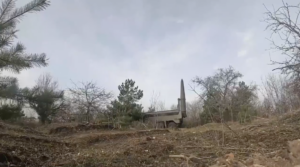
This image shows a remnant of the aft motor section, which includes the venturi nozzle, of a North Korean KN-23/KN-24/Hwasong-11 series missile. The KN-23/KN-24/Hwasong-11 has a generally similar appearance to the Russian 9M7 ‘Iskander’ series of ballistic missiles, but has differences in performance and in some aspects of the construction. (ARES)
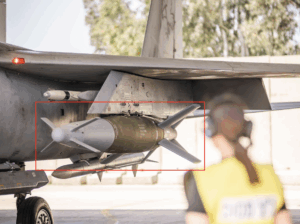
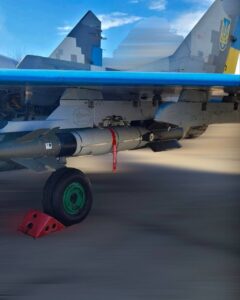
The Armement Air-Sol Modulaire (AASM; ‘Modular Air-to-Ground Armament’) family of French bolt-on guidance kits are fitted to air-delivered bombs of various sizes in a similar fashion to American JDAM kits. In some marketing materials, the acronym HAMMER is used, standing for ‘Highly Agile Modular Munition Extended Range’. This refers, in part, to the rocket boosters fitted to munitions in the family to extend their effective range. (ARES)
In this photo, a Ukrainian Sukhoi Su-25 ground-attack aircraft from the 299th Tactical Aviation Brigade, with the bort number ‘Blue 28’, is seen carrying an AASM-250 guided air-delivered bomb under its left wing. Available imagery shows that the AASM-250 has also been fitted to Mikoyan MiG-29 fighter aircraft, and can likely be carried by the Sukhoi Su-27 as well. (ARES)
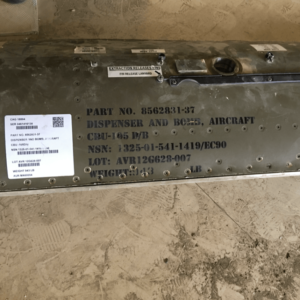
This image shows part of the SUU-66 dispenser (sometimes called a ‘shell’) that forms part of a CBU-105 D/B cluster bomb unit. In U.S. service, a ‘cluster bomb unit’ designation includes both the dispenser or shell, as well as the payload.
The CBU-105 series of cluster munitions consists of CBU-97-series munitions that are modified with a WCMD (Wind Corrected Munitions Dispenser) guidance kit. Both CBU-97 and CBU-105 series munitions are made-up of an SUU-66 dispenser filled with 10 BLU-108 submunitions. Each BLU-108 submunition contains 4 ‘skeet’ warheads that are ejected mid-air and independently seek out targets using an infrared sensor. A single skeet weighs 7.5 lb (3.4 kg) and contains a copper explosively formed penetrator (EFP) for armour penetration that is surrounded by a fragmentation ring offering some anti-personnel effect. (ARES)