The impact or effect the munition is intended to have
Functional use (10)
The specific model of munition pictured
Tentative Model (338)
Search
The external organisation that documented the munition
Research Organisation (6)
Colour of the munition pictured
Base Colour (12)
Colour of all, or some, of the markings on the munition
Marking Colour (11)
Language or script of the marking on a munition
Marking Script (9)
Condition of the munition pictured
Condition (6)
Key features defining the operation mechanisms of a projectile
Mechanical Feature (10)
Whether a munition is guided or unguided
Guidance (2)
Where the munition is launched from and what it targets
Domain (7)
The type of fins visible on the munition
Fins Characteristic (6)
The nominal diameter of a projectile. For most modern munitions, this is expressed in millimetres (e.g. 82 mm mortar projectile), but older artillery gun projectiles may be described in inches.
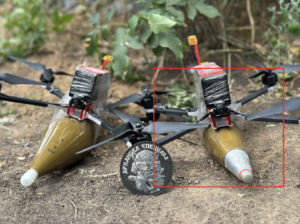
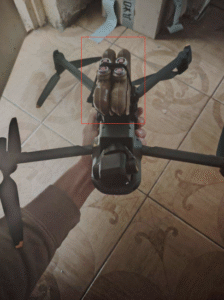
The munition in this image has been integrated into a commercial off-the-shelf (COTS) small UAV. This UAV (‘drone’) adds powered and guided delivery and converts the munition into a guided missile—regardless of the original, intended delivery method. (ARES)
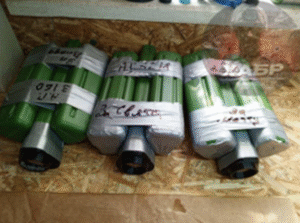
This image shows three sets of three PTM-1 series scatterable anti-vehicle mines taped together. While these mines have likely been repurposed from their original delivery munition to be delivered via UAV, this cannot be confirmed based off this image alone. (ARES)
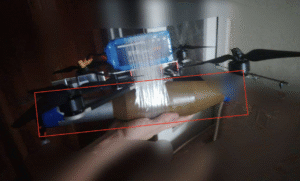
The warhead of the OWA UAV indicated in this image cannot be positively identified from this photograph alone. It appears to be the warhead section of either an OG-9 series or OG-15 series high explosive fragmentation (HE-FRAG) projectile, with a GO-2 or similar impact fuze fitted in the nose. (ARES)
This image shows four PFM-1 series anti-personnel landmines retained by a release mechanism to enable deployment via UAV. Ordinarily, PFM-1 series and other ‘scatterable mines’ are deployed via carrier munitions or dedicated mine-dispensing devices. In Ukraine and other conflicts, these mines have often been removed from their original carrier munitions in order that they may be delivered via UAV. (ARES)
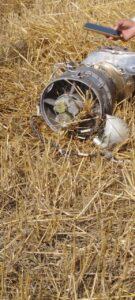
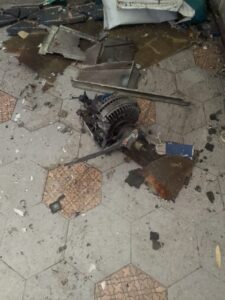
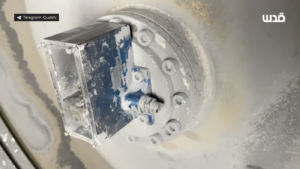
This image shows an AR731-4000 Wankel-type engine produced by UAV Engines Ltd. of the United Kingdom, used in an Israeli Harop munition. Variants of the Harop used in the 2020 Nagorno-Karabakh War featured a similar Wankel engine, but were marked to indicate a different manufacturer and model name: “MBT ENGINE” and “H2251-5100-503”, respectively. (ARES)
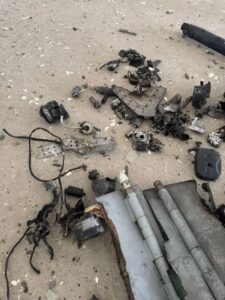
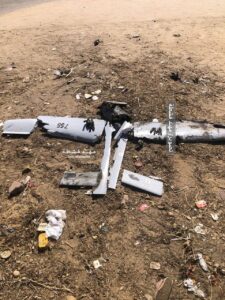
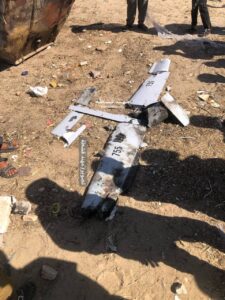
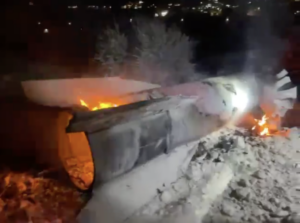
This image shows the remnants of a SkyStriker one-way attack UAV, manufactured by Elbit Systems of Israel. The SkyStriker can be fitted with various warhead options, including dual-purpose warheads weighing 5 or 10 kilograms. While it appears that a reconstruction was attempted with the remnants, the placement of the various components does not accurately represent an intact SkyStriker. (ARES)
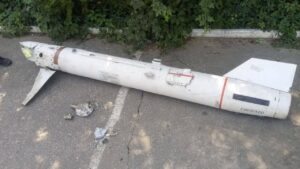
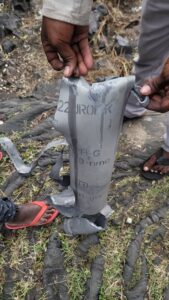
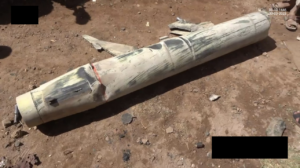
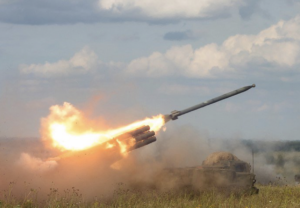
The JROF and JROF-K are Czech derivatives of the Soviet 122 mm ‘Grad’ series of surface-to-surface rockets. The JROF-K is the shorter, reduced-range variant, broadly analogous to the Soviet 9M22M. (ARES)
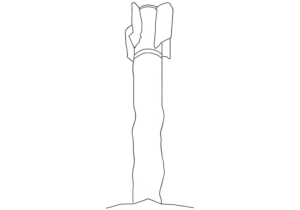
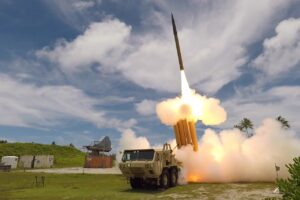
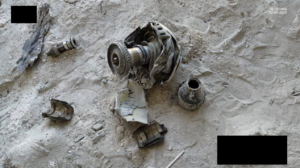
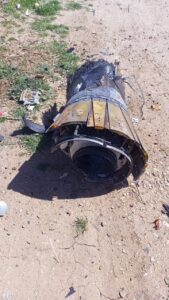
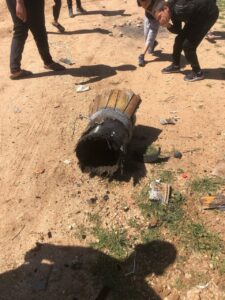
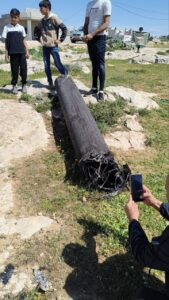
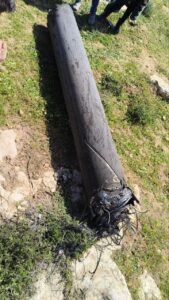
This image shows the flare from a Terminal High Altitude Area Defense (THAAD) system's ‘Talon’ kinetic interceptor missile. The flare is located at the aft end of the missile's booster engine. The ‘petals’ of the flare are initially flush, and are actuated into the deployed position, seen here, as part of the missile‘s functioning. (ARES)
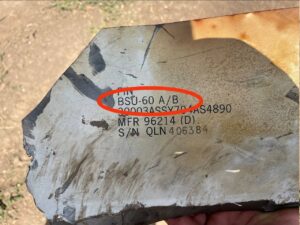
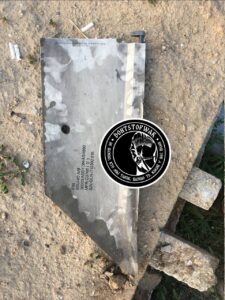
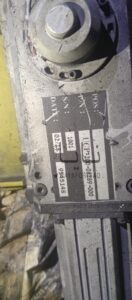
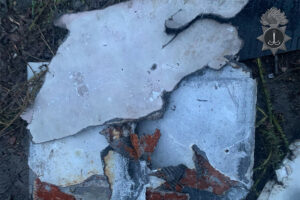
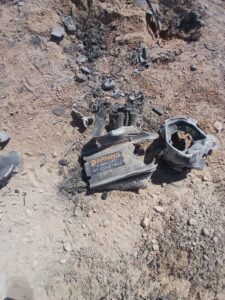
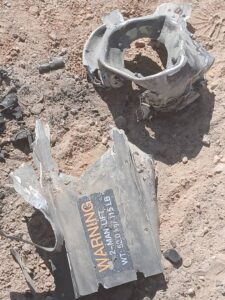
This image shows a fragment of the “inner petal assembly” of a Terminal High Altitude Area Defense (THAAD) system’s ‘Talon’ interceptor missile. The part number for the assembly (“23917ASSY1A62803-101 REV.E / E”), Commercial and Government Entity (CAGE) code (“07554”), manufacturer abbreviation (“CTL”), and serial number (“S/N DDLKD”) are visible. This CAGE code and manufacturer abbreviation are associated with CTL Aerospace Inc, a subcontractor for Lockheed Martin, the manufacturer of the THAAD system. It is not uncommon for complex munitions to be made by several different manufacturers, and thus multiple CAGE codes may be present as a result of the various subcontractors. (ARES)
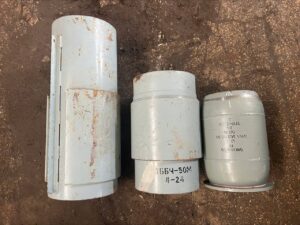
This image shows three different warheads developed by Russia for the Shahed-136/Geran-2 one-way attack (OWA) unmanned aerial vehicle (UAV), each of which differ from the original warhead designed by Iran for the Shahed-136. Left: A thermobaric explosive warhead; Middle: TBBCh-50M, a thermobaric explosive warhead; Right: OFZBCh-50, a high explosive warhead with an incendiary effect. Each of these warheads is also fitted with a fragmentation liner to increase the fragmentation effect generated when the warhead detonates. Some of the fragmentation liners may contain zirconium, a metal which is ignited when the warhead detonates, providing an additional incendiary effect. (ARES)
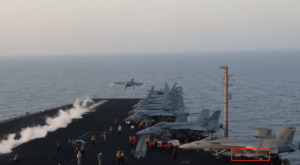
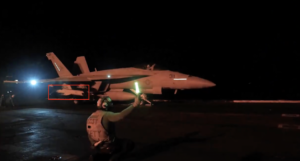
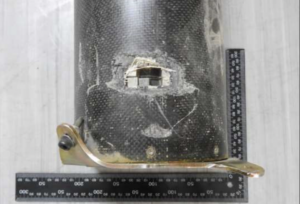
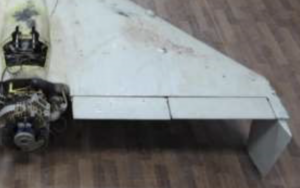
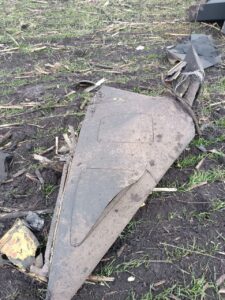
This image and the related entries show fragments of an AGM-84 Standoff Land Attack Missile-Expanded Response (SLAM-ER) series missile. AGM-84 SLAM-ER missiles are AGM-84E Standoff Land Attack Missiles (SLAM) that incorporate certain upgrades, including wings to increase the missile's range. The AGM-84 series include the anti-ship ‘Harpoon’ variants, from which the SLAM and SLAM-ER series are derived. As a result, many remnants will be similar or identical between variants. The wing remnant here is diagnostic, however. (ARES)
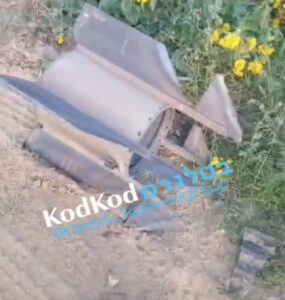
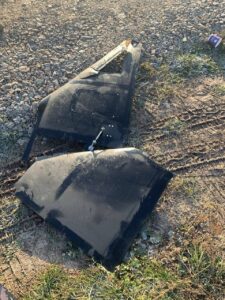
This image shows the rear fin section that is attached to a M-302/Khaibar-1/Fadi series rockets to add guidance capabilities. This rear fin section is installed, along with a forward control section between the warhead and the rocket motor. The guided munition, now classified as a missile, is referred to as a Nasr-1/Nasr-2. A similar, but larger, rear fin section is fitted to Zelzal rockets to convert them to guided munitions. (ARES).
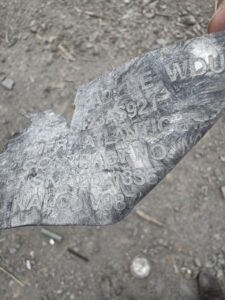
This image shows a fragment of a RGM/UGM-109 Tomahawk Land Attack Missile (TLAM) series missile's WDU-36/B warhead. The WDU-36/B warhead is a penetrator warhead for the TLAM, and is one of several available warhead options for TLAM series missiles. The complete "WDU" designation isn't visible, but the part number (3123AS921) is associated with the WDU-36/B. (ARES)
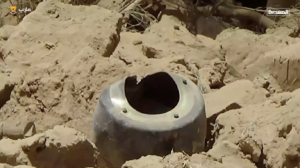
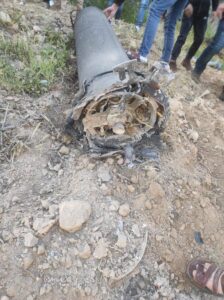
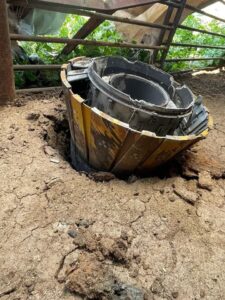
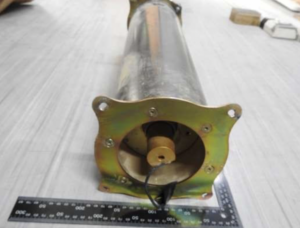
This image shows the rocket motor of a Kheibar Shekan or Fattah-1 medium-range ballistic missile (MRBM). The Fattah-1 was publicly unveiled by Iran in June 2023, with very few images surfacing since that time. Due to the lack of available reference material, differentially identifying the Kheibar Shekan and Fattah-1 is difficult. The missile components displayed at unveilings and public displays are also often different from those used in production models. (ARES).
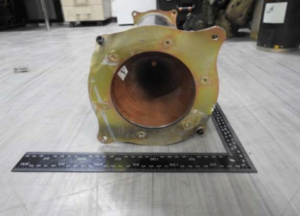
This image shows the copper cone of the shaped charge located at the front of the warhead fitted to a Shahed-131. The Ukrainian armed forces have recorded that the cone measures 111 mm in diameter and 162 mm in depth. The warhead is lined with cubic pre-formed fragments of 7 mm in diameter. The explosive content of the warhead is estimated to be between 10 and 15 kg. (ARES)