


Do not approach munitions
under any circumstances
Country or territory where the image was reported

Reported Location (53)

Year the image is reported to have been taken

Year (22)

2026
2025
2024
Classification groups of key explosive munitions used in conflicts

Munition Category (8)

The impact or effect the munition is intended to have

Functional use (10)

The specific model of munition pictured

Tentative Model (278)

Search

The external organisation that documented the munition

Research Organisation (6)

Colour of the munition pictured

Base Colour (12)

Colour of all, or some, of the markings on the munition

Marking Colour (11)

Language or script of the marking on a munition

Marking Script (10)

Condition of the munition pictured

Condition (6)

Key features defining the operation mechanisms of a projectile

Mechanical Feature (10)

Whether a munition is guided or unguided

Guidance (2)

Where the munition is launched from and what it targets

Domain (7)

The type of fins visible on the munition

Fins Characteristic (6)

The nominal diameter of a projectile. For most modern munitions, this is expressed in millimetres (e.g. 82 mm mortar projectile), but older artillery gun projectiles may be described in inches.

Calibre (77)

Weight class of the aerial bomb pictured

Weight Class (14)

301–400 of 961
OSMP1823
Analyst Note 2 March 2026
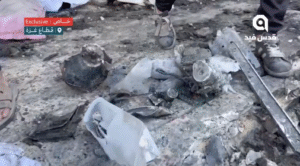
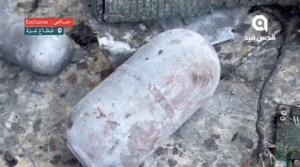
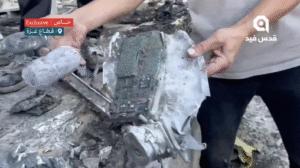
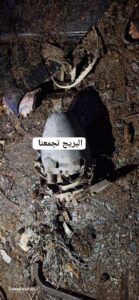
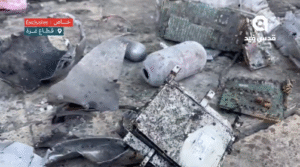
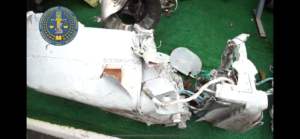
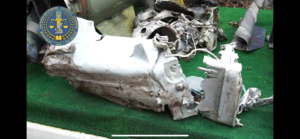
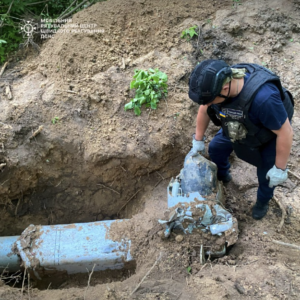
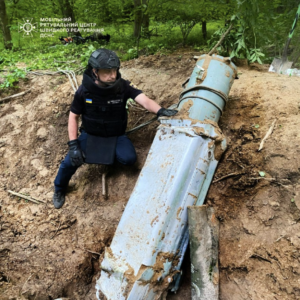
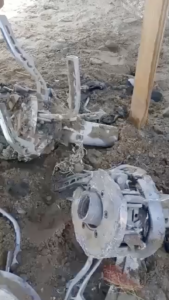
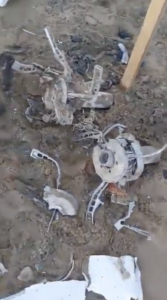
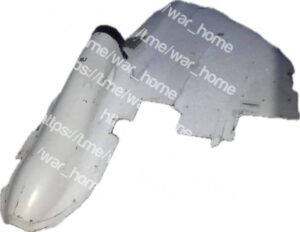
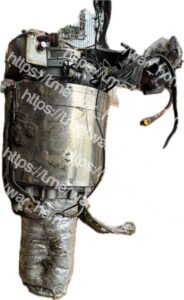
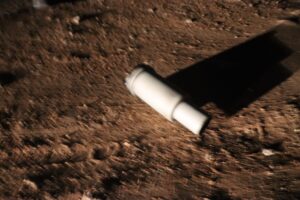
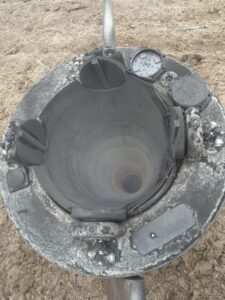
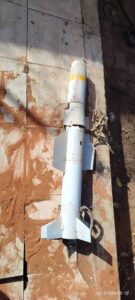
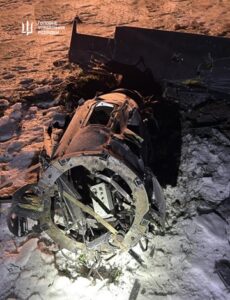
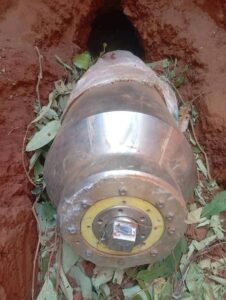
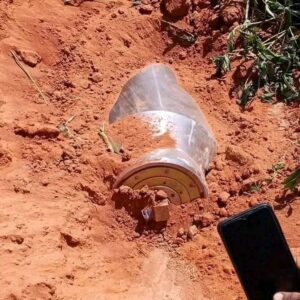
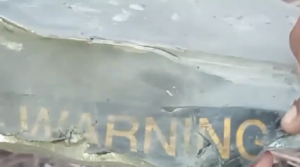
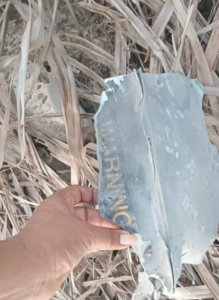
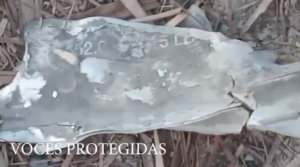
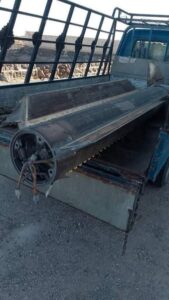
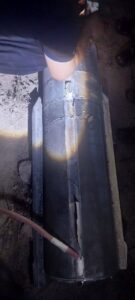
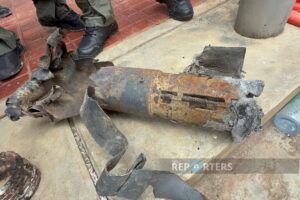
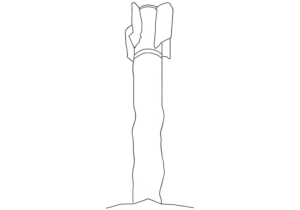
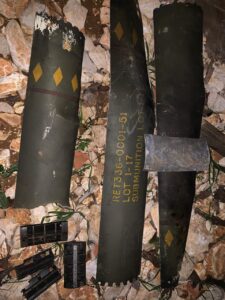
This image shows the remnants of a PAC-3 Cost Reduction Initiative (CRI) missile. The PAC-3 family of missiles are hit-to-kill interceptors that defend against incoming ballistic missiles, cruise missiles, aircraft, and other targets primarily by using kinetic impact. However, it is important to note that these missiles contain a high explosive fragmentation (HE-FRAG) “lethality enhancer” warhead. These warheads are much smaller than what would normally be expected on a surface-to-air missile of this size, but still present a hazard if it fails to function as designed. (ARES)
Collection

Американські боєприпаси використані в Ємені, 2025

Перевірені зображення американських боєприпасів під час бомбардувальної кампанії адміністрації Трампа проти підтримуваної Іраном бойової та політичної групи хуситів

View this collection

Collection

Ірансько-ізраїльський конфлікт. Червень 2025 року

Десятки перевірених зображень боєприпасів, використаних Іраном та Ізраїлем під час конфлікту між Ізраїлем та Іраном у червні 2025 року

View this collection

Collection

Україна 2022 – 2026

24 лютого 2022 року Росія розпочала повномасштабне вторгнення в Україну, із залученням військових сил, спрямованих на захоплення більшості великих міст, включаючи столицю Київ. Це стало найбільшим конфліктом у Європі з часів Другої світової війни, і близько чверті території України опинилося під контролем Росії

View this collection

Collection

Ізраїль і Газа 2023 – 2026

7 жовтня 2023 року бойовики ХАМАС прорвали міцно укріплений кордон між Ізраїлем і Сектором Газа, атакувавши численні міста і села. За повідомленнями, в Ізраїлі загинуло понад 1000 осіб, а понад 250 було взято в заручники і перевезено до Гази

View this collection
OSMP1792
Analyst Note 28 November 2025
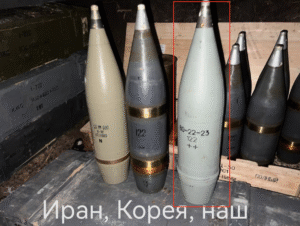
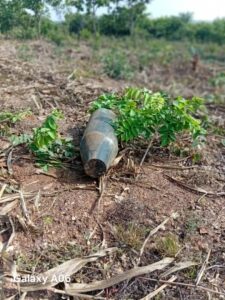
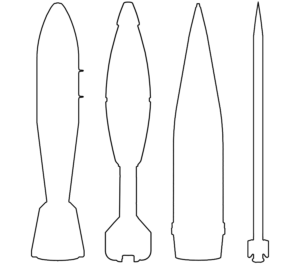
This image shows 122 mm high explosive (HE) artillery gun projectiles manufactured in three different states, L–R: Iran, North Korea, and Russia. Whilst these examples are distinct from one another—particularly in coloration, as well as the presence or absence of paint over the driving band and bourrelet—this is not always the case, and a combination of physical features and markings should be assessed before identification is made. (ARES)
OSMP1801
Analyst Note 5 February 2026
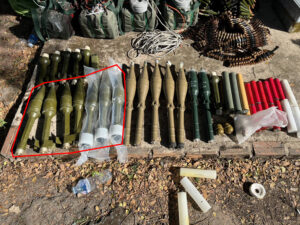
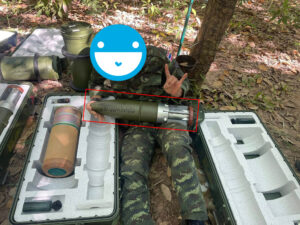
Pictured here are a pair of 106 mm M344A1 High Explosive Anti-Tank (HEAT) projectiles fitted with M509A1 point-initiating, base-detonating (PIBD) fuzes. These are designed to be fired from M40-series 106 mm recoilless rifles. Note that, despite the nominal 106 mm designations, the M40 has a bore diameter of 105 mm. (ARES)
OSMP1816
Analyst Note 31 December 2025
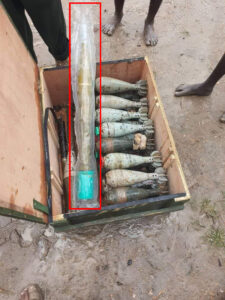
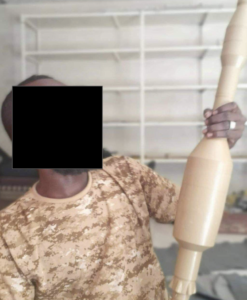
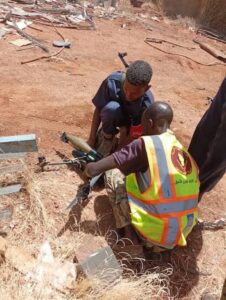
This PG-7VR recoilless gun projectile is painted in a tan colour often associated with Iranian production, but also used by other manufacturers. Iranian munitions have been seen and reported in Sudan with regularity. (ARES)
OSMP1803
Analyst Note 31 December 2025
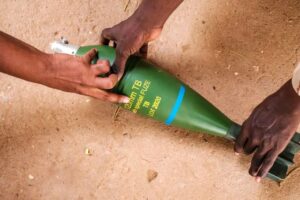
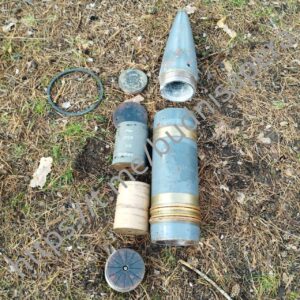
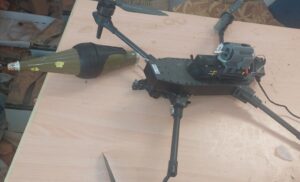
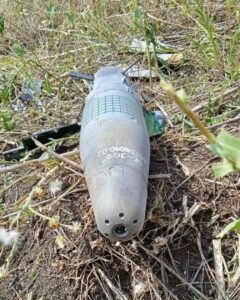
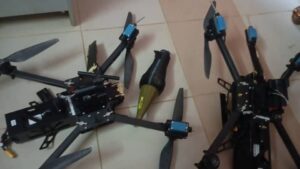
This munition, despite being adapated from the design of a 120 mm mortar projectile and closely resembling such, is actually a small air-delivered bomb intended to be dropped by UAV. The manufacturer clearly states that the munition should not be fired from a mortar. Additional data from the manufacturer states that it uses a UT M18 “special impact fuze”. (ARES)
OSMP1843
Analyst Note 31 December 2025
The UMPK guidance package is a ‘bolt-on’ kit that can be fitted to unguided air-delivered bombs to convert them to guided munitions. The UMPK kit also greatly extends the range of the munition to which it is fitted, allowing aircraft to strike from beyond the range of many air-defence systems. Currently only Russia manufacturers and uses these kits. (ARES)
OSMP1802
Analyst Note 31 December 2025
This image shows an FN-6-series man-portable air-defence system (MANPADS) being fired. In Sudan, this weapon is referred to as the ‘Nayzak’. The Nayzak is most likely a Chinese FN-6 re-marked for domestic use. (ARES)
OSMP1832
Analyst Note 31 December 2025
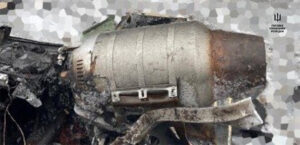
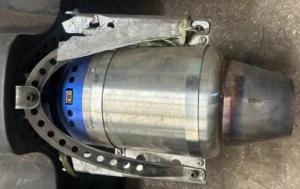
This image shows a Telefly JT80 jet engine, as used on Shahed-238 (Geran-3) UAVs. These jet engines are manufactured in China by Telefly Telecommunications Company. According to the manufacturer, each engine produces approximately 80kg of thrust. (ARES)
OSMP1838
Analyst Note 31 December 2025
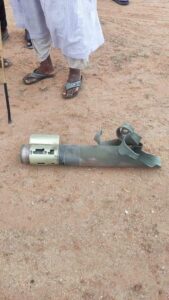
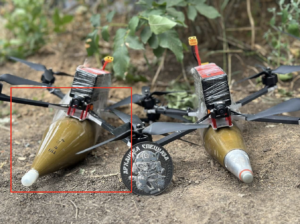
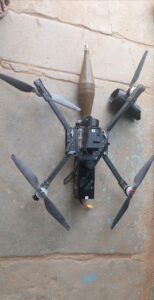
The munition indicated is a one-way-attack (OWA) UAV fitted with a PG-7-series high explosive anti-tank (HEAT) warhead. Not enough of the warhead is visible to provide a positive ID on which model of PG-7-series projectile it was harvested from. (ARES)
OSMP1828
Analyst Note 31 December 2025
This image shows a North Korean 170 mm artillery projectile, as fired by the M-1978 Koksan self-propelled artillery gun. Very little is known of the M-1978 Koksan due to the secretive nature of North Korean arms development, but both high explosive and rocket-assisted high explosive projectiles are believed to be available. The designations ‘M-1978’ and ‘Koksan’ were applied by American military analysts identified the system in Koksan, North Korea, in 1978. (ARES)
OSMP1883
Analyst Note 9 January 2026
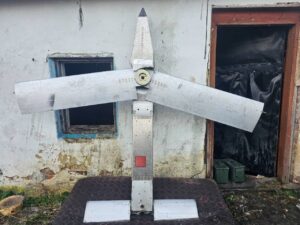
This image appears to show a remnant from either a 9M38- or 9M317-series surface-to-air missile. Positive identification of this munition cannot be made based on the imagery in this source alone; a rear control fin is visible in image but the 9M38- and 9M317-series missiles use indistinguishable rear fins. (ARES)
OSMP1882
Analyst Note 9 January 2026
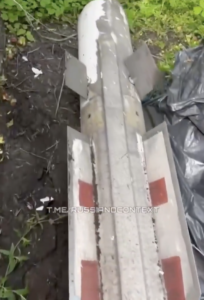
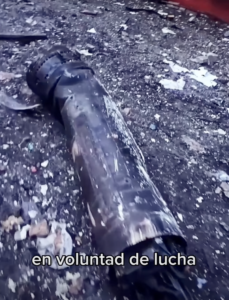
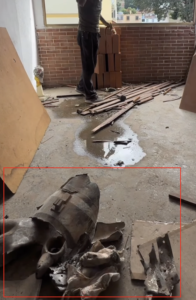
This image appears to shows the remnants of either a 9M38- or 9M317-series missile, however positive identification of this surface-to-air missile cannot be made based solely on the imagery in this source. The 9M38- and 9M317-series missiles are close in design and function, and are predominantly fired from the Buk family of surface-to-air missile (SAM) systems. The Buk-M2E SAM system is known to be in service in Venezuela, having been delivered under a Russian contract beginning in 2015. The source video for this entry shows the destroyed remains of a Buk-M2E launch vehicle, known as the 9A316E. (ARES)
OSMP1880
Analyst Note 9 January 2026
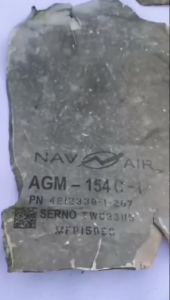
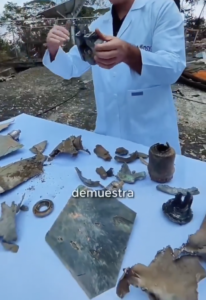
The AGM-154 Joint Standoff Weapon (JSOW) is a guided air-delivered ‘glide bomb’ that allows for long-range strikes using an unpowered munition. The AGM-154C and AGM-154C-1 variants (a remnant of the latter pictured here) carry a Bomb Royal Ordnance Augmented Charge (BROACH) multi-stage warhead which uses a WDU-44 shaped-charge warhead as its first stage, to help penetrate hardened targets, whilst the WDU-45 second stage comprises a conventional high explosive penetrator warhead (also called a ‘follow-through’ warhead). The AGM-154C-1 is described by the U.S. Navy as their “first air-to-ground Network-Enabled Weapon (NEW) capable of attacking stationary land and moving maritime targets. It includes GPS/INS guidance, terminal IR seeker and a Link 16 weapon data link. Integration of the Link-16 weapon data link and updated seeker software algorithms provide a capability against at-sea moving/relocatable targets.” (ARES)
OSMP1866
Analyst Note 9 January 2026
This image shows a WDU-36 series warhead as used in the RGM-/UGM-109 Tomahawk series of cruise missiles. The warhead design suggests this is likely a WDU-36/B from an RGM-/UGM-109E missile. The RGM-/UGM-109E Tomahawk Land Attack Missile (also known as TLAM Block IV) is an improved version of the BGM-109C TLAM-C. In cases where the missile strikes a building but does not function as intended, the dense, comparatively heavy warhead is often projected forwards of the point of impact. (ARES)
OSMP1690
Analyst Note 31 December 2025
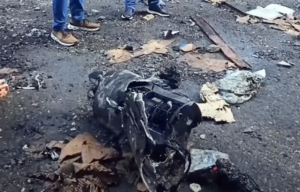
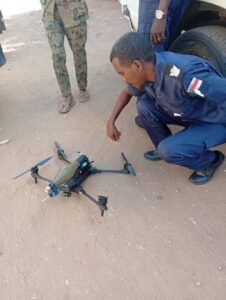
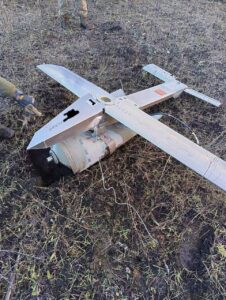
This image shows a one-way-attack (‘sacrificial’) UAV with the apparent warhead broken off. It is believed to have been attached to the grey mechanism located at the rear of the UAV, likely separating when the UAV was downed. (ARES)
OSMP1430
Analyst Note 15 September 2025
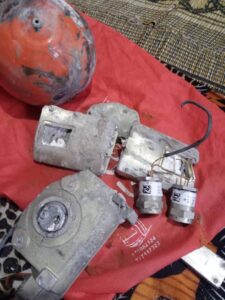
This image shows the MK 136 Third Stage Rocket Motor of a U.S. RIM-161 Standard Missile 3 (SM-3) Blk I interceptor missile. The SM-3 Blk I variants share the same propulsion sections, but have differences in the kill vehicle section. The SM-3 Blk II variants are substantially different, including new, larger-diameter propulsion sections. SM-3 missiles have a booster, dual-thrust rocket motor, third-stage rocket motor, and an altitude control section in the kill vehicle. (ARES)
OSMP1783
Analyst Note 31 December 2025
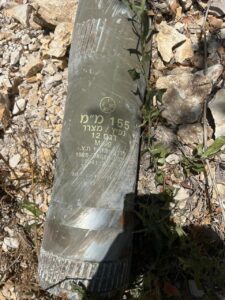
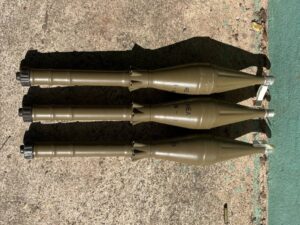
This image depicts remnants from a M999 (‘Barak Eitan’) 155 mm cluster munition. Reports indicate that the M999 artillery projectile carries nine M99 Dual-Purpose Improved Conventional Munition (DPICM) submunitions. (ARES)
OSMP671
Analyst Note 28 November 2025
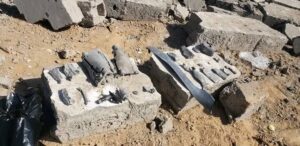
Markings on the forward section of this small, air-delivered bomb suggest that the designation is ‘BK-3OF’ (“БК-3ОФ”). The physical features of the munition suggest that it is laser-guided and likely carries a high explosive fragmentation (HE-FRAG) payload. This image shows the only known example, which was allegedly captured by Russian forces in conjunction with a Ukrainian UAV. (ARES)
OSMP1850
Analyst Note 9 January 2026
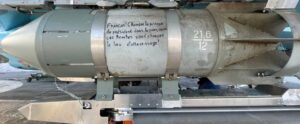
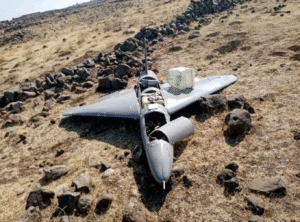
This Russian air-delivered cluster bomb is marked with a threatening message directed at the French people: «Français! Changer la politique du président dans le pays, sinon ces bombes vont changer le lieu d'atterrissage!» (“French people! Change the president’s policy in the country, otherwise these bombs will change their landing site!”). (ARES)