Do not approach munitions
under any circumstances
Country or territory where the image was reported

Reported Location (48)

Year the image is reported to have been taken

Year (20)

Classification groups of key explosive munitions used in conflicts

Munition Category (8)

The impact or effect the munition is intended to have

Functional use (10)

The specific model of munition pictured

Tentative Model (364)

Search

The external organisation that documented the munition

Research Organisation (6)

Colour of the munition pictured

Base Colour (12)

Colour of all, or some, of the markings on the munition

Marking Colour (10)

Language or script of the marking on a munition

Marking Script (9)

Condition of the munition pictured

Condition (6)

Key features defining the operation mechanisms of a projectile

Mechanical Feature (10)

Short metal pins or bolts for holding together two plates or pieces of metal.
Rivet Holes, Screws, Rivets
Whether a munition is guided or unguided

Guidance (2)

Where the munition is launched from and what it targets

Domain (7)

The type of fins visible on the munition

Fins Characteristic (5)

The nominal diameter of a projectile. For most modern munitions, this is expressed in millimetres (e.g. 82 mm mortar projectile), but older artillery gun projectiles may be described in inches.

Calibre (72)

Weight class of the aerial bomb pictured

Weight Class (14)

501–600 of 774

Current Filter

Rivet Holes, Screws, Rivets
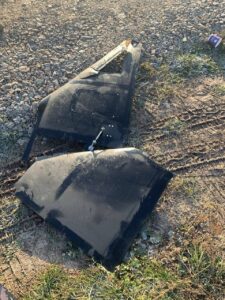
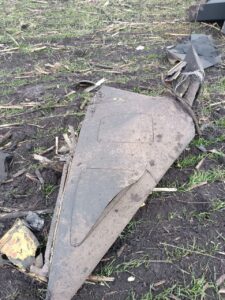
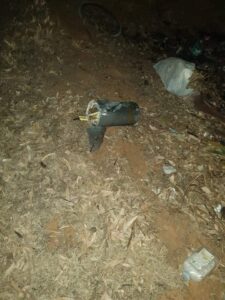
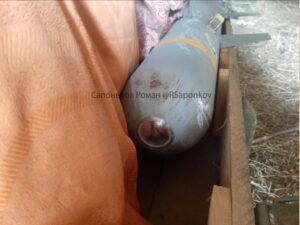
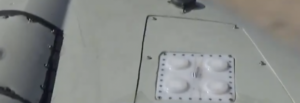
Short metal pins or bolts for holding together two plates or pieces of metal. Such rivet holes, typically filled with rivets, are found on multiple types of munition.
OSMP1125
Analyst Note:
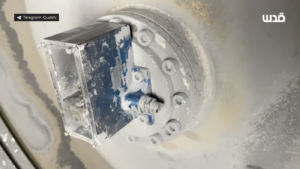
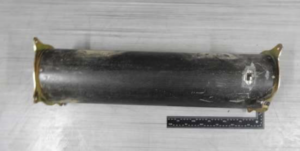
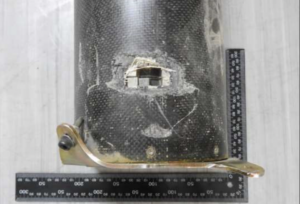
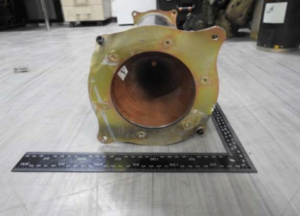
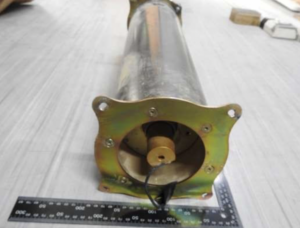
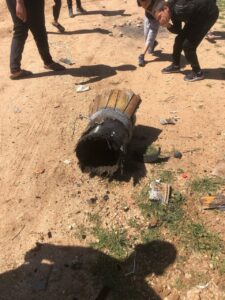
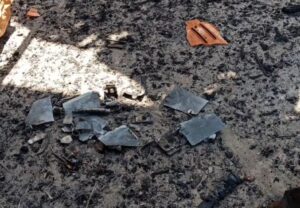
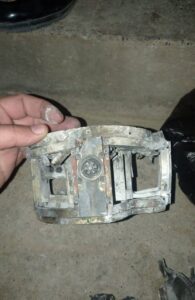
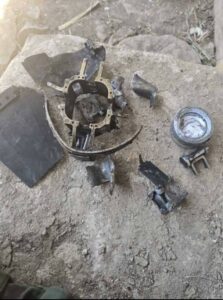
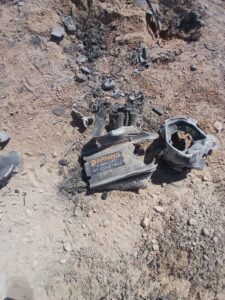
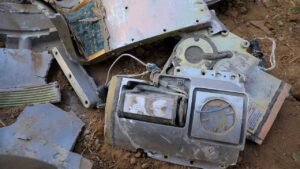
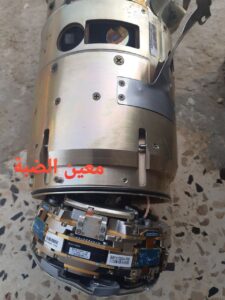
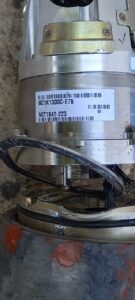
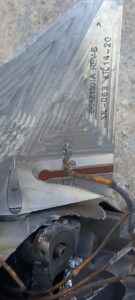
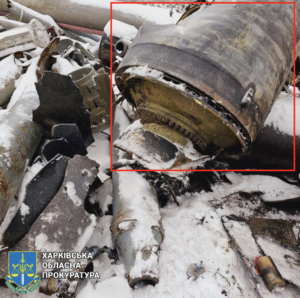
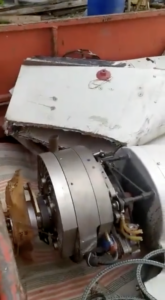
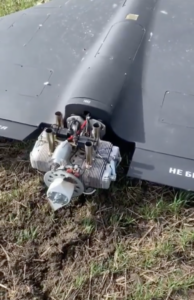
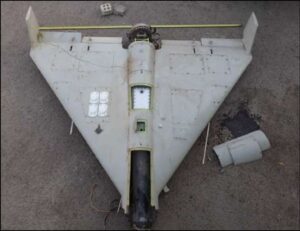
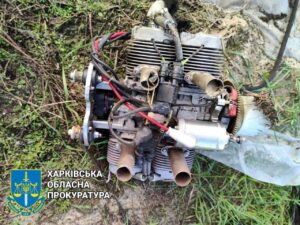
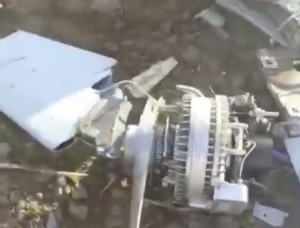
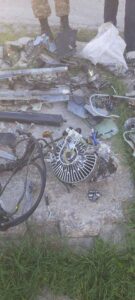
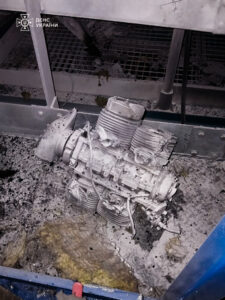
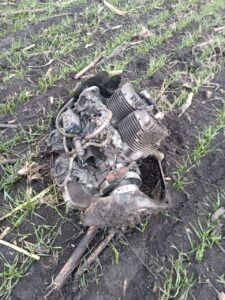
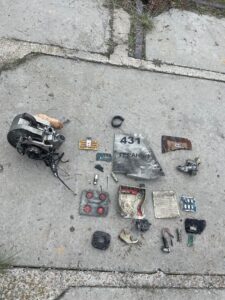
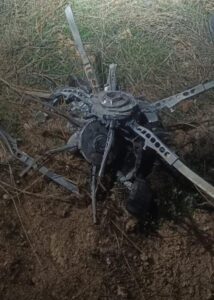
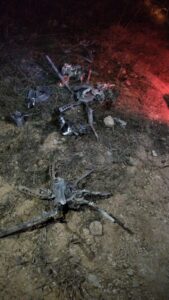
These images show a damaged Serat-01 engine which powers the Shahed-131 drone after its rocket-assisted launch. The Serat-01 is a copy of the MDR 208 engine, and is noticeably smaller than the MD550 which powers the larger Shahed-136. (ARES)
OSMP1117
Analyst Note:
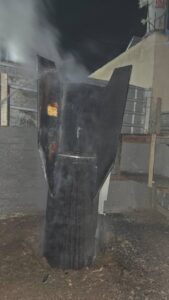
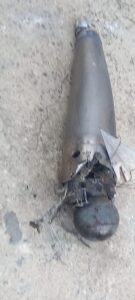
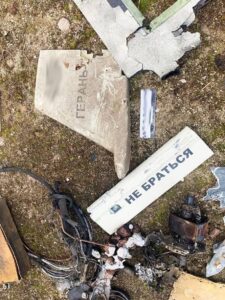
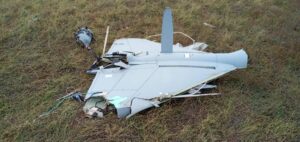
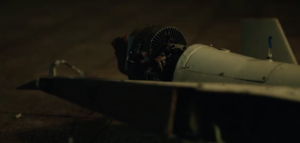
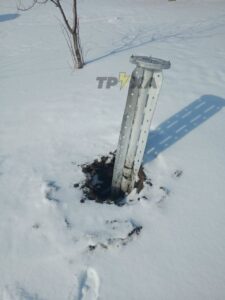
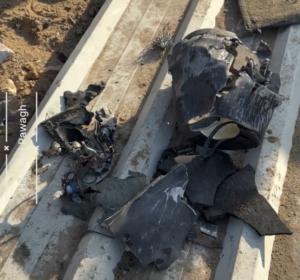
This image shows the BSF-50, one of several warheads developed by Russia for the Shahed-136/Geran-2 to replace the original Shahed-136 warhead designed by Iran. The BSF-50 is a high explosive warhead with a fragmentation effect. (ARES)
OSMP1126
Analyst Note:
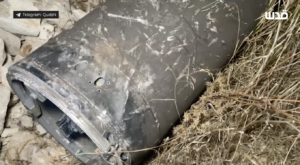
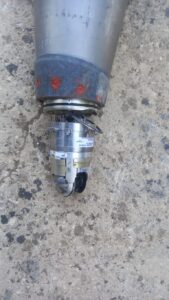
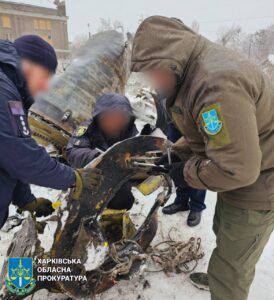
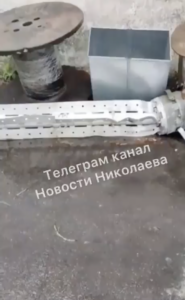
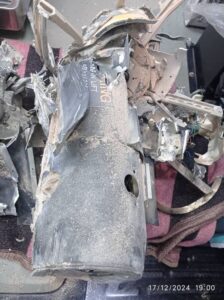
Depicted here is the MD-550 motor of a Shahed-136/Geran-2. This image was presented by Ukrainian President Zelenskyy as a fragment of the drone that reportedly hit the Chernobyl Nuclear Power Plant’s New Safe Confinement shelter. (ARES)
OSMP1076
Analyst Note:
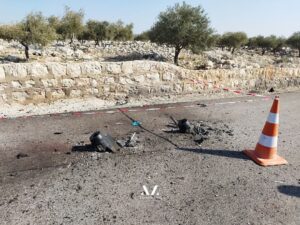
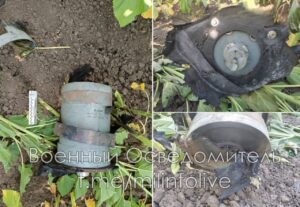
This image shows the functioned rocket motor of an Israeli Carpet rocket. The Carpet uses a fuel-air explosive (FAE) warhead which is designed to function mines and improvised explosive devices (IEDs), clearing a target area for the advance of friendly forces. These rockets are fired from the Carpet rocket launcher, which is loaded with up to 20 rockets and can be fitted to a variety of vehicles. (ARES)
OSMP1063
Analyst Note:
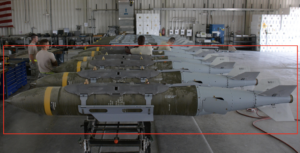
The Armement Air-Sol Modulaire (AASM; ‘Modular Air-to-Ground Armament’) family of French bolt-on guidance kits are fitted to air-delivered bombs of various sizes in a similar fashion to American JDAM kits. In some marketing materials, the acronym HAMMER is used, standing for ‘Highly Agile Modular Munition Extended Range’. This refers, in part, to the rocket boosters fitted to munitions in the family to extend their effective range. (ARES)
OSMP1062
Analyst Note:
In this photo, a Ukrainian Sukhoi Su-25 ground-attack aircraft from the 299th Tactical Aviation Brigade, with the bort number ‘Blue 28’, is seen carrying an AASM-250 guided air-delivered bomb under its left wing. Available imagery shows that the AASM-250 has also been fitted to Mikoyan MiG-29 fighter aircraft, and can likely be carried by the Sukhoi Su-27 as well. (ARES)
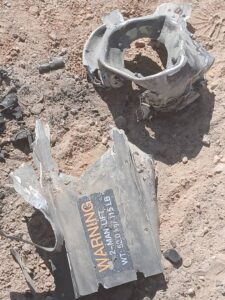
OSMP1056
Analyst Note:
This image shows the rear portions of two different two different Spike Non-Line-of-Sight (NLOS) missiles, which each include the control section and part of the rocket motor. The Spike NLOS has been in service with Israel since 1987, and is currently in its sixth generation, or iteration, which comprises an unknown number of variants. At least three different warhead configurations are reported: high explosive fragmentation (HE-FRAG), high explosive anti-tank (HEAT), and a ‘multipurpose’ or anti-structure variant with a penetrating blast and fragmentation warhead. (ARES)
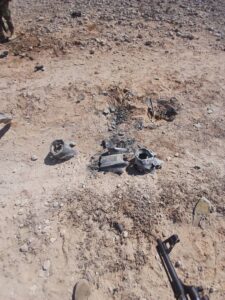

OSMP1058
Analyst Note:
This image shows a MK 84 2,000-pound bomb that has had its fuze and baseplate removed in order to access the explosive filler. The fuze, fuze retaining ring, and baseplate can be seen on the white sheet. The explosive material used to fill the bomb has been removed, possibly to be repurposed in improvised explosive devices or craft-produced munitions. Unexploded ordnance is often ‘harvested’ for these purposes. (ARES)
OSMP1046
Analyst Note:
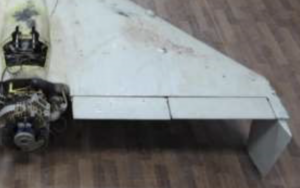
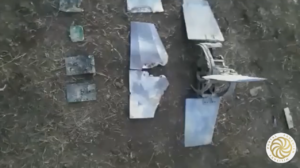
This image shows a wing fragment from a SPICE-1000 bomb guidance kit. While there are no remnants of the bomb body visible, it can be determined that a MK 83-series 1,000-pound bomb or similar was used, as MK-83 series bombs are paired with the SPICE-1000 bomb guidance kit to form a complete munition. (ARES)
OSMP1033
Analyst Note:
This image shows part of the SUU-66 dispenser (sometimes called a ‘shell’) that forms part of a CBU-105 D/B cluster bomb unit. In U.S. service, a ‘cluster bomb unit’ designation includes both the dispenser or shell, as well as the payload. The CBU-105 series of cluster munitions consists of CBU-97-series munitions that are modified with a WCMD (Wind Corrected Munitions Dispenser) guidance kit. Both CBU-97 and CBU-105 series munitions are made-up of an SUU-66 dispenser filled with 10 BLU-108 submunitions. Each BLU-108 submunition contains 4 ‘skeet’ warheads that are ejected mid-air and independently seek out targets using an infrared sensor. A single skeet weighs 7.5 lb (3.4 kg) and contains a copper explosively formed penetrator (EFP) for armour penetration that is surrounded by a fragmentation ring offering some anti-personnel effect. (ARES)
OSMP903
Analyst Note:
Whilst relatively little is known about Burmese air-delivered bombs from publicly available sources, researchers (including those at ARES and Myanmar Witness) have been collecting evidence based on munitions’ physical features and markings. Combined with information from confidential sources, this has allowed for the tentative identification of several models. (ARES)
OSMP920
Analyst Note:
The Stunner surface-to-air missile fired by the David’s Sling air defence system is a two-stage interceptor, meaning that the munition contains two separate rocket motors for launch and propulsion. The first stage, or launch motor, detaches from the munition after a short time, before the second stage, or flight motor, ignites. The second stage motor, visible here, was found relatively intact. (ARES)
OSMP984
Analyst Note:
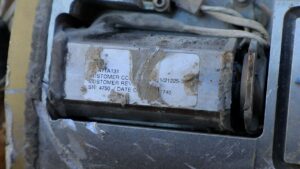
This image shows part of the warhead section of an MGM-140 Army Tactical Missile System (ATACMS) series tactical ballistic missile. This is the top of the warhead section, where it connects to the guidance section. A data plate is visible, giving information about the manufacturer (“Lockheed Martin Vought Systems”) and identifying this specific part (“WARHEAD, GUIDED MISSILE. HIGH EXPLOSIVE”. (ARES)
OSMP975
Analyst Note:
This image shows an SUU-30H/B, an air-delivered dispenser which can be configured to carry different submunition payloads. These can include 217 BLU-61 A/B, 650 BLU-63/B, or 650 BLU-86/B or BLU-86 A/B. The munition can also carry inert payloads. The specific combination of payload and dispenser determines the ‘Cluster Bomb Unit’ (CBU) designation, with SUU-30H/B dispensers being paired with different payloads to form the CBU-58 and CBU-71 series. Contextual information suggests that this dispenser was part of a CBU-58/B cluster munition, but this cannot be established from an assessment of this image alone. (ARES)
OSMP965
Analyst Note:
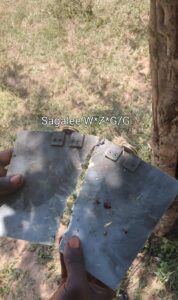
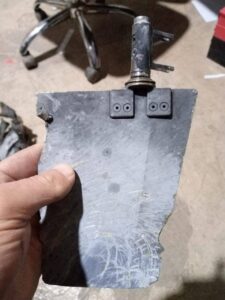
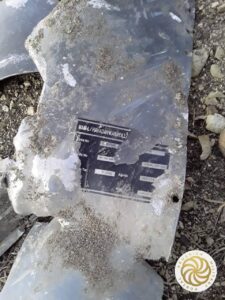
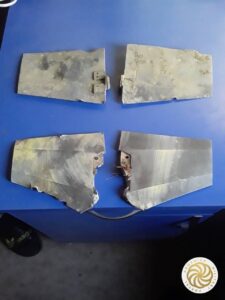
The internal components of large, complex munitions often feature markings to aid in assembly, supply chain oversight, and quality assurance. In this case, a data plate marked with the name of the manufacturer (“MBDA FRANCE”) has been affixed to one of the rear control fins (“EQ, VENTRAL, FIN TIP”) of the missile. The NATO Stock Number (NSN) is also visible. (ARES)
OSMP964
Analyst Note:
This image shows a Microturbo TRI 60-30 turbojet engine from a Storm Shadow-series air-launched cruise missile. Further remnants of the rear of the missile are also visible, including one of the rear control fins. The Storm Shadow has a range of more than 250 kilometres. (ARES)
OSMP960
Analyst Note:
This image shows the rear of the second stage of the penetrator warhead (also called a ‘follow-through’ warhead) of the Bomb Royal Ordnance Augmented Charge (BROACH) multi-stage warhead system present in the Storm Shadow/SCALP-EG missile. The cylindrical object in the centre of the warhead (with a data plate marked “THALES”) is the fuze. (ARES)
OSMP967
Analyst Note:
This image shows the first stage of the Bomb Royal Ordnance Augmented Charge (BROACH) multi-stage warhead used by the Storm Shadow/SCALP-EG missile. The BROACH uses a shaped-charge warhead (seen here) as its first stage, to help penetrate hardened targets, whilst the second stage comprises a conventional high explosive penetrator warhead (also called a ‘follow-through’ warhead) (ARES).
OSMP979
Analyst Note:
The remnant at left in this image is the second stage, or penetrator warhead, of the Bomb Royal Ordnance Augmented Charge (BROACH) multi-stage warhead as used in the Storm Shadow/SCALP-EG air-launched cruise missile. In this case, it has failed to function as intended. (ARES)
OSMP897
Analyst Note:
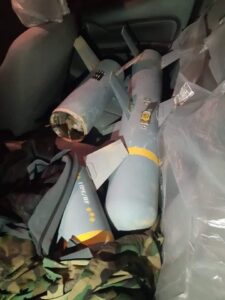
In this image, two GBU-39 guided air-delivered bombs can be seen in their shipping containers, with only the nose and the tail actuation section of the munitions clearly visible. Distinctive packaging such as this can sometimes be used as contextual evidence for the presence of specific munitions. (ARES)
OSMP949
Analyst Note:
This U.S. Department of Defense file photo shows an M142 High Mobility Artillery Rocket System (HIMARS) launching an MGM-140 Army Tactical Missile System (ATACMS) series tactical ballistic missile. (ARES)
OSMP942
Analyst Note:
This image shows a rocket motor section from an MGM-140 ATACMS series surface-to-surface ballistic missile. The warhead section of the MGM-140 series missiles separate from the rocket motor before functioning, resulting in the rocket motor often being found relatively intact near the target. The MGM-140 series missiles use the same rocket motor, preventing a positive identification of the variant based off the rocket motor alone, unless the variant markings are visible. (ARES)
OSMP928
Analyst Note:
This remnant of an MGM-140 Army Tactical Missile System (ATACMS) surface-to-surface ballistic missile is marked to indicate it is the MGM-140A variant, a cluster munition which carries 950 M74 multi-purpose submunitions. Submunitions of this type are sometimes referred to by the acronym ‘anti-personnel and anti‑materiel (APAM)’. Additional markings indicate a manufacturing date (“10/96”; October 1996), a serial number (“411240”), and other information. (ARES)