

Do not approach munitions
under any circumstances
Country or territory where the image was reported

Reported Location (52)

Year the image is reported to have been taken

Year (21)

Classification groups of key explosive munitions used in conflicts

Munition Category (8)

The impact or effect the munition is intended to have

Functional use (10)

The specific model of munition pictured

Tentative Model (353)

DM1399

Search

The external organisation that documented the munition

Research Organisation (6)

Colour of the munition pictured

Base Colour (12)

Colour of all, or some, of the markings on the munition

Marking Colour (11)

Language or script of the marking on a munition

Marking Script (10)

Condition of the munition pictured

Condition (6)

Key features defining the operation mechanisms of a projectile

Mechanical Feature (10)

Whether a munition is guided or unguided

Guidance (2)

Where the munition is launched from and what it targets

Domain (7)

The type of fins visible on the munition

Fins Characteristic (6)

The nominal diameter of a projectile. For most modern munitions, this is expressed in millimetres (e.g. 82 mm mortar projectile), but older artillery gun projectiles may be described in inches.

Calibre (76)

Weight class of the aerial bomb pictured

Weight Class (14)

1–3 of 3
OSMP2283
Analyst Note:
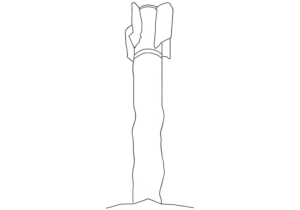
The German DM 1399 (AT2) anti-tank landmine shown here can be dispensed from rockets and ground vehicles. Upon being dispensed, a small parachute is deployed in order to slow the mine’s descent and assist in in landing base down; the parachute is released upon impact by an impact-release connector. Upon impact, from five to 12 (six shown) spring-loaded, metal legs deploy to right the mine; arming is completed anywhere from 15 seconds to five minutes thereafter. The base of the cylindrical body houses the battery and electronics assembly, with the main explosive charge and Misnay–Schardin shaped charge plate immediately above. The body is topped by a dome cover and an S3 sensor wire which extends approximately 600 mm (12 in) above the body of the mine. (ARES)

OSMP2282
Analyst Note:
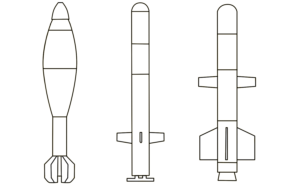
This image shows a German DM 1399 (AT2) dispensed anti-tank (anti-vehicle) landmine. This munition uses a shaped charge that relies on the Misnay–Schardin effect to penetrate the underside of armoured fighting vehicles. The DM 1399 reportedly has magnetic and pressure fuzing, along with an anti-disturbance feature and a self-destruct time delay of up to four days, settable in six different increments. The mines can be dispensed from rockets (MLRS), vehicles (Skorpion 2), and UAVs (Eggbox with 4 mines). Currently the mines are known to be in service with Finland, Germany, Norway, the United Kingdom, and Ukraine (having been donated by Germany). Denmark, Latvia, and Sweden are in the process of having AT2+ mines and Skorpion 2 systems delivered. (ARES)

Collection

Ukraine and Russia 2022–2026

On February 24, 2022, Russia launched a full-scale invasion of Ukraine, involving military forces aimed at capturing most major cities, including the capital, Kyiv. It became the largest conflict in Europe since World War II, and about a quarter of Ukraine’s territory came under Russian control. But Russian troops were eventually pushed back from Kyiv. […]

View this collection