



33 results
Current Filter
Ukraine
A large eastern European country that faced a full-scale Russian invasion in February 2022. Since then the Ukrainian military has fought a major war with Russian forces, with tens of thousands believed to have been killed.


Analyst Note:
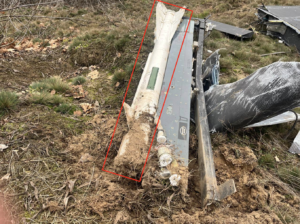
This image represents the first documented instance of a Shahed-series UAV carrying an R-60 air-to-air missile. This appears to add a new capability to the Shahed, enabling it to target enemy aircraft. Arming UAVs to counter interception and engage alternative targets is an emergent trend. Previously, unmanned surface vessels (USVs) employed by the Ukrainian Armed Forces have been observed carrying R-73 air-to-air missiles, for example. (ARES)
Analyst Note:
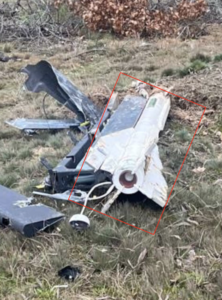
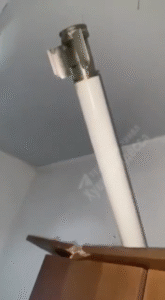
This image shows the rear section of a Hydra-70 rocket. The Hydra-70 uses the MK 66 series of rocket motors, visible here, but can be fitted with at least 11 different warheads. They can also be fitted with the Advanced Precision Kill Weapon System (APKWS) ‘bolt-on’ guidance kit, converting an unguided rocket into a guided missile. From the available imagery, it is not clear with which warhead or guidance section this munition may have been fitted. (ARES)

Analyst Note:
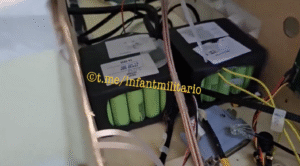
This photo shows some of the lithium-ion power banks found within a Gerbera UAV. These are used to power the onboard avionics, control surfaces, communications hardware, camera, and other components. The quantity and type of batteries fitted to the Gerbera will often vary based on the role for which the UAV has been configured—one-way attack (OWA; i.e., a ‘sacrificial’ munition), reconnaissance, signal relay, or decoy—and which specific hardware has been installed to effect this mission. (ARES)
Analyst Note:
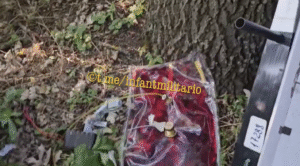
This photo shows the fuel bladder of a Gerbera UAV, which still contains some fuel. It is likely that a bladder is used—rather than a rigid tank—to save on both weight and cost. Some variants of the Gerbera have been observed to be fitted with a second bladder in the forward section of the fuselage, serving to extend the UAV’s range. (ARES)
Analyst Note:
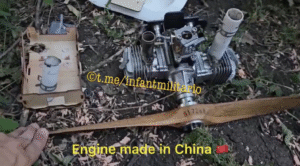
The DLE60 two-stroke petrol (gasoline) engine pictured here is the standard engine found on Gerbera UAVs. It is produced by the Chinese company Mile Haoxiang Technology Co., Ltd. and marketed specifically for use in UAVs. Although the Gerbera is manufactured in Russia, the engine and many other key components continue to be supplied from Chinese sources. (ARES)
Analyst Note:
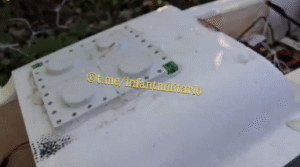
This image shows a Controlled Reception Pattern Antennas (CRPA) unit installed on a Gerbera-series UAV. CRPAs are specialised antenna arrays that help protect GPS receivers from interference, spoofing, and jamming. This particular model, featuring four antennas, was first observed on the Shahed-136 UAV and has since been routinely seen fitted to Gerbera-series UAVs. An alternative array, with six antenna elements, has also been observed, reflecting the varied and ever-evolving state of electronic warfare in Ukraine. (ARES)
Analyst Note:
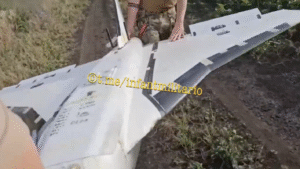
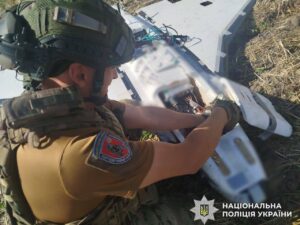
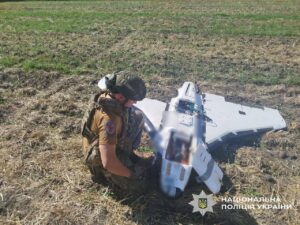
A Gerbera-series UAV is pictured here being carried by just two Ukrainian soldiers. This highlights the Gerbera’s lightweight design—the airframe is mostly constructed from Styrofoam and wood, which saves on both weight and cost. This particular example does not bear signs of significant damage, suggesting that it either malfunctioned or was brought down by EW and crashed. (ARES)
Analyst Note:
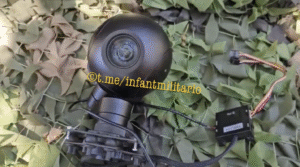
This image shows an A40 Pro camera, manufactured by the Chinese company Viewpro UAV and design specifically for use in UAVs. The black box to the right of the camera is the control box which manages video output, camera control, and power. The manufacturer claims this model has a 40× optical zoom, AI detection and tracking, and 3-axis gyro-stabilisation. The company further claims that it can customise the onboard AI recognition based on “target characteristics” provided by the client. Numerous Gerberas fitted with this model of camera are known to have been recovered by Ukrainian forces, although it is by no means the only camera model in use. (ARES)
Analyst Note:
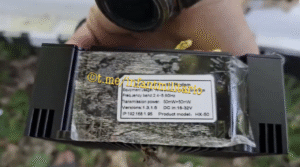
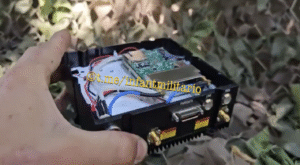
This image shows the back surface of a wireless communications module contained within a downed Gerbera UAV. Although labeled as an HX-50 model designed for fixed locations, Ukrainian military analysis indicates this is an XK-F358 mesh-network module more suitable for use in UAVs. See OSMP1646 for further details. (ARES)
Analyst Note:
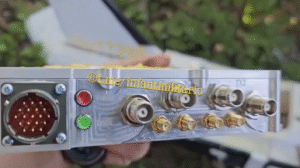
This image shows the front and interior surfaces of a wireless communications module recovered from a downed Gerbera UAV. Although labelled as an HX-50 industrial wireless modem (compatible with WiFi and 5G/4G networks and designed for fixed locations), analysis by Ukrainian military sources indicates that this component is, in fact, an XK-F358 mesh-network module which offers significantly more capabilities. Manufactured and sold by Shenzhen Xingkai Technology Co., Ltd., these modules are designed for, amongst other things, use in robots and unmanned vehicles. Gerbera UAVs have been found operating on a wide variety of frequencies and networks, and this type of module is well-suited to this use. (ARES)
Analyst Note:
Pictured is a navigation/GPS module recovered from a downed Gerbera UAV. This particular model is used with the 4-antenna CRPA module seen in OSMP1648. The four RX ports on the bottom are normally directly connected to the CRPA (antenna) module, with other connections made to the UAV’s flight controller and power sources. Some Gerberas have been recovered with CRPA modules bearing a different number of antennas; different navigation modules have been observed on these. (ARES)
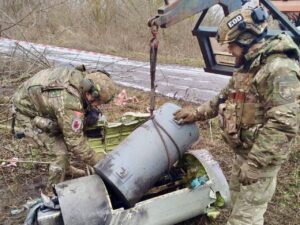
Analyst Note:
This image shows the second warhead present in some variants of the Kh-101 cruise missile. The inclusion of this additional warhead requires a smaller fuel tank in the missile, offering increased explosive weight in exchange for a reduced maximum range. (ARES)
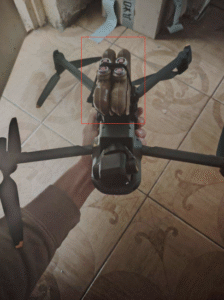
Analyst Note:
This image shows four PFM-1 series anti-personnel landmines retained by a release mechanism to enable deployment via UAV. Ordinarily, PFM-1 series and other ‘scatterable mines’ are deployed via carrier munitions or dedicated mine-dispensing devices. In Ukraine and other conflicts, these mines have often been removed from their original carrier munitions in order that they may be delivered via UAV. (ARES)
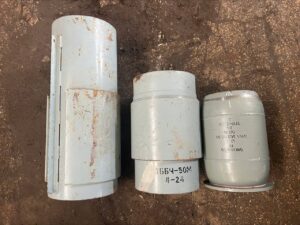
Analyst Note:
This image shows three different warheads developed by Russia for the Shahed-136/Geran-2 one-way attack (OWA) unmanned aerial vehicle (UAV), each of which differ from the original warhead designed by Iran for the Shahed-136. Left: A thermobaric explosive warhead; Middle: TBBCh-50M, a thermobaric explosive warhead; Right: OFZBCh-50, a high explosive warhead with an incendiary effect. Each of these warheads is also fitted with a fragmentation liner to increase the fragmentation effect generated when the warhead detonates. Some of the fragmentation liners may contain zirconium, a metal which is ignited when the warhead detonates, providing an additional incendiary effect. (ARES)
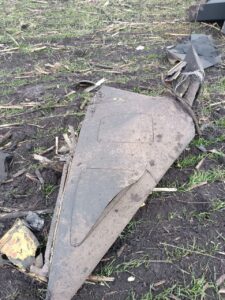
Analyst Note:
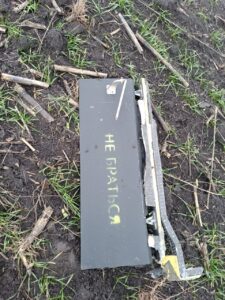
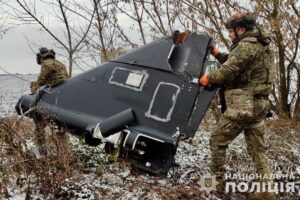
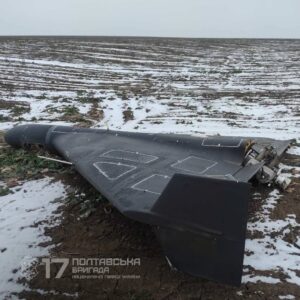
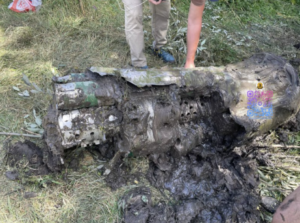
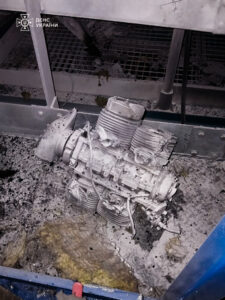
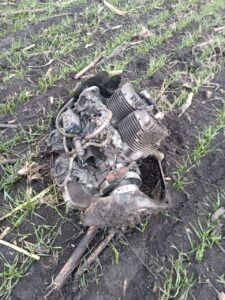
Depicted here is the MD-550 motor of a Shahed-136/Geran-2. This image was presented by Ukrainian President Zelenskyy as a fragment of the drone that reportedly hit the Chernobyl Nuclear Power Plant’s New Safe Confinement shelter. (ARES)
Analyst Note:
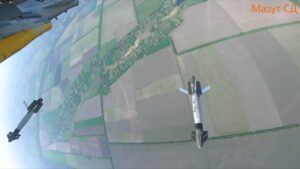
The Armement Air-Sol Modulaire (AASM; ‘Modular Air-to-Ground Armament’) family of French bolt-on guidance kits are fitted to air-delivered bombs of various sizes in a similar fashion to American JDAM kits. In some marketing materials, the acronym HAMMER is used, standing for ‘Highly Agile Modular Munition Extended Range’. This refers, in part, to the rocket boosters fitted to munitions in the family to extend their effective range. (ARES)
Analyst Note:
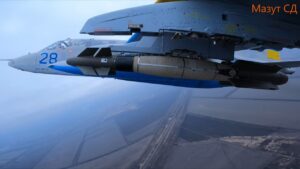
In this photo, a Ukrainian Sukhoi Su-25 ground-attack aircraft from the 299th Tactical Aviation Brigade, with the bort number ‘Blue 28’, is seen carrying an AASM-250 guided air-delivered bomb under its left wing. Available imagery shows that the AASM-250 has also been fitted to Mikoyan MiG-29 fighter aircraft, and can likely be carried by the Sukhoi Su-27 as well. (ARES)