





1–7 of 7
Analyst Note
11 September 2024
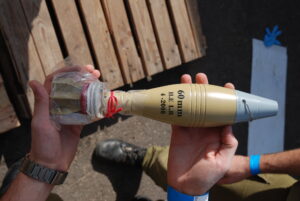
This is an Iranian 60 mm mortar projectile, marked to indicate it is of the ‘high explosive, long-range’ type (“H.E L.R”). Both the munition body and fuze are marked to with the year of production (“2008”). Whilst the tan colouring is often indicative of Iranian-made munitions (especially where the fins are also painted), this is not diagnostic, and a combination of physical features and markings should be assessed to reach a positive identification. (ARES)
Analyst Note
14 October 2024
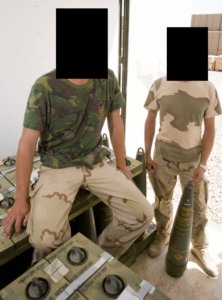
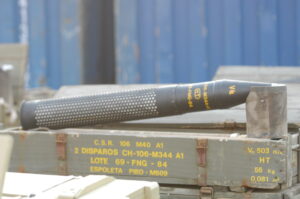
Markings on this 106 mm recoilless gun projectile indicate it is a M344A1 high explosive anti-tank (HEAT) round (“CH-106-M344-A1”) produced by Fábrica Nacional de Granada (“FNG”), Spain, in 1984 (“84”). The packing crate identifies the intended weapon as an M40A1 Cañón sin retroceso, or ‘recoilless rifle’ (“C.S.R. 106 M40 A1”). Other markings show that the round is fitted with an M509-type point-impact, base initiating (PIBD) fuze (“Espoleta PIBD M509”), and give additional details such as the expected muzzle velocity (“V₀”) of 503 m/s. (ARES)
Analyst Note
14 October 2024
This Iranian M91 81 mm mortar projectile is marked to indicate it was produced in 2009. The AZ111A2 fuze fitted to the projectile is also marked with the same year of manufacture. (ARES)
Analyst Note
14 October 2024
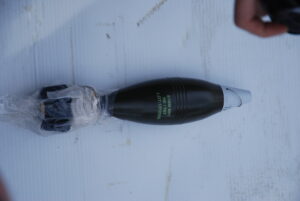
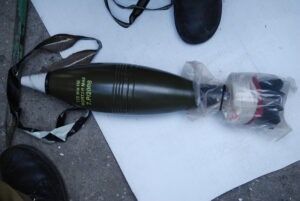
This Iranian M48 120 mm mortar projectile is marked to indicate it was manufactured in 2008. A plastic bag cable-tied to the tail of the munition protects the auxiliary, or supplemental, propellant charges fitted to the round. (ARES)
Analyst Note
14 October 2024
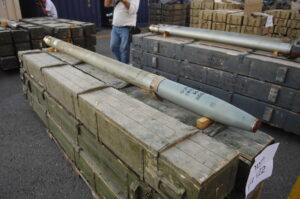
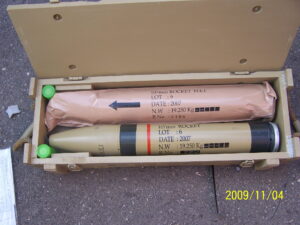
This Iranian copy of the Chinese Type 63 107 mm rocket is marked with a red stripe and text to indicate it is of the high explosive incendiary (“H.E.I”) type. Markings also show that it was produced in 2007. (ARES)