Do not approach munitions
under any circumstances
Country or territory where the image was reported

Reported Location (52)

A large country in Eastern Europe and North Asia.
Russia
Year the image is reported to have been taken

Year (22)

Classification groups of key explosive munitions used in conflicts

Munition Category (8)

The impact or effect the munition is intended to have

Functional use (10)

A broad term for a variety of different carrier munitions which contain and dispense submunitions - smaller munitions, sometimes called 'bomblets'.
Cluster Munition
Use the detonation of an explosive to propel small fragments of material from the body of the munition at high velocity
Fragmentation Munition
The specific model of munition pictured

Tentative Model (293)

Search

The external organisation that documented the munition

Research Organisation (6)

Colour of the munition pictured

Base Colour (12)

Colour of all, or some, of the markings on the munition

Marking Colour (11)

Language or script of the marking on a munition

Marking Script (10)

Condition of the munition pictured

Condition (6)

Key features defining the operation mechanisms of a projectile

Mechanical Feature (10)

Whether a munition is guided or unguided

Guidance (2)

Where the munition is launched from and what it targets

Domain (7)

The type of fins visible on the munition

Fins Characteristic (6)

The nominal diameter of a projectile. For most modern munitions, this is expressed in millimetres (e.g. 82 mm mortar projectile), but older artillery gun projectiles may be described in inches.

Calibre (77)

Weight class of the aerial bomb pictured

Weight Class (14)

1–28 of 28

Current Filter

Cluster Munition
Carrier munitions which contain and dispense submunitions (smaller munitions, sometimes called ‘'bomblets’'). Cluster munitions generally scatter their payload over a wide area, either to increase hit probability or for area-denial purposes. They can take the form of multiple munition categories. Some submunitions - especially older models, or those stored or employed incorrectly - can have a high dud rate, resulting in an enduring explosive hazard. More than 100 states have signed an international convention banning the use of cluster munitions - but not Russia, the United States, China, or Israel.

Current Filter

Fragmentation Munition
Fragmentation munitions use the detonation of an explosive to propel small fragments of material (‘fragmentation’) from the body of the munition at high velocity. A fragmentation munition typically affects a wider area than a simple blast munition of the same size, and is effective against personnel and unarmoured vehicles. Fragmentation is the primary mechanism of lethality for many common explosive munitions, but these munitions almost invariably also affect their environment through blast and other mechanisms (e.g., a high explosive fragmentation munition).

Current Filter

Russia
A large country in Eastern Europe and North Asia. The Russian military began a full-scale invasion of Ukraine in 2022 and has since been engaged in heavy combat with the Ukrainian Armed Forces. Russia was also directly involved in Syria between 2015 and 2024, militarily aiding the country's former President Bashar al-Assad.
OSMP1967
Analyst Note 27 April 2026
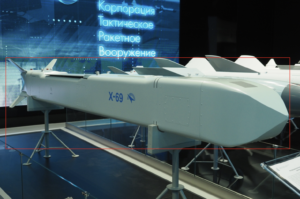
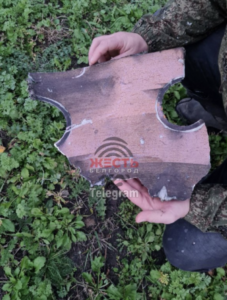
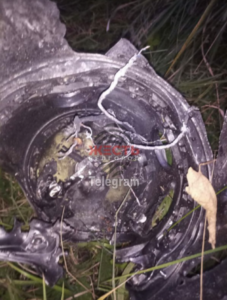
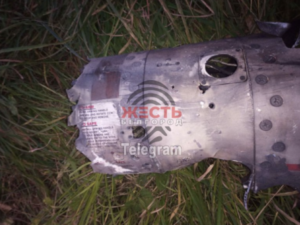
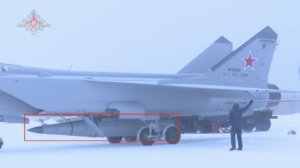
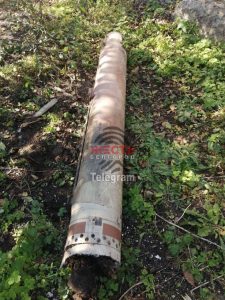
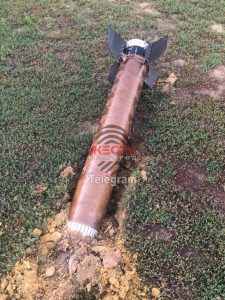
Shown is the Russian Kh-69 (marked in Cyrillic: “Х-69”) cruise missile which was debuted at a Russian arms show in August 2022, and entered into active military service the following year. The Kh-69 was reportedly first used in combat in February 2024, engaging Ukrainian targets. The more compact design when compared with previous Russian missiles results in a smaller radar signature, which is further reduced by the trapezoidal form factor. The Kh-69 is classed by the Russian military as a ‘stealth cruise missile’ and carries either a penetrator or cluster (submunitions) warhead. (ARES)
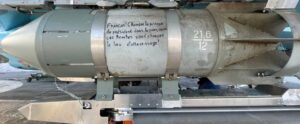
OSMP1850
Analyst Note 9 January 2026
This Russian air-delivered cluster bomb is marked with a threatening message directed at the French people: «Français! Changer la politique du président dans le pays, sinon ces bombes vont changer le lieu d'atterrissage!» (“French people! Change the president’s policy in the country, otherwise these bombs will change their landing site!”). (ARES)
OSMP1666
Analyst Note 28 November 2025
This munition remnant is marked with a manufacturer’s CAGE Code (“MFR-05DN8”) which indicates it was produced by Klune Industries. Klune Industries is a sub-contractor on the GMLRS contract. (ARES)
OSMP1667
Analyst Note 21 November 2025
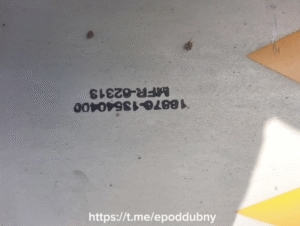
This munition remnant is marked with a manufacturer’s CAGE Code (“MFR-62313”) which indicates it was produced by Lockheed Martin. Lockheed Martin is the primary contractor that makes GMLRS missiles. (ARES)
OSMP1668
Analyst Note 28 November 2025
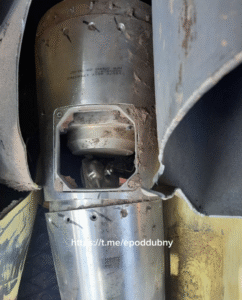
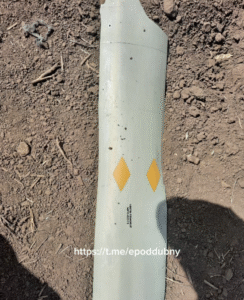
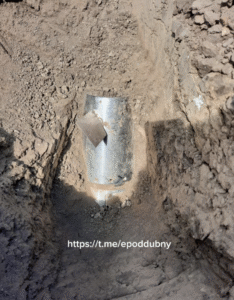
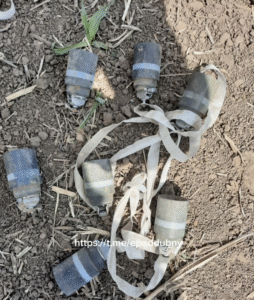
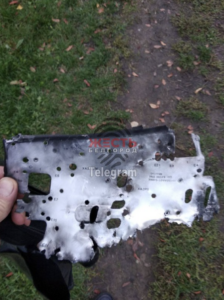
This image shows a remnant from an American M30 Guided Multiple Launch Rocket System(GMLRS) missile, which carries M77/M101 submunitions. The yellow diamond markings indicate a payload of explosive submunitions. (ARES)
OSMP1671
Analyst Note 28 November 2025
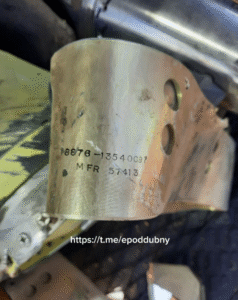
This munition remnant is marked with a manufacturer’s CAGE Code (“MFR-57413”) which indicates it was produced by the Maine Machine Products Company, a sub-contractor on the GMLRS contract. (ARES)
OSMP958
Analyst Note 20 November 2024
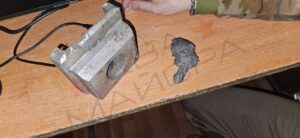
This image shows part of a heavy-duty suspension lug associated with the Storm Shadow air-launched cruise missile. This is made clear from dot-peened markings which include “STORM SHADOW USE ONLY” and identifiers such as a NATO Stock Number (NSN). (ARES)
OSMP957
Analyst Note 20 November 2024
The munitions remnant on the left of this image is part of a suspension lug associated with the Storm Shadow air-launched cruise missile, which is used to attach the munition to an aircraft. This component is of heavy construction, and as such often survives the missile’s functioning intact. This photograph purports to show remnants recovered from a Storm Shadow missile that was fired by Ukrainian forces into Russian territory, but this claim cannot be verified from the image alone. (ARES)