


Do not approach munitions
under any circumstances
Country or territory where the image was reported

Reported Location (52)

Year the image is reported to have been taken

Year (21)

Classification groups of key explosive munitions used in conflicts

Munition Category (8)

The impact or effect the munition is intended to have

Functional use (10)

The specific model of munition pictured

Tentative Model (352)

M18A1

Search

The external organisation that documented the munition

Research Organisation (6)

Colour of the munition pictured

Base Colour (12)

Colour of all, or some, of the markings on the munition

Marking Colour (11)

Language or script of the marking on a munition

Marking Script (10)

Condition of the munition pictured

Condition (6)

Key features defining the operation mechanisms of a projectile

Mechanical Feature (10)

Whether a munition is guided or unguided

Guidance (2)

Where the munition is launched from and what it targets

Domain (7)

The type of fins visible on the munition

Fins Characteristic (6)

The nominal diameter of a projectile. For most modern munitions, this is expressed in millimetres (e.g. 82 mm mortar projectile), but older artillery gun projectiles may be described in inches.

Calibre (76)

Weight class of the aerial bomb pictured

Weight Class (14)

1–1 of 1
OSMP2455
Analyst Note:
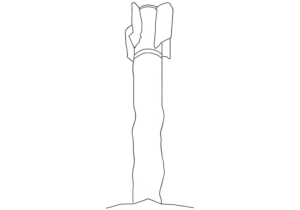
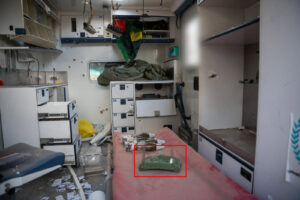
This image shows an Iranian M18A1 anti-personnel landmine, an Iranian copy of the American M18A1 ‘Claymore’ design. Iran has produced their own copy of the M18A1 since at least 2004. According to Iranian sources, it contains 600 spherical, steel pre-formed fragments that are 6 mm in diameter. These mines are designed to propel these steel balls in an arc forward of the munition upon detonation. (ARES)