Do not approach munitions
under any circumstances
Country or territory where the image was reported

Reported Location (41)

A large Spanish-speaking country in the north of Latin America which has seen political and economy instability since 2013, including large-scale protests amid allegations of electoral fraud.
Venezuela
Year the image is reported to have been taken

Year (20)

Classification groups of key explosive munitions used in conflicts

Munition Category (8)

The impact or effect the munition is intended to have

Functional use (10)

The specific model of munition pictured

Tentative Model (270)

Search

The external organisation that documented the munition

Research Organisation (6)

Colour of the munition pictured

Base Colour (12)

Colour of all, or some, of the markings on the munition

Marking Colour (10)

Language or script of the marking on a munition

Marking Script (9)

Condition of the munition pictured

Condition (6)

Key features defining the operation mechanisms of a projectile

Mechanical Feature (9)

Whether a munition is guided or unguided

Guidance (2)

Where the munition is launched from and what it targets

Domain (5)

The type of fins visible on the munition

Fins Characteristic (5)

The nominal diameter of a projectile. For most modern munitions, this is expressed in millimetres (e.g. 82 mm mortar projectile), but older artillery gun projectiles may be described in inches.

Calibre (68)

Weight class of the aerial bomb pictured

Weight Class (15)

8 results

Current Filter

Venezuela
A large Spanish-speaking country in the north of Latin America which has seen political and economy instability since 2013, including large-scale protests amid allegations of electoral fraud. On January 3rd 2026, the U.S. military launched a military raid which resulted in the capture of President Nicolás Maduro, after accusing him of involvement in narcoterrorism and drug smuggling.
OSMP1883
Analyst Note:
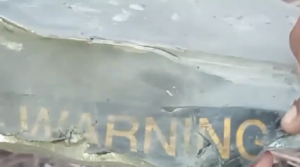
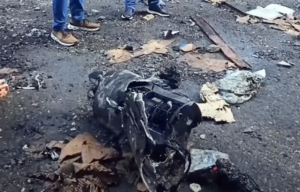
This image appears to show a remnant from either a 9M38- or 9M317-series surface-to-air missile. Positive identification of this munition cannot be made based on the imagery in this source alone; a rear control fin is visible in image but the 9M38- and 9M317-series missiles use indistinguishable rear fins. (ARES)
OSMP1882
Analyst Note:
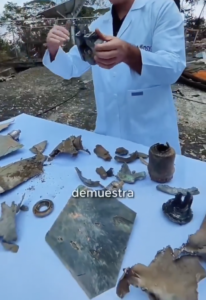
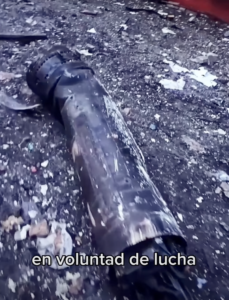
This image appears to shows the remnants of either a 9M38- or 9M317-series missile, however positive identification of this surface-to-air missile cannot be made based solely on the imagery in this source. The 9M38- and 9M317-series missiles are close in design and function, and are predominantly fired from the Buk family of surface-to-air missile (SAM) systems. The Buk-M2E SAM system is known to be in service in Venezuela, having been delivered under a Russian contract beginning in 2015. The source video for this entry shows the destroyed remains of a Buk-M2E launch vehicle, known as the 9A316E. (ARES)
OSMP1880
Analyst Note:
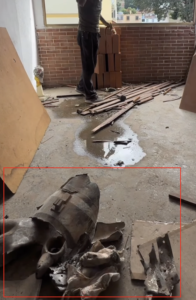
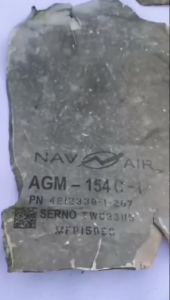
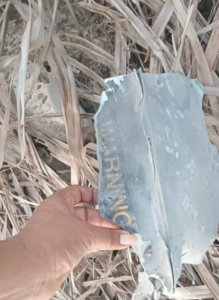
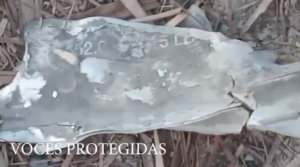
The AGM-154 Joint Standoff Weapon (JSOW) is a guided air-delivered ‘glide bomb’ that allows for long-range strikes using an unpowered munition. The AGM-154C and AGM-154C-1 variants (a remnant of the latter pictured here) carry a Bomb Royal Ordnance Augmented Charge (BROACH) multi-stage warhead which uses a WDU-44 shaped-charge warhead as its first stage, to help penetrate hardened targets, whilst the WDU-45 second stage comprises a conventional high explosive penetrator warhead (also called a ‘follow-through’ warhead). The AGM-154C-1 is described by the U.S. Navy as their “first air-to-ground Network-Enabled Weapon (NEW) capable of attacking stationary land and moving maritime targets. It includes GPS/INS guidance, terminal IR seeker and a Link 16 weapon data link. Integration of the Link-16 weapon data link and updated seeker software algorithms provide a capability against at-sea moving/relocatable targets.” (ARES)