
Do not approach munitions
under any circumstances
Country or territory where the image was reported

Reported Location (52)

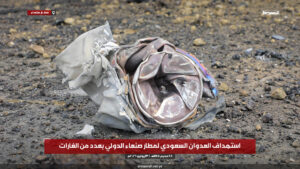
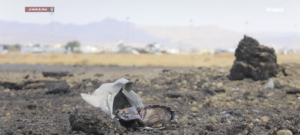
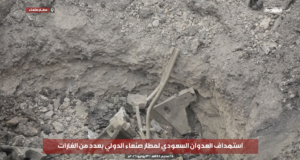
Sana'a International Airport
Year the image is reported to have been taken

Year (21)

Classification groups of key explosive munitions used in conflicts

Munition Category (8)

The impact or effect the munition is intended to have

Functional use (10)

The specific model of munition pictured

Tentative Model (352)

Search

The external organisation that documented the munition

Research Organisation (6)

Colour of the munition pictured

Base Colour (12)

Colour of all, or some, of the markings on the munition

Marking Colour (11)

Language or script of the marking on a munition

Marking Script (10)

Condition of the munition pictured

Condition (6)

Key features defining the operation mechanisms of a projectile

Mechanical Feature (10)

Whether a munition is guided or unguided

Guidance (2)

Where the munition is launched from and what it targets

Domain (7)

The type of fins visible on the munition

Fins Characteristic (6)

The nominal diameter of a projectile. For most modern munitions, this is expressed in millimetres (e.g. 82 mm mortar projectile), but older artillery gun projectiles may be described in inches.

Calibre (76)

Weight class of the aerial bomb pictured

Weight Class (14)

1–4 of 4
OSMP2374
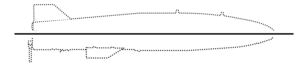
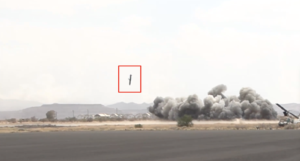
Analyst Note:
This image shows a munition shortly before impact. While the quality of the image is not high enough to conclusively identify the munition, remnants of a Storm Shadow/SCALP EG missile were recovered following this strike, supporting a more precise identification. Whilst Saudi Arabia has denied conducting this strike, and the Yemeni Army has claimed responsibility, Saudi Arabia is known to possess Storm Shadow/SCALP EG missiles and the capability to deploy them, whereas the Yemeni Army is not known to possess or use this weapon. (ARES)