OSMP Collection
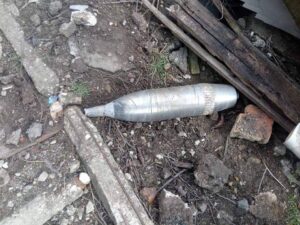
How to tell if an artillery projectile has been fired
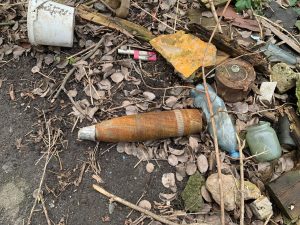
If an artillery gun projectile appears unfunctioned, it can sometimes be challenging to tell on first glance whether it has been fired and failed to function, or has not been fired at all. In general, munitions specialists look for the following three characteristics in making this determination:
- Engraved driving bands, where the soft material (typically copper) of the bands has been deformed by the lands of a gun’s rifling as the projectile passes up the bore towards the muzzle;
- Scoring to the body of the projectile, particularly on the bourrelet, especially where showing rifling impressions which align with the engraved rifling in the driving bands;
- Impact damage, especially to the nose (inc. fuze, usually) of the projectile.
If one or more of these features is present on an intact artillery gun projectile, it is likely to have been fired and failed to function.
Analyst Note
28 November 2025
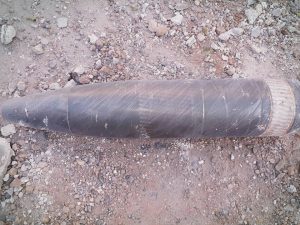
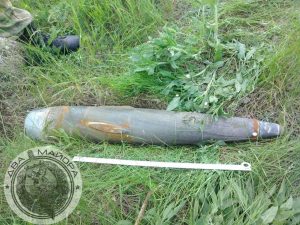
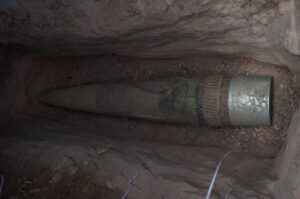
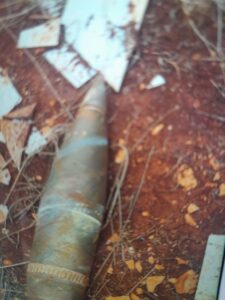
The munition depicted in this image is a type of aerodynamically optimised artillery projectile, in this case 155 mm in calibre, known as an ‘Extended Range Full-Bore (ERFB)’ design. This example is a cargo projectile fitted with a base-bleed (BB) base unit to further extend its range. This configuration is designated NR269, and reportedly contains 56 M46 dual-purpose (anti-personnel/anti-armour) submunitions. (ARES)
Analyst Note
28 November 2025
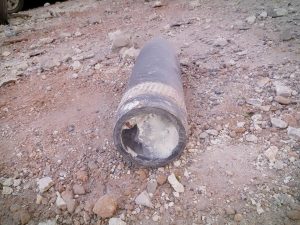
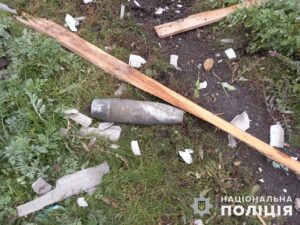
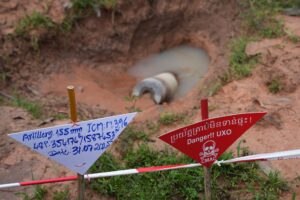
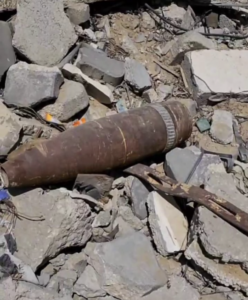
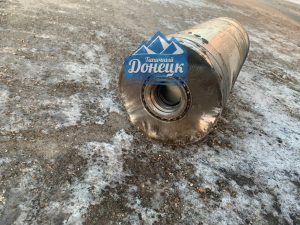
This image shows the base of a 155 mm Extended Range Full-Bore (ERFB) projectile, fitted with either a base-bleed (BB) or a base-bleed, rocket-assisted (BB/RA) base unit. Although munitions of this type are capable of carrying submunitions and this image is associated with an incident about which claims of cluster munitions use have been made, there is not enough of the projectile visible in the source images to determine what type of payload was carried by this particular round. (ARES)



Analyst Note
30 May 2024
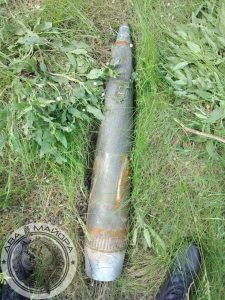
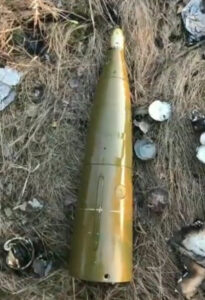
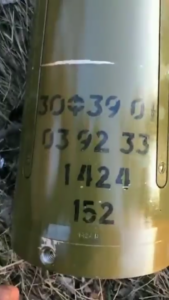
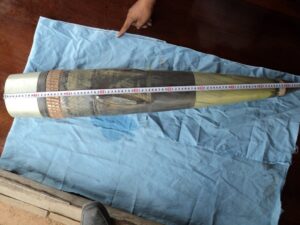
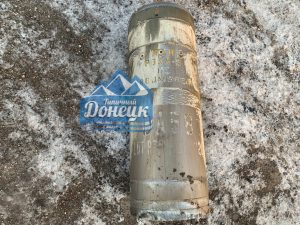
Many guided (or otherwise complex) munitions like this one are marked with additional information on individual assemblies or components. This can include information on sub-contractors that produced or integrated specific parts of a munition. (ARES)